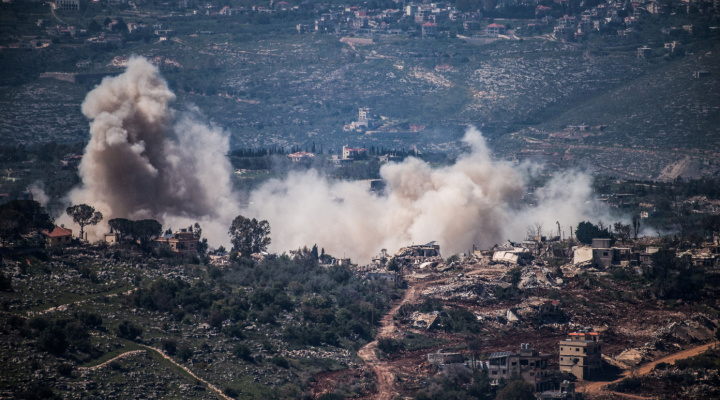
BEIRUT, April 23, 2026 — The Israel Defense Forces (IDF) are employing advanced battlefield technology in their ongoing conflict with Hezbollah, significantly enhancing operational capabilities in southern Lebanon. Recent military engagements have seen the deployment of fleets of explosive robots and high-tech artillery systems aimed at dismantling the Iran-backed group’s infrastructure.
The IDF’s strategy focuses on minimizing risks to personnel by deploying autonomous robots for high-risk missions, particularly to destroy strategic targets that are currently inaccessible to ground forces. This marks a substantial increase in the IDF’s use of autonomous systems in warfare. Israeli officials state that this new technology utilizes intelligence data to scan vast areas, identify Hezbollah infrastructure both above and below ground, and systematically dismantle networks built over decades in challenging terrains filled with civilian populations.
The conflict reignited on March 2, 2026, following an offensive by Hezbollah, which opened fire in support of Iran just days after a joint US-Israeli military campaign began against the Iranian regime. In response, Israeli troops have established a buffer zone extending 5 to 10 kilometers (3 to 6 miles) into Lebanon, aimed at protecting northern Israel from the threat posed by Hezbollah rockets and drones.
To navigate Lebanon’s rugged mountainous terrain, which severely limits the movement of heavy engineering equipment, the IDF has previously utilized robotic systems in conflicts, including the war in Gaza. These systems have provided ground forces with a strategic advantage while reducing their exposure to danger. The capability to explore tunnels and enhance detection of armed operatives has proven crucial in urban and complex environments.
In addition to robotic systems, the IDF has expanded its arsenal with the “Ro’em” self-propelled howitzer battery developed by Elbit Systems. This platform, which integrates advanced technology and artificial intelligence, can fire between six and eight rounds per minute at ranges of up to 40 kilometers, delivering faster and more accurate firepower.
Negotiations for a ceasefire culminated in a 10-day truce mediated by the United States last week. Though this has significantly reduced violence, the prospect of long-term peace remains fragile. Israeli forces maintain a critical presence in southern Lebanon to secure the buffer zone and dismantle Hezbollah’s capabilities. Despite the ceasefire, Israeli officials have cautioned Lebanese citizens against returning to their homes, warning of potential exploitation by Hezbollah to reestablish its infrastructure under civilian cover.
Hezbollah, designated as a terrorist organization internationally, asserts its right to resist what it terms Israeli occupation, rejecting direct negotiations with Israel. In a notable shift, the Lebanese government has begun direct contacts with Israel, despite strong opposition from Hezbollah. Israel’s position in these discussions centers on two key demands: the complete disarmament of Hezbollah and a sustainable, security-based peace framework.
Lebanon is seeking an Israeli withdrawal from the south, the return of Lebanese detainees held in Israel, and the formal delineation of their land border. As these negotiations unfold, the regional dynamics remain complex, with the potential for broader implications as both sides navigate their respective demands amid ongoing hostilities.
While military operations continue, the introduction of advanced technologies by the IDF signals a shift in modern warfare, potentially reshaping the future of military engagements in the region. As both sides evaluate their strategies and the broader geopolitical landscape, the ongoing conflict underscores the intricate interplay of military power and diplomatic negotiations in pursuit of stability in the area.
See also AI Awareness Reveals Dual Impact on Hotel Employees: Performance Boost or Job Stress?
 IGM Library and Turnitin Launch Training on Academic Integrity Amid AI Challenges
 Qualcomm Reveals 3D DRAM NPU Project for AI Phones, Promising 40 TOPS by 2027
 Study Finds Elon Musk’s Grok Most Dangerous AI Model for Reinforcing Delusions
 Apple Unveils ParaRNN, Achieving 665× Faster Training for 7B-Parameter RNNs