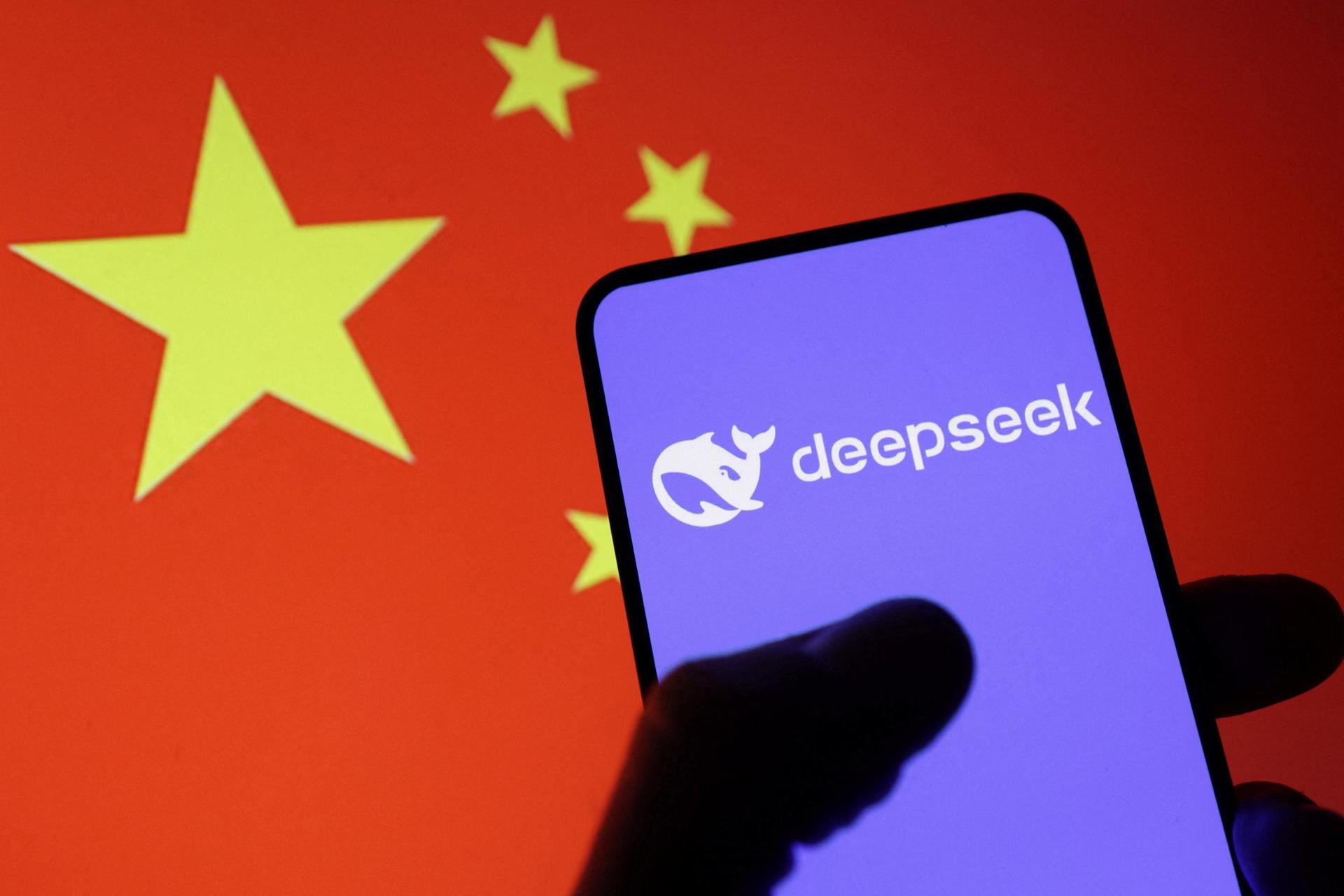
HONG KONG — DeepSeek, the Chinese artificial intelligence startup that disrupted global markets last year, unveiled preview versions of its latest major update on Friday, intensifying the ongoing AI rivalry between China and the U.S. Users have been eagerly anticipating the release of V4, keen to see how it stacks up against American counterparts such as OpenAI’s ChatGPT, Anthropic’s Claude, and Google’s Gemini. Both Anthropic and OpenAI have asserted that DeepSeek has unfairly leveraged their technologies in its development.
Market analysts had originally forecasted an earlier release for the new model, expecting it to debut over two months ago at the start of the Lunar New Year. The newly launched V4 open-source models, which come in “pro” and “flash” versions, feature significant advances in knowledge, reasoning, and “agentic” capabilities, which allow the AI to execute complex tasks autonomously. A notable shift for DeepSeek is the integration of computer chips from Chinese tech giant Huawei, marking a reduction in dependency on U.S. chip manufacturers like Nvidia.
V4 succeeds the V3 model released in late 2024, but it was DeepSeek’s specialized “reasoning” AI, known as R1, that caught markets off guard with its launch in January 2025. DeepSeek claimed that R1 was more cost-effective than OpenAI’s comparable model and served as a testament to China’s technological advancements in the AI sphere.
The “V4 Pro Max” version boasts “superior performance” on standard reasoning benchmarks compared to OpenAI’s GPT-5.2 and Google’s Gemini 3.0-Pro, while falling “marginally” short of GPT-5.4 and Gemini 3.1-Pro. This latest release arrived just hours after OpenAI introduced its new GPT-5.5 model on Thursday. Regarding agentic capabilities, the “pro” version of V4 is said to outperform Claude’s Sonnet 4.5 and approaches the performance of Claude’s Opus 4.5, according to DeepSeek’s own assessments.
DeepSeek noted that its “flash” version performs comparably to the “pro” version on basic agent tasks and has reasoning capabilities closely mirroring those of the “pro” variant. “Based on the benchmark results, it does appear DeepSeek V4 is going to be very competitive against its U.S. rivals,” commented Lian Jye Su, chief analyst at the technology research firm Omdia.
Marina Zhang, an associate professor at the University of Technology Sydney, described the rollout of V4 as a “pivotal milestone for China’s AI industry,” highlighting its importance amid escalating global competition for technological self-reliance. DeepSeek also provides a free web and mobile chatbot, distinguishing itself with an open-source model that allows developers to modify and enhance its core technology, unlike the proprietary approaches taken by Anthropic, Google, and OpenAI.
Both the “pro” and “flash” versions of V4 feature a context window of 1 million tokens, significantly improved from the 128,000 tokens supported by the previous V3 model. Huawei announced that its Ascend chips are compatible with the V4 models, marking a technical achievement that allows DeepSeek to operate outside the Nvidia-centric computing ecosystem, particularly relevant in light of ongoing U.S.-China technological decoupling.
A January report from Microsoft indicated that DeepSeek’s usage has been gaining traction in various developing nations, especially where Huawei phones are prevalent. However, some analysts maintain a degree of skepticism regarding V4’s potential impact. Ivan Su, a senior equity analyst at Morningstar, described V4 as a “competent” successor but noted it lacks the groundbreaking features of R1.
“Domestic competition has intensified significantly since R1’s release,” Su remarked. “DeepSeek’s own evaluation suggests its capabilities largely match on most fronts against U.S. models, but independent evaluations are needed for definitive conclusions.” In February, Anthropic accused DeepSeek and two other Chinese AI laboratories of orchestrating “industrial-scale campaigns” to illicitly enhance their own models by using a technique called distillation, which involves training a less capable model on the outputs of a more powerful one. OpenAI echoed similar claims in a letter to U.S. lawmakers.
This week, Michael Kratsios, the chief science and technology adviser to U.S. President Donald Trump, accused foreign tech companies, mainly based in China, of distilling leading U.S. AI systems and “exploiting American expertise and innovation.” In response, China’s embassy in Washington characterized these allegations as “unjustified suppression of Chinese companies by the U.S.”
See also AI Could Potentially Eliminate Over 4% of Jobs, Warns Jobs and Skills Australia
 Georgia Tech Unveils Diffusion-DFL AI Model, Boosting Decision Accuracy by Over 99%
 Nvidia Launches Nemotron 3 Nano Omni, Open Model with 30B Parameters and Advanced Multimodal Capabilities
 86% of Consumers Demand Disclosure of AI-Generated Content, Survey Reveals
 SenseTime Launches SenseNova U1, Promising Speedy Image Processing for AI Development