






















































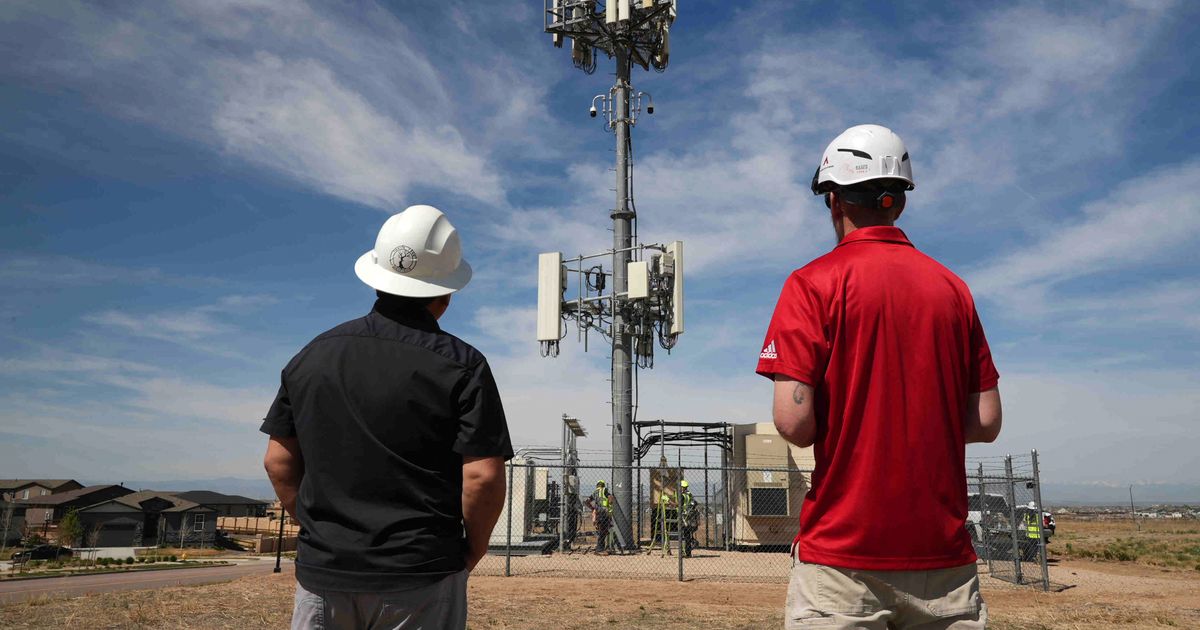
On a March afternoon, artificial intelligence detected what appeared to be smoke in a camera feed from Arizona’s Coconino National Forest. After human analysts confirmed it wasn’t merely a cloud or dust, they alerted the state’s forest service and the largest electric utility. This early warning system allowed firefighters to contain what became known as the Diamond Fire before it spread beyond 7 acres (2.8 hectares).
Arizona Public Service, which has nearly 40 active AI smoke-detection cameras and plans to increase this number to 71 by summer’s end, is at the forefront of a growing trend. With climate change leading to record-breaking temperatures and diminished snowpack, states across the fire-prone West are increasingly leveraging AI technology to enhance wildfire detection and prevention efforts.
“Earlier detection means we can launch aircraft and personnel to it and keep those fires as small as we can,” said John Truett, fire management officer for the Arizona Department of Forestry and Fire Management. As more utilities adopt similar technologies, the race to combat wildfires becomes more urgent. In Colorado, for example, Xcel Energy has installed 126 AI cameras and aims to deploy them in seven of the eight states it services by year’s end.
In California, the ALERTCalifornia network operates roughly 1,240 AI-enabled cameras that function similarly to those in Arizona. The initiative, led by geology and geophysics professor Neal Driscoll at the University of California, San Diego, has shown that human oversight is essential for minimizing false alarms while training the technology to improve its accuracy. “The AI that’s being run on the cameras is actually beating 911 calls,” Driscoll noted.
Across Arizona and California, the technology is particularly valuable in remote, sparsely populated areas where wildfires might go unnoticed for extended periods. “It’s just the ones where we won’t get a 911 call for a long time; it is extremely helpful to have that AI always monitoring that camera,” explained Brent Pascua, battalion chief for the California Department of Forestry and Fire Protection, also known as Cal Fire. “In many cases, we’ve started a response before 911 was even called.”
The technology has gained traction as wildfires become more frequent and severe. Pano AI, launched in 2020, combines high-definition camera feeds, satellite data, and AI monitoring to provide actionable insights to its customers, which include utilities and government agencies across 17 U.S. states, as well as in Australia and Canada. The company reported that its technology detected 725 wildfires in the U.S. last year alone.
Cindy Kobold, a meteorologist with Arizona Public Service, stated that the technology typically notifies them about 45 minutes faster than the first 911 call. Arvind Satyam, co-founder and chief commercial officer of Pano AI, emphasized that the development of this technology was spurred by the increasing severity of wildfires fueled by climate change. “The technology helps firefighters to safely and effectively respond while protecting communities and infrastructure,” he said.
However, challenges remain in the widespread adoption of AI wildfire detection systems. Cost is a significant barrier; for instance, Pano AI charges around $50,000 annually per camera, which includes fire risk analysis and a 24/7 intelligence center. False alarms can also be costly, diverting attention and resources away from genuine threats, noted Patrick Roberts, a senior researcher with the nonprofit RAND Corporation. “Do you send help right away? Do you monitor? Should you worry about it? Where do you send help?” he asked, highlighting the complexities of decision-making even with AI assistance.
In urban areas, human eyes often spot fires quickly, which lessens the urgency for AI-driven monitoring. The technology’s effectiveness diminishes during extreme weather events, such as hurricane-force winds that can rapidly alter fire behavior, as witnessed in Los Angeles last year. Pascua reiterated that while AI provides real-time information, it cannot replace the human factor in decision-making regarding firefighting tactics.
Beyond detection, AI may also assist in identifying optimal locations for vegetation thinning and cool burns, as well as monitoring air quality for smoke indicators. Professor Chaowei “Phil” Yang from George Mason University is collaborating with researchers from California State University of Los Angeles, the city of Los Angeles, and NASA’s Jet Propulsion Laboratory to develop a system that predicts fire behavior and assesses potential smoke pollution impacts on communities. This technology is expected to be operational within three years.
“AI in wildfires is no longer just speculative. It’s really being used,” Roberts said, underscoring the technology’s growing significance in wildfire management. As advancements continue, he believes, “The future is AI everywhere,” suggesting the lines between AI wildfire detection and traditional methods will increasingly blur.
See also Amazon and Anthropic Expand AI Partnership with $100B Investment in AWS Technologies
 Big Tech to Invest $3.7 Trillion in AI Infrastructure, Surpassing Historic Rail Expansion
 Vertiv Reports 83% Earnings Growth Amid $15B AI Data Center Demand Surge
 Galaxy Digital Shifts Focus to AI Data Centers, Reports $216M Q1 Loss
 Nebius Acquires Eigen AI for $643M to Enhance AI Infrastructure and Efficiency






