
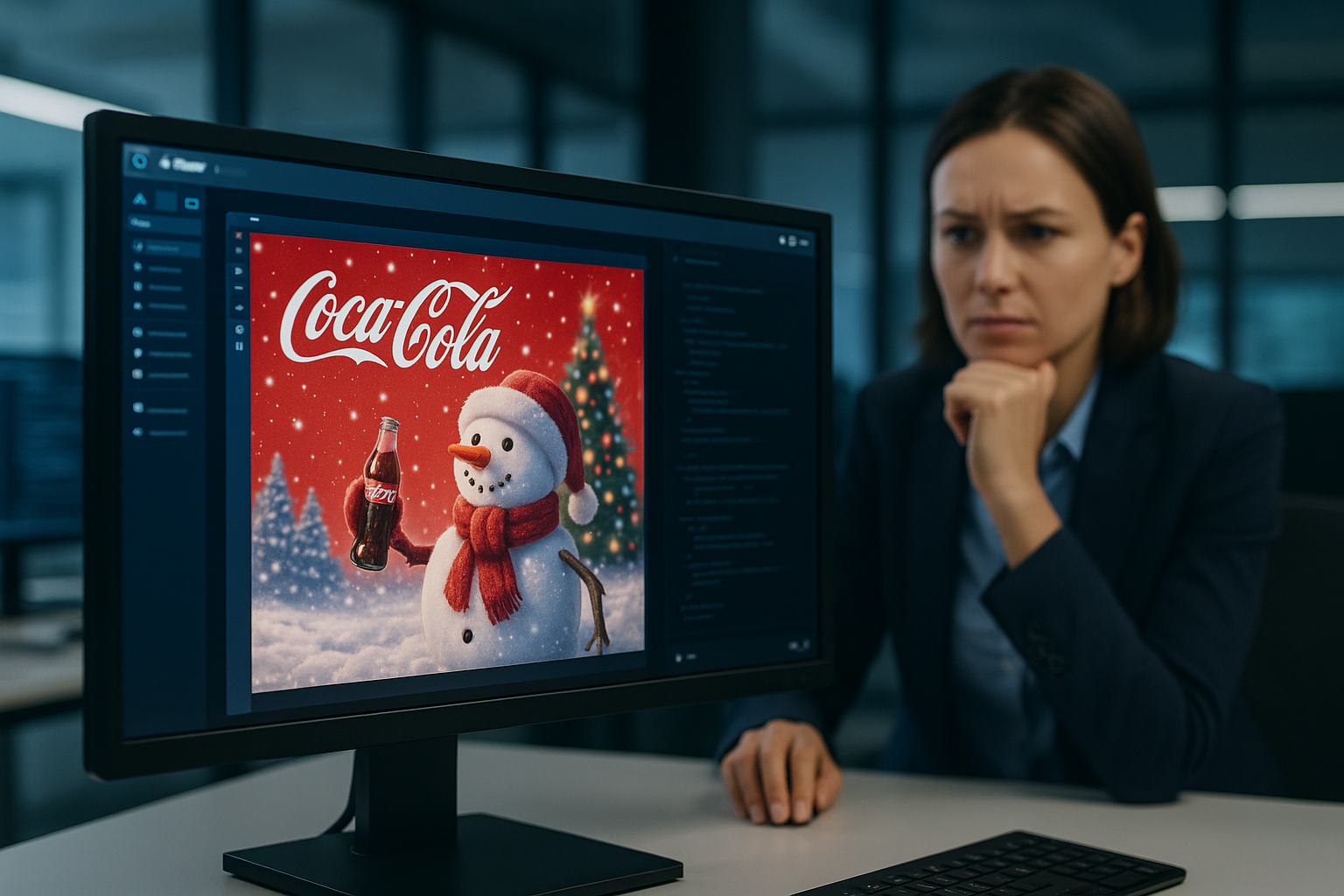
Coca-Cola faces ongoing scrutiny regarding its holiday advertising strategies, particularly its use of generative AI. For the second consecutive year, the beverage giant is grappling with backlash related to its AI-generated ads, despite claiming to have implemented changes following last year’s criticisms. This year’s reimagining of the iconic 1995 “Holidays Are Coming” advertisement emphasizes the use of animals, diverging from last year’s unsettling human representations.
Despite these modifications, online commentators have pointed out inconsistencies within the ad, such as differing depictions of Coca-Cola trucks, raising questions about the effectiveness of the company’s human monitoring and quality control mechanisms. Jeff Sherman, CEO of Top Marketing Agency, noted in Marketing Daily that “Even sophisticated AI animations can appear cold or impersonal if they overshadow the story, characters, or brand values that audiences expect.” This suggests that the emotional connection traditionally fostered by Coca-Cola’s holiday campaigns may have been compromised.
Some social media users speculate that Coca-Cola’s pivot to AI was primarily a cost-cutting measure, further fueling negative perceptions of the brand’s authenticity in its holiday messaging. While the company did not disclose the specifics of the campaign’s costs, CMO Manolo Arroyo informed the Wall Street Journal that the production timeline was significantly reduced from a year to just “around a month.” This aligns with industry observations that generative AI tools can slash traditional ad production costs by up to 60-70%, as cited in the 2024 Global Marketing Tech Report from WARC and Deloitte.
Critics have questioned whether Coca-Cola needed to produce a new campaign at all. Many have suggested that simply rerunning the beloved 1995 advertisement would have effectively evoked nostalgia at a fraction of the cost. Sherman emphasized, “Rerunning the original 1995 ‘Holidays Are Coming’ ad, which was one of the most beloved in advertising history, would absolutely have delivered nostalgia at a fraction of the cost.” However, he also acknowledged that brands like Coca-Cola cannot continuously recycle their heritage without appearing stagnant.
Conversely, Vanessa Chin, Senior Vice President of Marketing at System1, disagreed with this assessment. She argued that Coca-Cola could effectively leverage its original content to engage consumers without the backlash associated with AI-generated material. Her insights reflect System1’s research, which indicates that strong creative assets tend to “wear in” over time, enhancing both short- and long-term performance. According to Chin, nostalgic campaigns resonate deeply with older audiences who link them to positive memories.
Despite the potential benefits of novelty and innovation that AI-driven campaigns can signal, Chin cautioned that the initial allure of AI may fade quickly. This notion is underlined by the decline in ratings for other AI-generated ads, such as Google Gemini’s “Dear Sydney,” which fell from 4.4 to 3.7 stars in System1’s analysis. This suggests that while AI can create buzz, it may not sustain consumer engagement as effectively as traditional creative assets.
The discourse surrounding Coca-Cola’s advertising strategy further demonstrates how social media can shape public perception, creating a feedback loop that amplifies negative sentiment. Chin noted, “Consumer perception can absolutely be influenced by news coverage or negative social commentary.” Echoing this sentiment, Sherman added that “even if only a small, vocal minority reacts negatively, the algorithmic amplification on social media can distort sentiment.” For brands lacking the deep reservoir of goodwill that Coca-Cola enjoys, the reputational risks associated with AI advertising could be significant.
As Coca-Cola navigates the challenges of integrating AI into its marketing strategies, the brand’s experience underscores the delicate balance between innovation and maintaining the emotional connection that consumers expect during the holiday season. The effectiveness of its campaign may ultimately hinge on whether it can leverage technological advancements without alienating its core audience.
See also Triangle AI Systems Launches Marketing Reset System™ for $1M-$10M Businesses
 72% of Marketers Plan AI Use, Yet Only 45% Feel Prepared, Reveals MiQ Report
 AI Transforms Real Estate Marketing, Cutting Home Tour Costs by 80% in Spain
 Publishers Embrace AI Marketing Strategies to Combat Content Saturation at Frankfurt Book Fair
 Gen Alpha Embraces AI, Shifting Aspirations and Brand Narratives in 2024