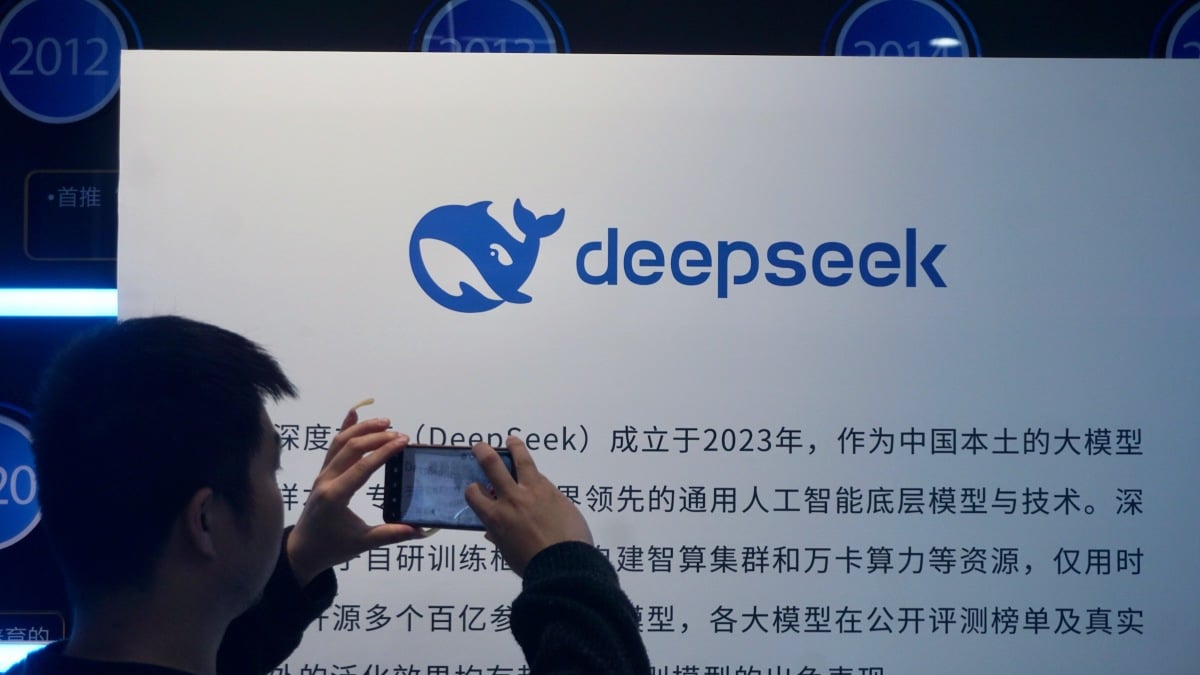
The ongoing race for artificial intelligence supremacy has intensified with the preview release of DeepSeek V4, an open-source AI model from the Chinese company DeepSeek. This development, unveiled in 2026, highlights the fierce competition among U.S. and Chinese tech firms, with major players like OpenAI and Anthropic also vying for dominance in the AI landscape.
DeepSeek V4 marks a significant shift in the AI arena, as it is positioned as a true open-source model, a stark contrast to the proprietary nature of models developed by U.S. companies. OpenAI and Anthropic have maintained strict control over their AI technologies, whereas DeepSeek allows users to download and modify its model freely under an MIT license. Two versions of DeepSeek V4 are now accessible for public use, which can be found at chat.deepseek.com.
This announcement comes on the heels of another open-source model from Chinese firm Moonshot AI, Kimi K2.6. However, early testers have indicated that DeepSeek V4 surpasses Kimi K2.6 in performance. DeepSeek further solidifies China’s position as a leader in open-source AI, a space that has been less explored by American firms.
Performance metrics for DeepSeek V4 suggest substantial improvements in agentic tasks and coding capabilities. The company claims that the new model integrates seamlessly with leading AI agents such as Claude Code, OpenClaw, and OpenCode. Benchmark results released by DeepSeek indicate that V4 achieves performance levels comparable to the latest models from OpenAI, Google, and Anthropic.
On AI leaderboards like Arena and Artificial Analysis, however, DeepSeek V4 is currently trailing behind its U.S. counterparts. This could change rapidly as developers and users continue to engage with the model.
A key advantage of DeepSeek V4 lies in its cost structure. Since its entry into the AI market with the R1 model in January 2025, DeepSeek has emphasized efficiency and affordability in AI development. The pricing for DeepSeek V4 further underscores this approach, as it is significantly cheaper than competitors such as OpenAI’s GPT-5.5, Anthropic’s Claude Opus 4.7, and Google’s Gemini 3.1 Pro.
Specifically, DeepSeek V4 is priced at $1.74 per million input tokens and $3.48 per million output tokens, representing approximately one-sixth the cost of the latest U.S. models. In contrast, GPT-5.5 charges $5 for input and $30 for output tokens, while Claude Opus 4.7 costs $5 for input and $25 for output. Google’s Gemini 3.1 Pro, while somewhat more economical, still falls short of DeepSeek’s pricing, charging $2 for input tokens and $12 for output tokens.
This pricing strategy could significantly enhance DeepSeek’s market adoption, making it a compelling option for developers and businesses looking for cost-effective AI solutions. For instance, a task that would cost $5.22 with DeepSeek V4 would amount to approximately $35 with GPT-5.5, highlighting a substantial financial incentive for potential users.
As the AI landscape continues to evolve, the release of DeepSeek V4 may further energize the ongoing competition between East and West. With the U.S. and Chinese tech firms racing to innovate and capture market share, the implications of these developments could resonate well beyond the technology sector, influencing global economic dynamics and regulatory discussions in the years to come.
See also Germany”s National Team Prepares for World Cup Qualifiers with Disco Atmosphere
 95% of AI Projects Fail in Companies According to MIT
 AI in Food & Beverages Market to Surge from $11.08B to $263.80B by 2032
 Satya Nadella Supports OpenAI’s $100B Revenue Goal, Highlights AI Funding Needs
 Wall Street Recovers from Early Loss as Nvidia Surges 1.8% Amid Market Volatility