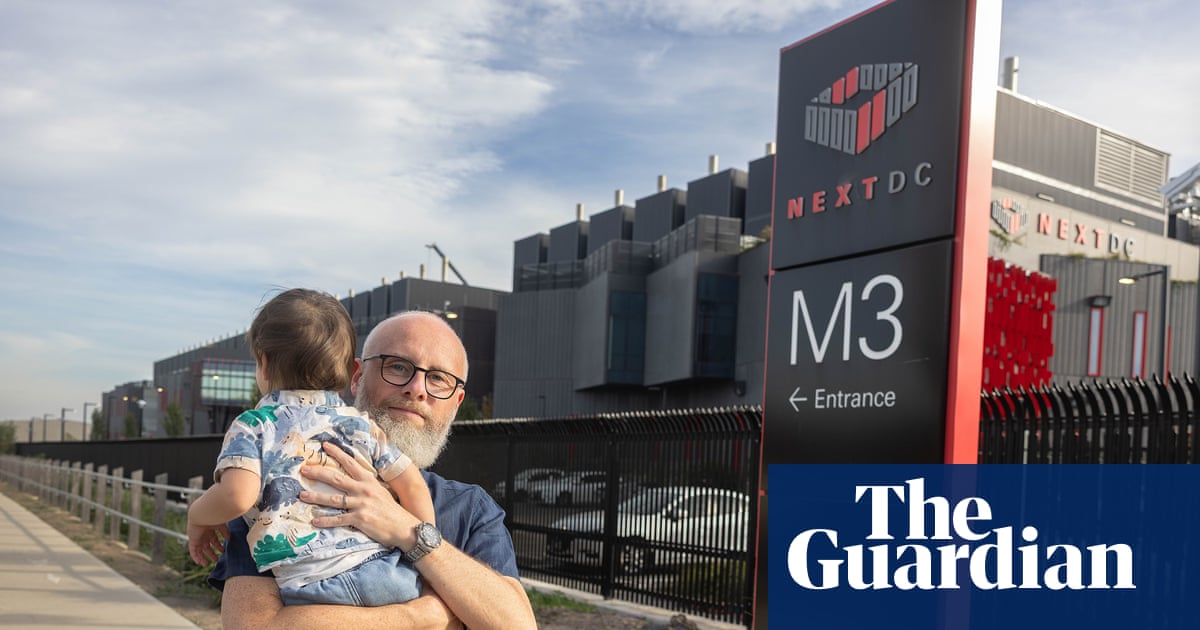
Residents near a new datacentre in West Footscray, Melbourne, are expressing significant concerns over the construction and expansion of what is being promoted as “Australia’s largest hyperscale AI factory.” The facility, known as M3, has drawn criticism from local parents like Sean Brown, who worries about the impact of the ongoing construction noise, towering structures, and emissions from an increasing number of diesel generators on his 19-month-old son’s health.
Brown lamented that the environmental impact of the facility has never been assessed, stating, “He is growing – neurologically, pulmonarily, physically – in the shadow of a facility whose cumulative environmental impact has never been assessed.” He believes the expansion, which is anticipated to double the current size to 10 hectares, will have no positive effect on the community and will only exacerbate existing issues.
The M3 datacentre is expected to draw 225 megawatts (MW) of power and operate continuously. This expansion is part of a broader trend in Australia, where the demand for datacentres is surging due to the explosive growth of digital services and generative AI technologies. NextDC, the company behind M3, emphasizes the significance of this infrastructure investment for Australia’s economic future.
NextDC CEO Craig Scroggie previously described the rapid growth of the M3 site as “stunning.” In a LinkedIn post, he stated, “We’re building Australia’s largest hyperscale AI factory purpose-built for the new AI era of accelerated computing.” Local residents, however, feel that their quality of life is being sacrificed for the sake of such developments. Many argue that the zoning decisions did not consider the massive scale of these facilities.
Residents near the site aren’t alone in their opposition. The Maribyrnong local council has voiced its disapproval of the proposed expansion but is currently awaiting planning approval from the Victorian government. A spokesperson for the Victorian planning minister, Sonia Kilkenny, indicated that the proposal is under review and declined to comment further.
Concerns over datacentre placements are not confined to Melbourne. In Lane Cove, Sydney, a new 90MW datacentre proposal named Project Mars is under scrutiny by the NSW government. Local authorities contend that the facility exceeds height limitations and could be visually intrusive next to residential areas and bushland. Community member Daniel Bolger expressed worries about the proximity of the datacentre to schools, labeling the nearby Blackman Park as “the lungs of Lane Cove.”
Bolger criticized the local council for being sidelined in the decision-making process and highlighted growing concerns about the potential impact on local schools and the overall power draw of these facilities. NSW Planning Minister Paul Scully assured that public feedback would be considered during the consultation process before any final decision is made.
As criticism mounts in response to similar proposals, a datacentre planned for Hazelmere, Western Australia, has also sparked community backlash. Local resident Kate Herren described the project as “huge” and unsuitable for its location, which is near the Helena River. Walter McGuire, chair of the Bibbul Ngarma Aboriginal Association, emphasized the cultural and ecological significance of the river, stating, “Giant datacentres belong in industrial areas, not on the banks of our rivers and wetlands.”
A spokesperson for GreenSquareDC, behind the Hazelmere proposal, noted that it is situated in an established industrial area with necessary transport and power infrastructure. They acknowledged community concerns and stated their commitment to engaging with residents throughout the planning process.
Despite the local opposition, the datacentre industry maintains that such developments are crucial for Australia’s digital architecture. Belinda Dennett, CEO of Data Centres Australia, acknowledged that construction can be disruptive, particularly near residential zones, but emphasized that developers comply with strict environmental and building standards. She highlighted the economic opportunities these facilities could bring, asserting, “These benefits will flow to the local communities that neighbour datacentres too.”
As Australia continues to position itself to compete in the burgeoning datacentre market, the tug-of-war between progress and community well-being remains a pressing issue. The need for careful planning and consideration of local impacts will be crucial as the nation seeks to balance its technological aspirations with the quality of life for its residents.
See also Tesseract Launches Site Manager and PRISM Vision Badge for Job Site Clarity
 Affordable Android Smartwatches That Offer Great Value and Features
 Russia”s AIDOL Robot Stumbles During Debut in Moscow
 AI Technology Revolutionizes Meat Processing at Cargill Slaughterhouse
 Seagate Unveils Exos 4U100: 3.2PB AI-Ready Storage with Advanced HAMR Tech