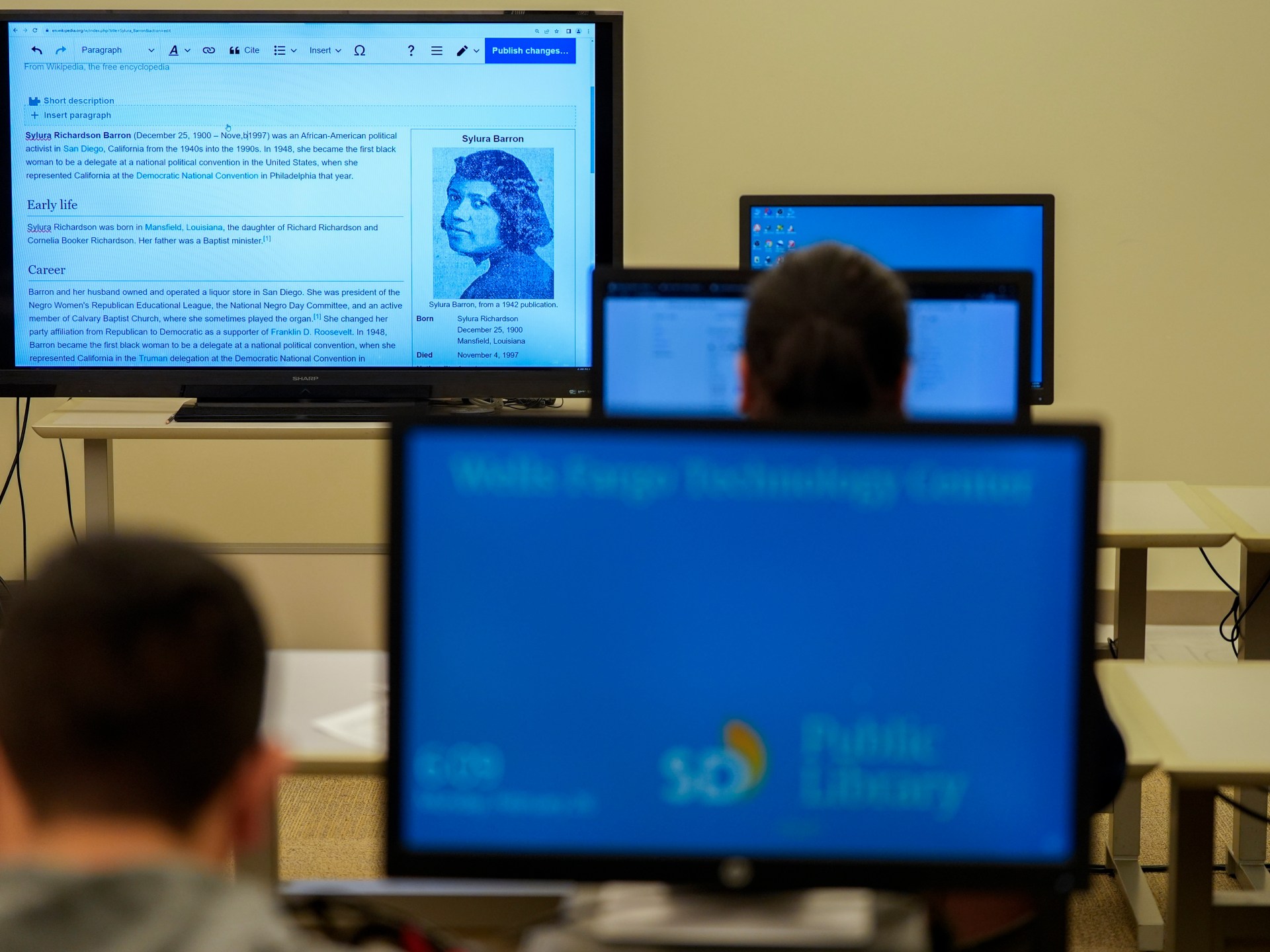
In a bold move to disrupt the online information landscape, tech billionaire Elon Musk recently introduced Grokipedia, an AI-driven encyclopedia designed to rival Wikipedia. Launched on October 27, Musk made an ambitious claim on X (formerly Twitter), asserting, “Grokipedia will exceed Wikipedia by several orders of magnitude in breadth, depth and accuracy.”
As the age of generative artificial intelligence and AI-assisted search engines continues to evolve, Wikipedia remains a human-curated repository of knowledge. This contrasts sharply with Grokipedia’s AI-generated content, which has already faced scrutiny for its quality and reliability.
Grokipedia will exceed Wikipedia by several orders of magnitude in breadth, depth and accuracy https://t.co/Nt4M6vqEZu
— Elon Musk (@elonmusk) October 28, 2025
However, an investigation by PolitiFact revealed serious concerns about Grokipedia’s content quality. Many articles were found to be largely copied from Wikipedia, with significant issues related to sourcing and accuracy. For instance, while Musk stated that Grokipedia’s chatbot, Grok, was instructed to enhance the top one million Wikipedia articles, the reality appears more complex. In a conversation on the “All-In” tech and business podcast, he elaborated on the goal of “researching the rest of the internet” to correct and enrich Wikipedia’s entries.
Despite this, PolitiFact’s analysis highlighted that Grokipedia often lacks citations and frequently introduces misleading claims. In many cases, the site removes essential context from its articles, potentially leading to misunderstandings.
Concerns Over Content Quality and Reliability
For instance, a sample of Grokipedia’s 885,279 articles showed alarming similarities to Wikipedia’s entries. In many cases, Grokipedia included an attribution statement, acknowledging that its content was adapted from Wikipedia under the Creative Commons Attribution-ShareAlike 4.0 License. However, some articles failed to provide necessary citations and reference lists, compromising their reliability. For example, the entry for “Monday” closely mirrored Wikipedia’s article but contained no citations, despite the Wikipedia version listing 22 references.
Joseph Reagle, an associate professor of communication studies at Northeastern University, criticized Grokipedia’s approach, arguing that it misunderstands the collaborative strength of Wikipedia, which benefits from the contributions of thousands of dedicated volunteers. “Wikipedia’s merits are that it is the result of a community of thousands of people diligently working to create high-quality content,” Reagle stated.
Moreover, the Wikimedia Foundation, which operates Wikipedia, has acknowledged Grokipedia’s issues with content replication. Selena Decklemann, the Foundation’s chief product and technology officer, remarked, “Even Grokipedia needs Wikipedia to exist. Wikipedia’s content is open source by design; we expect it will be used in good faith to educate.”
Lack of Editorial Oversight
PolitiFact’s review also uncovered instances where Grokipedia introduced inaccuracies. For example, the addition of a statement regarding the order of awards in the Nobel Prize ceremony was found to be incorrect and unsupported by any citation. This lack of oversight raises questions about Grokipedia’s editorial process, as there is no transparency regarding how errors are corrected or how content is updated. While registered users can suggest edits, the absence of a visible edit history diminishes accountability.
In contrast, Wikipedia maintains an open structure that allows for public scrutiny and detailed documentation of sources. This transparency enables users to trace the origins of information and ensures that content is continually refined through community engagement.
As the competition between Grokipedia and Wikipedia unfolds, the implications for the online information landscape are significant. While AI-generated platforms like Grokipedia promise rapid content generation, they must grapple with the challenge of ensuring accuracy and maintaining trustworthiness in an era where misinformation is rampant. The evolution of online knowledge sharing will depend heavily on how well these platforms address these critical issues.
See also Taiwan Semiconductor Manufacturing Achieves 41% Revenue Growth Amid AI Demand Surge
 English High Court Rules on Getty’s IP Claims Against Stability AI, Leaving Key Issues Unresolved
 IonQ Outperforms D-Wave in AI Potential with $39.9M Q3 Revenue vs. $3.7M
 Microsoft Acknowledges AI Backlash as Users Shift to Linux Amid Windows 10 Support End
 47% of Indian Enterprises Deploy Generative AI but 95% Limit Budget to Under 20% of IT Spend