






















































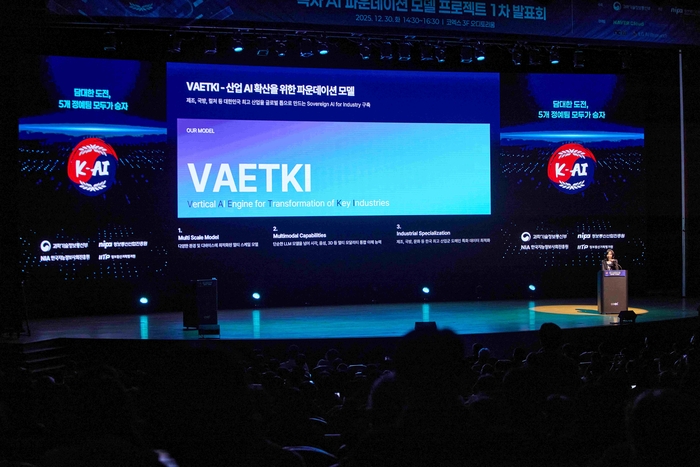
The NCAI consortium announced on December 31 its plan to open-source “VAETKI” (Vertical AI Engine for Transformation of Key Industries), an artificial intelligence model designed specifically for South Korea’s leading sectors, including manufacturing, defense, logistics, and cultural content. This announcement was made during a public briefing held by NCAI CEO Lee Yeon-soo, where he also introduced another AI model called “Backkey.” This initiative is part of South Korea’s independent AI foundation model project aimed at enhancing domestic capabilities in AI technology.
At the briefing, NCAI highlighted the completion of the first phase of Backkey’s development, showcasing empirical results and outlining future roadmaps for various industries. Beyond merely functioning as a Large Language Model (LLM), NCAI is advocating for what it terms “Sovereign AI,” which is tailored to meet the specific security and operational needs of domestic industrial environments. To realize this vision, the consortium has formed a “Grand Consortium” composed of 14 industrial, academic, and research institutions, as well as 40 consumer partners, including notable names like Lotte Innovate, POSCO DX, MBC, KAIST, ETRI, and Korea University.
One of the key innovations of the Backkey model is its application of the Mixture of Experts (MoE) architecture, which allows it to activate only the 11 billion parameters necessary for inference, despite having over 100 billion total parameters. This design significantly reduces operational costs while maintaining strong performance metrics. The consortium emphasized that this technological development enables greater efficiency without requiring high-cost GPU infrastructure, making it particularly suited for industrial applications.
Furthermore, NCAI’s independently developed MLA (Multi-Head Latent Attention) technology has been shown to decrease memory usage by up to 83% compared to existing models, enhancing computational speed. This advancement allows for the immediate application of AI technology in sectors lacking advanced hardware.
The consortium is already engaged in practical applications of Backkey across more than 28 industrial sites. In the smart industry realm, it is collaborating with InterX to analyze process data from auto parts manufacturers and optimize production lines. Additionally, partnerships with major domestic manufacturers are in place for the Industrial AX project.
In the defense and security sectors, NCAI has formed a Memorandum of Understanding with the Army Headquarters, focusing on AI applications that function securely within closed environments. A notable initiative is the development of an on-premises meeting minutes system designed to completely segregate classified data from non-classified information, ensuring robust data security.
In logistics and distribution, discussions are underway with Lotte Innovate to establish a domain operations platform. The consortium is also working to enhance the competitiveness of South Korea’s smart airport system by creating a data sandbox that can facilitate safe operations within national security facilities.
Moreover, in the cultural content sector, NCAI has secured a K-content business deal with the Korea Creative Content Agency. This initiative aims to revolutionize the K-content industry pipeline by utilizing AI producers trained in Korean historical literature and broadcast archives to ensure that content creation is deeply rooted in cultural context.
Looking ahead, the NCAI consortium plans to expedite technological advancements and expand globally by 2027. Plans are in place to develop a 200 billion-parameter model that aims to achieve the highest state-of-the-art performance globally, alongside a Large Multimodal Model (LMM) that integrates text, images, video, 3D, and sound. This strategic vision aims to position ‘K-Sovereign AI’ for export to growing markets in the Middle East and Southeast Asia by 2027.
Lee Yeon-soo has emphasized that the goal extends beyond merely achieving high-performance AI models; it is about propelling South Korea’s manufacturing, defense, and cultural sectors to global prominence through cutting-edge technology. “We will do our best to make the AI technology accumulated in games become a key engine that turns factories in the real world, protects national security, and spreads K-culture,” said Lee.
See also Chinese Local Governments Launch AI Bureaus to Enhance Innovation and Industry Growth
 Texas Enacts New AI Regulations and Tax Hikes Post-Disaster Starting January 1
 UK Government Unveils £1 Billion Plan to Ban Harmful AI Apps and Protect Youth
 US Government Secures $250M Generative AI Deal with BigBear.ai and Ask Sage for Enhanced Operations
 Texas Introduces New AI Governance Law, Banning Deepfakes and Enhancing Transparency















