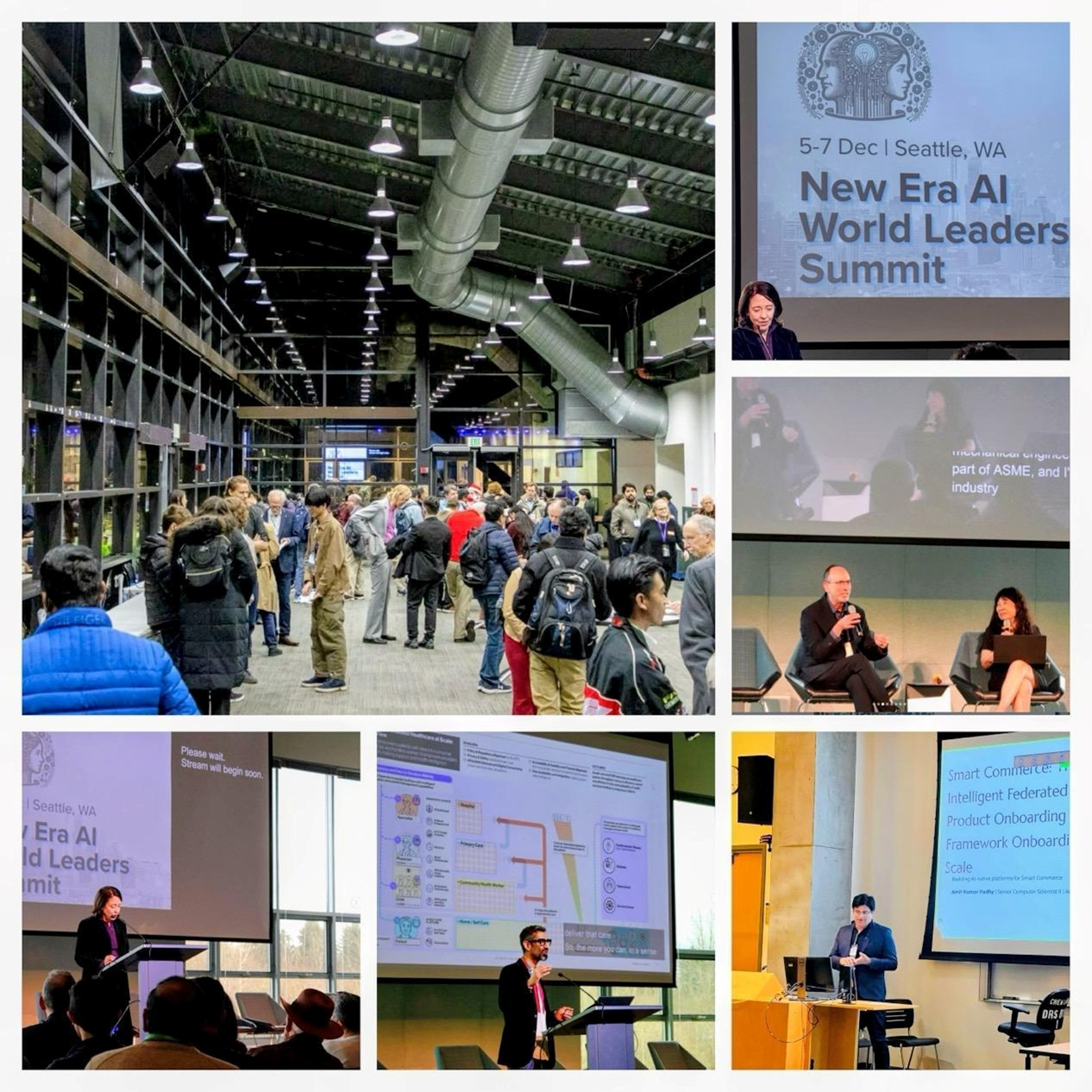
SEATTLE/BOTHELL, Wash. — A pivotal shift in the discourse surrounding artificial intelligence (AI) emerged at the 2025 IEEE New Era AI World Leaders Summit, held at the University of Washington, Bothell, from December 5–7. Leaders from technology, policy, and engineering converged with a focused intent: translating AI from theoretical frameworks into practical, scalable applications.
Framed by New Era AI Event Chair Sheree Wen as a “working forum,” the three-day summit saw participation from major players such as Google, Amazon, Microsoft, OpenAI, Meta, and others. The central theme revolved around ensuring the reliability of AI systems at scale, a necessity as the technology begins to permeate everyday operations.
Setting a serious tone early in the event, U.S. Senator Maria Cantwell, Chair of the Senate Committee on Commerce, Science, and Transportation, articulated that responsible AI adoption is not merely an ethical obligation but a national imperative. Her focus on workforce readiness highlighted the urgent need for innovative frameworks to safeguard both users and workers amidst rapid AI deployment.
The technical foundation for this deployment was elaborated by Tim Lee, IEEE-USA President and Boeing Technical Fellow. He outlined significant advancements in microelectronics and semiconductors that will fuel AI’s next phase. Lee emphasized that without breakthroughs in heterogeneous integration, the industry’s aspirations for scalable AI would remain largely theoretical.
As discussions progressed, a spotlight was cast on real-world applications of AI. Harold Tobin, Director of the Pacific Northwest Seismic Network, showcased how AI-driven data analysis is revolutionizing earthquake and tsunami early-warning systems, highlighting the critical stakes involved in getting deployment right.
Sessions covered an array of pertinent topics, including trustworthy AI validation, privacy-preserving architectures, serverless computing, digital twins, and intelligent automation. The unifying narrative emphasized the transition from mere proof-of-concept demonstrations to production-grade systems capable of managing complexity and regulatory scrutiny.
A perspective on the architecture of agentic AI systems was provided by Amit Kumar Padhy, Senior Computer Scientist II at Adobe. Padhy discussed semi-autonomous systems designed to function within enterprise environments, focusing on practical design patterns that facilitate automation without compromising oversight or reliability.
As the summit reached its conclusion, a consensus appeared to solidify across policy, industry, and engineering sectors. Participants agreed that the forthcoming era of AI would not be characterized by increasingly large models or ostentatious demonstrations, but by systems robust enough to perform reliably in real-world contexts—systems that are auditable, maintainable, and trustworthy.
In this light, the Bothell summit marked a crucial inflection point in AI’s evolution: the transition from a technology filled with promise to one defined by deployment, performance, and accountability. The age of AI prototypes is drawing to a close, signaling the commencement of serious efforts to make AI operational.
See also DeepSnitch AI Rises 115% in Presale, Attracts $1.1M as Crypto Capital Shifts to Altcoins
 AI Boom Masks Debt-Fueled Inequality as Fed Cuts Rates Amid Economic Fragility
 India AI Summit 2026: Transforming Human Capital for an Inclusive Future
 CodeT5 Reaches 22,172 Monthly Downloads, Surpassing OpenAI’s Code Models
 UK Government Orders Elon Musk’s X to Address Grok AI’s Production of Non-Consensual Images