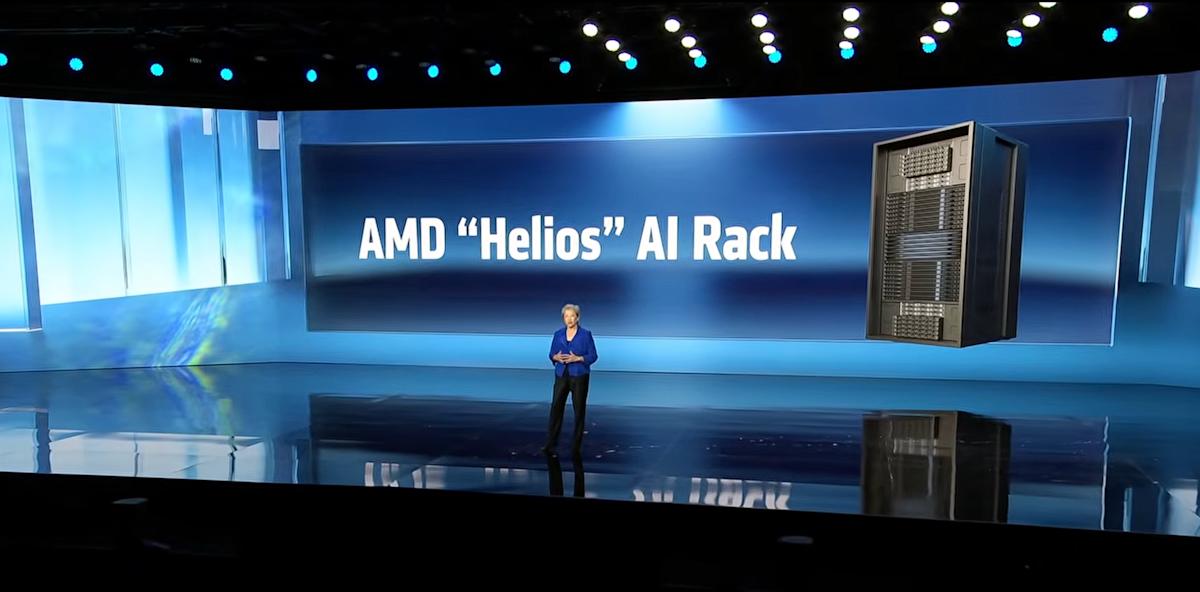
AMD (AMD) CEO Lisa Su unveiled the company’s forthcoming AI data center platform during her keynote at CES 2026 in Las Vegas on Monday, providing a first look at the Helios system and detailing its construction. Su showcased a large Helios rack unit on stage, claiming it to be the “world’s best AI rack,” positioning it directly against Nvidia’s established dominance in the market.
Nvidia (NVDA) recently debuted its latest offering, the Vera Rubin NVL72, at CES, which has set the benchmark for rack-scale systems. Helios is designed to compete directly with Nvidia’s NVL systems, incorporating 72 of AMD’s MI455X chips to match the NVL72’s 72 Rubin GPUs. This move reflects AMD’s strategic intent to penetrate deeper into Nvidia’s market share in the AI data center sector.
During her presentation, Su further elaborated on AMD’s upcoming MI500 series data center GPUs, which the company claims will provide up to a 1,000x increase in AI performance compared to its current MI300X GPUs. This level of performance escalation, according to Su, will be essential to accommodate a projected 5 billion daily AI users within the next five years, necessitating a dramatic increase in global computing capacity by a factor of 100.
The anticipated surge in AI applications could significantly benefit both AMD and Nvidia, as AMD has seen substantial gains from its AI data center business, with its stock price climbing 76% over the past year, exceeding Nvidia’s 30% rise. However, Nvidia continues to overshadow AMD in market capitalization, boasting a valuation of $4.5 trillion compared to AMD’s $359 billion.
In addition to AI advancements, AMD showcased its involvement in the robotics space, featuring Generative Bionics CEO Daniele Pucci. Together, they introduced the GENE.01 humanoid robot, powered by AMD’s CPUs and GPUs, aimed at operational use in industrial settings. AMD is also an investor in Generative Bionics, highlighting its commitment to innovation in multiple tech sectors.
On the consumer front, Su announced new Ryzen AI 400 Series and Ryzen AI Pro 400 series chips aimed at challenging Intel’s new Core Ultra 3 processors, which are built using the latest 18A process technology. The new AMD chips are equipped with up to 12 high-performance CPU cores along with integrated Radeon 800M series graphics and an NPU capable of delivering up to 60 trillion operations per second (TOPs), a metric used to gauge AI processing capability.
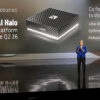
AMD asserts that these enhancements promise multi-day battery life and robust performance for both AI and gaming applications. The company also introduced its Ryzen AI Max+ chips tailored for premium light laptops, workstations, and mini-PCs, alongside the Ryzen AI Halo developer platform. This mini desktop PC is geared towards helping developers build AI models locally, directly competing with Nvidia’s DGX Spark mini-PC, which is priced at $3,999, although AMD has yet to disclose the Halo’s pricing.
As the AI landscape continues to evolve, AMD’s focus on leveraging its technological advancements to capture market share from Nvidia could reshape competitive dynamics in the sector. With both companies investing heavily in AI and related technologies, the coming years will be crucial for their positioning in a rapidly growing marketplace.
See also Micron, SK Hynix, and Sandisk Poised to Lead $100B AI Memory Supercycle, Analysts Say
 Generative AI Transforms Finance by 2026: Boosting Efficiency and Creating New Jobs
 Finance Updates Reveal No December Spending and Boiler Repairs at Administration Building
 Caterpillar Integrates Nvidia’s AI in Excavators for Enhanced Construction Efficiency
 ATG Raises $15 Million to Launch AI Financial Advisor, Autonomous, by 2026