






















































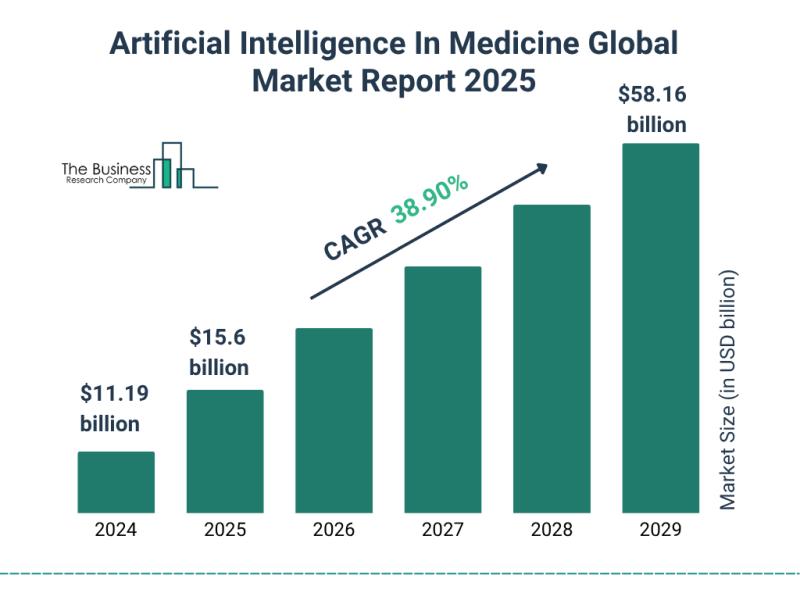
The artificial intelligence (AI) sector within medicine is on a remarkable growth trajectory, with projections indicating a significant increase in market valuation. As of 2024, the medical AI market is expected to reach $11.19 billion, with forecasts suggesting it will expand to $15.6 billion by 2025. This growth represents a robust compound annual growth rate (CAGR) of 39.4%.
This surge can be attributed to several factors, such as the increasing emphasis on optimizing patient outcomes, a shortage of practicing physicians, a rise in trained medical personnel, and advancements in the computational capabilities of AI platforms.
Future Growth Projections
Looking further ahead, the artificial intelligence in medicine market is anticipated to escalate even more dramatically, with expectations of reaching an estimated $58.16 billion by 2029. This projection corresponds to a CAGR of 38.9%. Key contributors to this future growth include a rising incidence of chronic diseases, a shift toward digital transformation methodologies, and significant developments in areas like robotic medical assistants, patient management software, and AI-driven pharmaceutical research.
Remote patient monitoring (RPM) is one area seeing rapid adoption. RPM technologies are designed to track individual health metrics outside traditional clinical settings, leveraging machine learning to manage large volumes of patient data. For example, data from Statistics Canada reveals that in 2022, residents in British Columbia (73.8%) and Newfoundland and Labrador (70.7%) were the most likely to engage in virtual medical appointments, compared to lower engagement rates in regions such as Prince Edward Island (36.9%) and Quebec (37.6%). As patient engagement with RPM solutions increases, this will likely propel further innovation and application of AI in healthcare.
Disruptive Trends in AI Medicine
Innovations are rapidly reshaping the landscape of the medical AI sector. Companies are focusing on developing advanced AI platforms that streamline workflows and enhance decision-making processes. A notable example is OM1 Inc., which introduced the PhenOM platform in April 2023. This platform utilizes observational data to identify unique digital characteristics associated with various diseases, thereby enabling tailored assessments of individual patient metrics for better risk forecasting and clinical decision-making.
The market segmentation of AI in medicine includes categories such as:
- By Type: Hardware; Software; Services
- By Technology: Machine Learning; Natural Language Processing; Context-Aware Processing; Computer Vision
- By Application: Medical Administration and Support; Patient Management; Research and Development
- By End User: Hospitals; Clinics; Research Institutions
Within these segments, hardware includes AI-powered imaging devices and wearable health devices, while software encompasses machine learning algorithms and clinical decision support systems. Services in the sector range from AI consulting to data management.
Global Market Leaders and Regional Insights
Some of the major players currently dominating the artificial intelligence in medicine market include Google LLC, Microsoft Corporation, Intel Corporation, IBM Corporation, and Medtronic PLC. North America is anticipated to remain the largest region in this market, while the Asia-Pacific region is projected as the fastest-growing area in the upcoming years.
For stakeholders ranging from business leaders and investors to policy makers and consultants, understanding these trends is crucial. The insights provided through comprehensive reports can aid in identifying growth opportunities and aligning regulatory frameworks with industry developments.
For those interested in a deeper analysis of the artificial intelligence market in medicine, detailed reports are available for purchase, offering valuable insights into market dynamics and trends.
 Google VP Shantanu Sinha Highlights Creative Student Uses of AI in Education
 Interior Designers’ AI Tool Adoption Triples to 29% in 2025, Survey Reveals
 Yann LeCun Exits Meta to Launch AI Startup Amid Shift to Product-Driven Development
 Siemens Announces AI-Driven Solutions to Accelerate Clean Energy Transition
 Perplexity Launches Comet AI Browser, Enhancing Browsing Speed and Productivity















