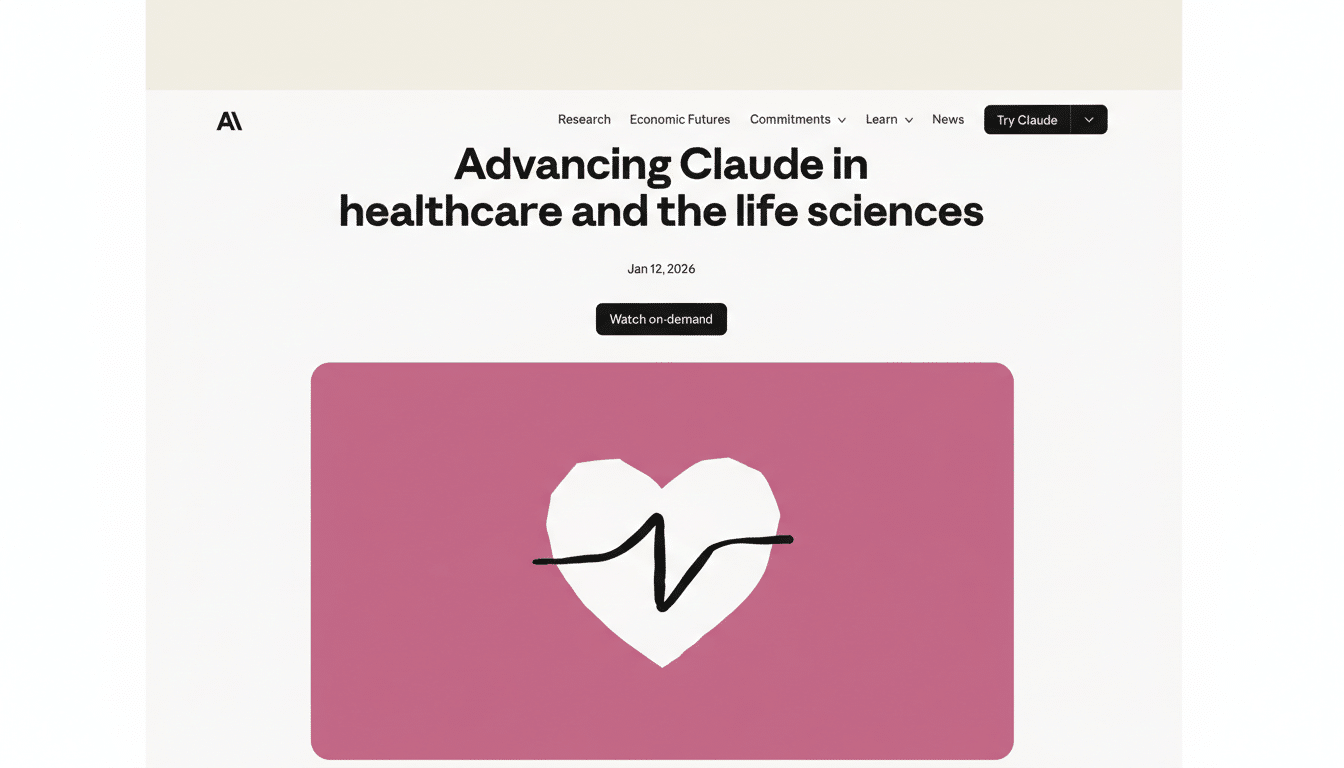
Anthropic has launched Claude for Healthcare, a specialized version of its AI platform aimed at enhancing operational efficiency for healthcare providers, payers, and patients. This announcement comes on the heels of OpenAI’s introduction of ChatGPT Health, marking a significant intensification in the race to develop reliable, healthcare-grade AI solutions. These tools are designed to automate cumbersome workflows, synthesize medical literature, and deliver real-time policy and coverage information, moving beyond mere conversational capabilities.
Claude for Healthcare integrates natural-language reasoning with “connectors” to various clinical and administrative data sources, such as the Centers for Medicare and Medicaid Services Coverage Database, ICD-10 coding references, the National Provider Identifier registry, and PubMed. This capability allows an AI agent to efficiently verify provider identities, propose appropriate ICD-10 codes, and locate coverage criteria without necessitating staff to navigate multiple portals.
Anthropic emphasizes workflows that alleviate administrative burdens, notably in areas like prior authorization reviews. Claude can compile necessary documentation, align it with payer policies, draft justification letters, and prepare submissions for clinician approval. This efficiency extends to chart summarization, referral coordination, clinical trial matching, and quality reporting. Both Claude and ChatGPT Health can also sync user-authorized data from mobile devices and wearables, with Anthropic assuring that such data will not be used for model training.
While ChatGPT Health appears to be focusing initially on a patient-facing experience, Claude for Healthcare targets provider and payer workflows directly. This strategic difference is crucial, as healthcare systems increasingly seek measurable returns on investment in areas that bog down clinician productivity and delay patient care. OpenAI estimates that around 230 million people engage with health topics through ChatGPT each week. In contrast, Anthropic is banking on the long-term adoption of its AI tools within clinical operations, where efficiency is paramount.
Both companies stress the importance of privacy controls and clarify that AI-generated outputs should not replace professional medical advice. The real test for these AI systems lies in their ability to ground answers in reliable data sources—such as policy bulletins and medical literature—rather than relying on generic language that risks inaccuracies.
The urgency for such solutions is underscored by the growing administrative burden faced by healthcare providers. The American Medical Association reports that physicians handle an average of 45 prior authorization requests weekly, consuming approximately 14 hours of work, with 88% of those surveyed describing the burden as high or extremely high. Moreover, 94% report that the authorization process delays care, and nearly one-third cite serious adverse events linked to prior authorization requirements. Implementing credible automation to reduce even a fraction of this workload could significantly enhance patient access and throughput.
Beyond streamlining paperwork, McKinsey estimates that generative AI could unlock between $60 billion and $110 billion in annual value within the U.S. healthcare system by expediting documentation, refining care navigation, and enhancing revenue cycle performance. Industry advocates, including CAQH, argue that automating routine transactions could save billions. Claude’s integration capabilities could be instrumental in achieving these efficiency gains if they prove accurate and verifiable.
Healthcare AI operates under more stringent regulations than most enterprise software. Solutions like Claude for Healthcare will require business associate agreements, effective de-identification methods, and safeguards to reduce the risk of generating inaccurate recommendations. The U.S. Food and Drug Administration has set clear guidelines for Clinical Decision Support tools, indicating that those venturing into diagnostic functions will be subjected to rigorous device-level oversight. Stakeholders will likely demand validation studies, independent testing, and comprehensive model descriptions that outline limitations and data sources.
Market Context
Claude for Healthcare enters a competitive landscape, with companies like Microsoft expanding Nuance’s ambient scribing and Azure AI services into large health systems. Google has tested Med-PaLM and provides healthcare search tools through Vertex AI, while AWS has launched HealthScribe for clinical note automation. Specialized startups like Abridge and DeepScribe are also gaining traction with evidence-based scribing solutions. Meanwhile, OpenAI’s ChatGPT Health is carving out consumer engagement and building a growing app ecosystem. Anthropic’s strategy focuses on reliability, transparency, and robust enterprise-grade connectors to distinguish itself.
Looking ahead, pivotal questions will determine whether Claude for Healthcare becomes integral in clinical settings. Will Anthropic publish comparative accuracy benchmarks for coding, prior authorization justifications, and literature synthesis? Can it seamlessly integrate with major electronic health records and payer systems? How will safety protocols, audit trails, and human oversight be implemented? Most importantly, will early users experience tangible reductions in turnaround times, denials, and documentation burdens?
With patient interest in AI for health-related inquiries surging and healthcare facilities eager to reclaim clinician time, the timing for such innovations is promising. However, the next phase of this rollout will hinge on demonstrable proof of effectiveness. If Claude’s connectors consistently provide accurate information from authoritative sources and its agents facilitate quicker actions, Anthropic could not only respond to OpenAI’s advancements but also set a new standard for the healthcare AI landscape.
See also Invest in Nvidia Now: Projected $213B Revenue by 2026 Amid AI Market Surge
 Elon Musk Accelerates AI Chip Development, Promising New Processors Every Nine Months
 Discover the Best ChatGPT Alternatives: Top AI Tools Tested for Performance and Value
 U.S.-Taiwan Tariff Deal Boosts TSMC’s Arizona Expansion, Lowers Chip Costs for Consumers
 AI Ethics in High-Risk Operations: Balancing Confidence Thresholds and Human Oversight