






















































Intuitive Surgical recently detailed its third-quarter 2025 performance, emphasizing that the new da Vinci 5 system is more than just a hardware update. It is designed with a significantly enhanced digital infrastructure, offering approximately 10,000 times the compute power of previous models. This advancement facilitates the ongoing collection and processing of surgical data across numerous dimensions, positioning the company at the forefront of surgical technology innovation.
The integrated Hub is a cornerstone of this strategy, crucial for capturing and relaying substantial intraoperative video data. The combination of this video stream with kinematic and force data, along with electronic medical record (EMR) data where available, creates a multimodal dataset for central analysis. CEO Dave Rosa articulated that the journey begins with “really good data,” which sets the stage for more sophisticated applications of AI and machine learning in surgical settings.
Recent software updates for the da Vinci 5 system feature tools such as Force Gauge, Focus Mode, in-console video replay, and 3D model manipulation. These enhancements are designed to improve surgeon awareness and facilitate real-time decision-making during procedures. Management connected these capabilities to a long-term objective of providing real-time intraoperative insights, moving beyond traditional post-operative analytics.
Looking ahead, Intuitive Surgical envisions its digital roadmap as a vehicle for AI-driven intraoperative guidance and what it terms “augmented dexterity.” By utilizing AI on aggregated surgical datasets, the company aims to assist surgeons and care teams in optimizing surgical outcomes, operational efficiency, and economic viability.
While Intuitive Surgical is firmly rooted in robotics, it is also potentially broadening its strategic focus. If its initiatives continue as planned, the data architecture of the da Vinci 5 could enable the company to transition from a robotics leader into a surgical data intelligence enterprise, potentially monetizing insights alongside its instruments and systems.
In the broader medical device landscape, several companies are also integrating AI to enhance the efficiency and effectiveness of their devices. Notably, GE HealthCare and Boston Scientific have made significant strides in this area, embedding AI into various products.
Boston Scientific has identified AI as a key differentiator in its electrophysiology and mapping ecosystem. The company is actively integrating AI into its OPAL HDx mapping system and the Cortex AI algorithm, aiming to improve visualization and targeting of arrhythmia sources, particularly in cases of persistent atrial fibrillation. Management has framed these AI investments as software-led enhancements that not only increase procedural precision but also streamline workflows and broaden the patient demographic.
Meanwhile, GE HealthCare is positioning AI at the core of its “precision care” strategy, infusing intelligence into its imaging hardware, cloud software, and digital workflows. The company reported robust adoption of AI-enabled products within its Advanced Visualization Solutions, which include ultrasound platforms and interventional imaging systems that feature integrated AI capabilities. GE HealthCare’s portfolio also includes CareIntellect and other SaaS offerings that provide real-time clinical insights and support for cardiology, radiology, and perinatal care.
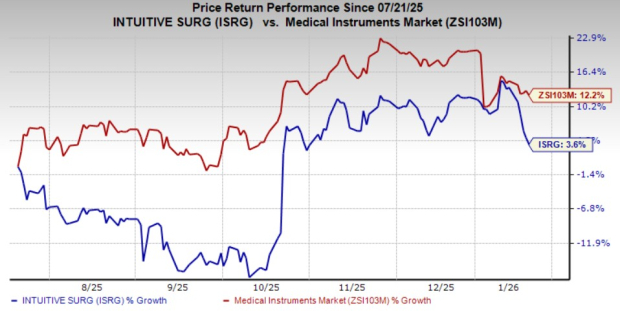
On the financial front, shares of Intuitive Surgical (ISRG) have increased by 3.6% over the past six months, albeit trailing the broader industry, which has seen a 12.2% rise during the same period. Currently, Intuitive Surgical trades at a forward price-to-earnings ratio of 55.23, which is above the industry average but below its five-year median of 71.51. The Zacks Consensus Estimate for Intuitive Surgical’s 2026 earnings suggests an 11.1% increase compared to the prior year’s figures. The stock holds a Zacks Rank #2 (Buy), indicating positive market sentiment.
As the medical technology sector continues to evolve, the integration of advanced AI capabilities into surgical systems and devices may redefine operational norms and patient outcomes, positioning companies like Intuitive Surgical, GE HealthCare, and Boston Scientific at the forefront of this transformative wave.
Intuitive Surgical | Boston Scientific | GE HealthCare
See also AI Chatbot Adoption Surges: Consumer Confidence Rises Amid Growing Skepticism in 2026
 Tech Hiring Projected to Rise 12-15% by 2026 Driven by AI and Cybersecurity Demand
 Enhans Launches Agentic AI ‘CommerceOS’ at NRF 2026, Establishes San Francisco HQ for Growth
 Geopolitical Tensions Force Businesses to Pivot from China to India Amid AI Job Risks
 AI Spending Expected to Surge in 2026: Top 5 Stocks Including Nvidia and AMD















