






















































By Soumoshree Mukherjee
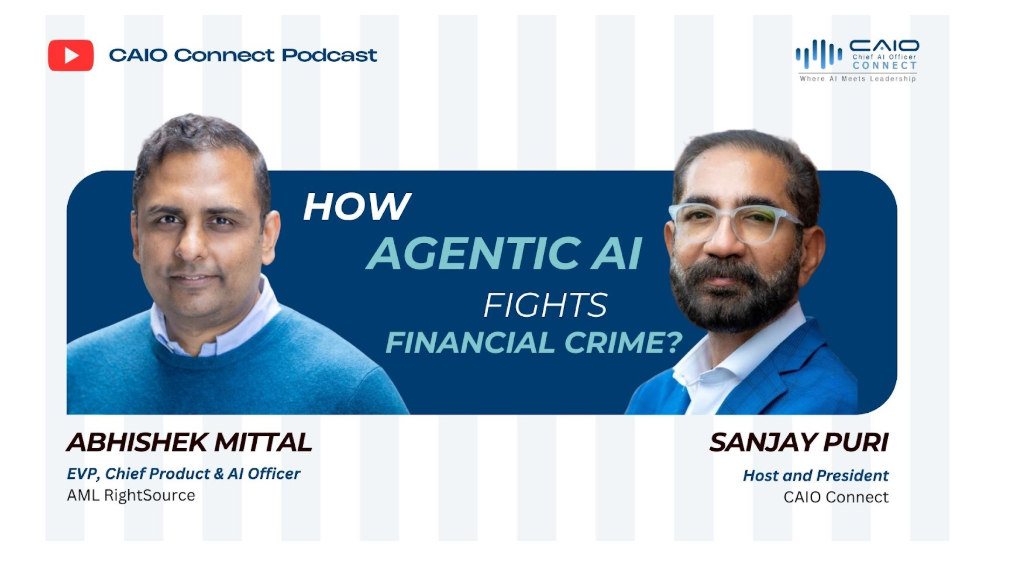
In a recent episode of the “CAIO Connect” podcast, Sanjay Puri engaged Abhishek Mittal, EVP and Chief Product & AI Officer at AML RightSource, in an in-depth discussion on transforming imperfect data into effective AI systems. Mittal, who has a background in innovation at Wolters Kluwer, emphasizes the pressing need for technological advancement in the fight against financial crime, which he notes would represent the seventh-largest GDP globally if it were a country.
At AML RightSource, Mittal’s mission is clear: leverage artificial intelligence to combat money laundering and financial fraud. He argues that the need for innovation in this field is critical, given the staggering scale of financial crime. His strategy integrates domain expertise with AI analytics and human oversight to identify the complex patterns of illicit activity embedded in vast data sets. “The intersection of finance and technology isn’t just about efficiency,” Mittal states. “It’s about protecting trust in the system.”
Despite common industry sentiment that development should commence only once data quality reaches perfection, Mittal urges organizations to take action immediately. He promotes a “run in laps” methodology—initiating projects with high-value use cases, iteratively enhancing data quality, and learning through practical implementation. “You can’t wait for perfect data because the real world is never perfect,” he explains. “Each use case you deploy improves the data that follows.” This pragmatic mindset allows businesses to transition AI from a theoretical concept into a tangible driver of results.
Mittal recounts his previous skepticism towards synthetic data but acknowledges its utility when labeled data is scarce. He has found that synthetic datasets can effectively prepare organizations for rare financial scenarios, like recessions, that may not be adequately represented in real data. “Synthetic data lets us test resilience,” he says. “But it must always be validated with real data and human oversight.”
As AI models become increasingly commoditized, Mittal believes that experience rather than algorithms will differentiate successful enterprises. He suggests that the real competitive edge lies in teams trained to effectively integrate machine intelligence with human judgment. Organizations that mesh their operational knowledge with advanced AI capabilities can outperform even the most nimble startups. “It’s not about who builds the best model,” he asserts. “It’s about who knows how to apply it best.”
Looking to the future, Mittal anticipates the emergence of agentic AI—systems capable of not only predicting or recommending but also acting autonomously. He describes this as the dawn of the “digital FTE,” where AI agents work in concert with human teams.
However, he warns that the success of agentic AI hinges on three critical enablers: a reimagined approach to processes rather than mere automation of existing workflows; the empowerment of domain experts to guide and evaluate outcomes; and engineering excellence to ensure seamless connections between AI systems and legacy infrastructure.
In closing, Puri highlights Mittal’s central philosophy: the importance of pragmatism over perfection in deploying AI technologies. Mittal advocates for embedding AI into real workflows to enhance both efficiency and accountability. “Start small. Scale fast. Stay accountable,” he advises. “That’s how you turn AI from a lab experiment into enterprise transformation.”
See also 48% of Financial Advisers Use AI Tools, 87% Plan to Adopt in Next Year
 Snowflake Launches Cortex Code AI Agent, Promising 10x Productivity Gains
 European Firms Target $10B Investment in Vietnam’s AI and Semiconductor Sectors















