






















































Emerging Paradigms in AI-Driven Work Environments
The rise of agentic coding is reshaping organizational dynamics, marking a significant departure from traditional software engineering practices. This evolution highlights a broader transformation in how tasks are executed across various sectors, where coding served as the initial testbed due to its clear feedback mechanisms and measurable outputs. As this model matures, experts predict that other knowledge work domains will soon follow suit.
Data from Anthropic indicates that engineers are now integrating AI into approximately 60% of their daily tasks, yet they can only “fully delegate” 0-20% of these activities. This limitation underscores a structural shift towards a new work model, where humans assume the role of orchestrators, while AI functions as the executor. For example, in legal contexts, marketing reviews that typically took 2-3 days have been reduced to 24 hours. In customer operations, the execution speed doubled, and in workforce management, Fountain reported a 50% enhancement in screening efficiency through multi-agent orchestration.
The orchestrator-executor pattern is gaining traction across various industries. As a general principle, wherever success criteria are clearly defined and outputs are measurable, the human role is transitioning from active participation to strategic direction.
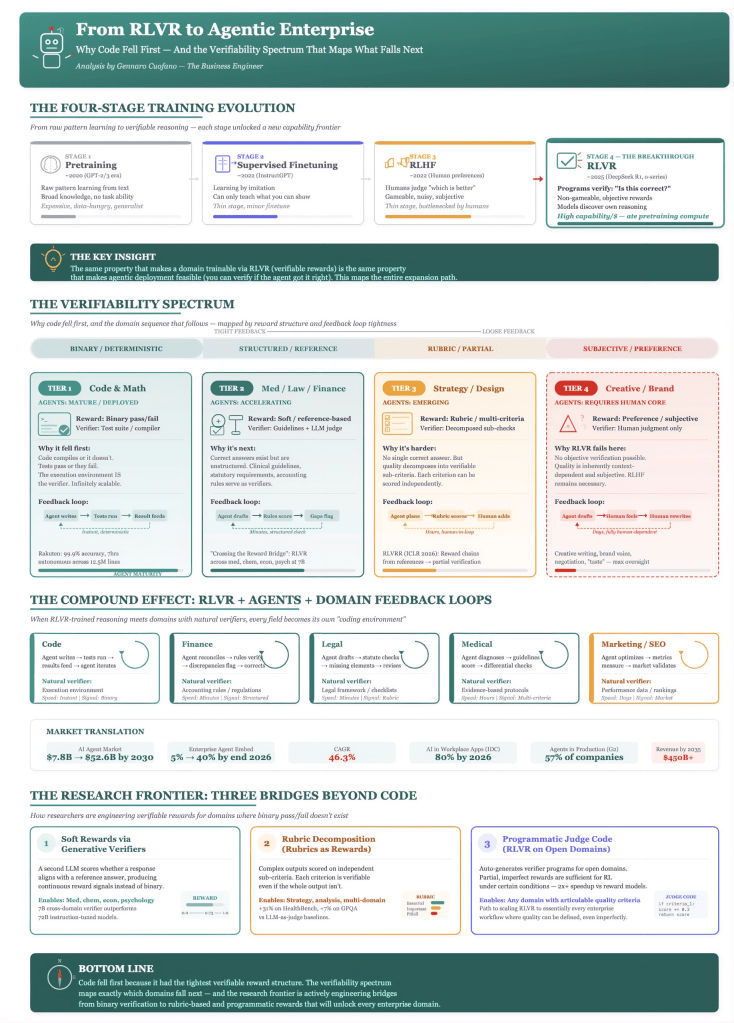
The development of multi-agent systems represents a significant leap from traditional single-agent frameworks. This shift can be likened to moving from a solo consultant to a coordinated team environment. In coding, for instance, an orchestrator agent manages specialized sub-agents tasked with code generation, testing, security assessment, and documentation. Technologies such as Anthropic’s MCP and Google’s A2A protocol are laying the groundwork for standardized agent interoperability, akin to the HTTP protocols that shaped the web. According to Gartner, the integration of task-specific AI agents into enterprise applications is expected to surge from under 5% in 2025 to 40% by the end of 2026—a figure that marks an eightfold increase.
The concept of long-running autonomy is exemplified by the case of Rakuten, where the AI model known as Claude Code executed a complex extraction process across a 12.5-million-line codebase in just seven hours, achieving an impressive 99.9% numerical accuracy. Findings from Anthropic suggest that approximately 27% of AI-assisted work involves tasks that would not have been completed otherwise, thereby validating claims that long-running autonomy not only expedites existing workflows but also enables previously infeasible projects.
The democratization of AI technology is further illustrated by Zapier, which has achieved 89% AI adoption across its workforce, deploying over 800 agents internally. This has empowered design teams to prototype in real-time during customer interviews, enabled non-technical employees to troubleshoot network issues, and allowed a lawyer without coding experience to develop self-service tools that triage legal matters before they escalate. By 2026, projections indicate that roughly 40% of enterprise software will be created using natural-language-driven approaches, often referred to as “vibe coding.”
However, the advancement of agentic coding also raises significant security concerns. This dual-use battleground means that security must be built into AI architectures from the ground up. A recent report from Deloitte highlights that only one in five companies currently possesses a mature governance model for agentic AI.
The implications of these developments are profound, signaling a shift not only in how work is executed but also in the strategic roles employees will play in the future workplace. As organizations adapt to these changes, the focus will likely be on harnessing AI capabilities to enhance productivity and enable new forms of creative and technical work.
For a more in-depth exploration of these trends, visit The Business Engineer.
See also Pentagon Threatens to Cut Ties with Anthropic Over AI Ethics in Military Use
 Cohere Achieves $240M ARR in 2025, Surpassing Targets and Signaling Strong Enterprise Growth
 AI Automation Causes 126% Surge in High-Tech Unemployment in Israel’s Software Sector
 Elon Musk Defends xAI’s Safety Culture Amid High-Profile Departures and Internal Strife














