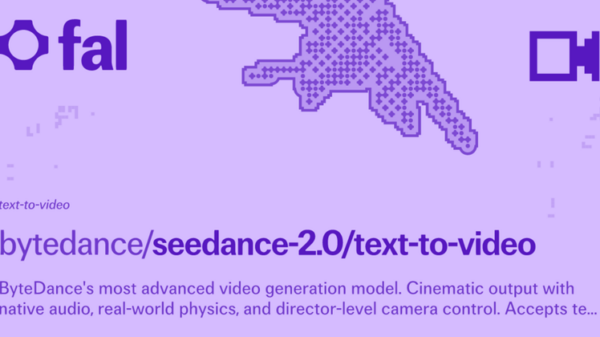
Hollywood studios are intensifying their legal battle against AI technology, with the Walt Disney Company and Paramount Pictures sending cease-and-desist letters to ByteDance regarding its Seedance 2.0 model. These letters signal a transition from informal complaints to formal enforcement, as the studios allege unauthorized use of copyrighted characters.
Both Disney and Paramount have cited intellectual property infringements in their correspondence with ByteDance, indicating serious concerns about the use of their creative assets. In a statement to Decrypt, a ByteDance spokesperson said, “ByteDance respects intellectual property rights, and we have heard the concerns regarding Seedance 2.0. We are taking steps to strengthen current safeguards as we work to prevent the unauthorized use of intellectual property and likeness by users.”
The escalation of actions from major studios is not limited to legal notices. Both the Screen Actors Guild-American Federation of Television and Radio Artists (SAG-AFTRA) and the Motion Picture Association have voiced concerns that certain AI outputs may infringe on performers’ rights, including issues of consent and compensation. SAG-AFTRA has condemned Seedance 2.0 for allegedly utilizing performers’ voices and likenesses without proper authorization.
In response to these industry-wide apprehensions, the startup LightBar has emerged as a potential ally for studios. LightBar specializes in analyzing AI outputs to identify signs of unauthorized training, thus providing crucial evidence that may be leveraged in litigation or licensing discussions. The platform claims it conducts “research campaigns” where users generate outputs with structured prompts aimed at testing specific generative AI models or studio intellectual property.
LightBar’s proprietary analysis engine evaluates submissions based on “percentage likeness, distinctive character traits, and prominence,” positioning itself as an essential tool in the ongoing dispute between traditional media and rapidly evolving AI technologies. The company asserts that the data it provides can strengthen a studio’s negotiating position, particularly when disputes arise over AI-generated content that closely resembles copyrighted materials.
As studios formalize their infringement claims, they are also collaborating with LightBar to explore legal and licensing actions related to Seedance 2.0 and other AI models. The startup aims to empower studios by shifting the leverage back in their favor, as the results of their analyses serve to outline methodologies and provide quantifiable proof supporting further review.
Recent comments from industry experts indicate that the current wave of disputes is establishing a new battleground focused on attribution and evidence in the AI economy. Ram Kumar, a core contributor at OpenLedger, highlighted that documenting model outputs can significantly bolster a studio’s position during negotiations. He emphasized the importance of creating verifiable logs that connect prompts to outputs, explaining that such measures can translate resemblance into quantifiable proof in legal contexts.
The legal actions taken by Disney and Paramount, alongside the assertions from industry unions, underscore a growing recognition within the creative community that AI-generated content may breach existing copyright and contractual rights. The Motion Picture Association has urged ByteDance to halt the development of Seedance 2.0, reiterating that the model utilizes copyrighted works without authorization, thereby reinforcing the industry’s call for accountability from AI developers.
The momentum of these disputes indicates a pivotal shift in how intellectual property rights will be managed in an era dominated by generative AI technologies. As studios and labor groups unite against perceived infringements, the stakes are rising for platforms like Seedance 2.0. LightBar’s involvement suggests that technological advancements may provide crucial support for the creative industries as they navigate this complex landscape, where the lines of ownership and rights are increasingly blurred.
As this legal landscape continues to evolve, the implications for both the creative industries and AI technology developers remain profound. The outcome of these disputes will likely shape not only current business practices but also the future development of AI systems with built-in accountability and transparency features.
See also ChatBCI Launches P300 Speller BCI with Context-Driven Word Prediction Using GPT-3.5
 Alibaba Launches Qwen-3.5 Open-Source AI Model with 397 Billion Parameters and Native Multimodality
 OpenAI Retires GPT-4o, Sparking Outcry Among AI Companion Community
 Gucci Launches First Luxury AI Lens on Snapchat, Transforming Users into La Famiglia Characters
 Rutgers and Red Hat AI Launch T3D Framework, Boosting Text Generation by 85%