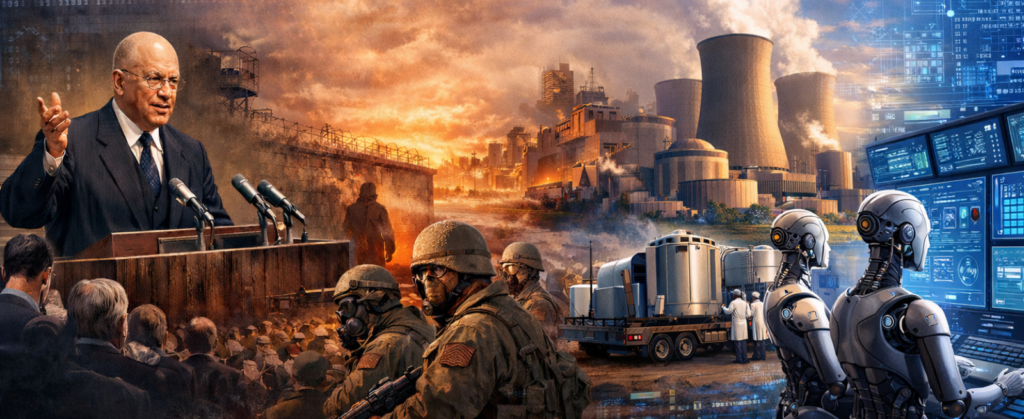
In a landscape where artificial intelligence (AI) is poised to revolutionize industries, the United States is revisiting its nuclear energy strategy to meet growing energy demands. This reflection comes decades after President Dwight Eisenhower’s “Atoms for Peace” speech to the United Nations General Assembly on December 8, 1953, which called for the peaceful use of atomic energy. Today, as energy consumption surges with the expansion of AI data centers, the need for a coherent energy strategy has never been more pressing.
Throughout 2025, discussions among senators, think tanks, and federal commissions have drawn parallels between the urgency of advancing AI technologies and the Manhattan Project that produced the atomic bomb. The energy requirements for powering these AI initiatives could mandate a new project of equal magnitude. Despite previous efforts, including an executive order from former President Donald Trump aimed at revitalizing the nuclear industrial base, the attention has largely been diverted to the competitive dynamics of technology development with China. With U.S. public support for nuclear energy reaching a near-record high, the current moment offers a unique opportunity to enhance the role of atomic power in bolstering America’s AI strategy.
The early Cold War era saw nuclear technology revolutionizing energy generation, fueling everything from cities to military vessels. However, the burgeoning number of AI data facilities has raised alarms over energy consumption. Brian Janous, former President of Energy at Microsoft, highlighted the challenge, stating that utilities have not seen a period of load growth in nearly two decades and are unprepared to match the rapid development of AI technology. While the White House is exploring nuclear options, its AI strategy, released last July, mentions nuclear power only briefly. This omission signals a need for more focused consideration of how nuclear energy can support AI’s sustainable growth.
Currently, America operates 94 nuclear reactors, contributing 20% of its total energy supply with 97 gigawatts (GW) capacity. The largest reactor, located in Georgia, generates 4.5 GW. A recent report from Goldman Sachs projects that the U.S. will require an additional 47 GW of energy to sustain its AI centers by 2030, a demand equivalent to half of the nation’s current nuclear capacity. Notably, Meta CEO Mark Zuckerberg has recognized this need, securing nuclear energy agreements to power his new 6.6 GW AI facility in Ohio. Companies like Meta and OpenAI could soon account for over 10% of the U.S. power grid, and these demands are expected to escalate.
Professor Joohyun Moon of Dankook University has proposed that small modular reactors (SMRs)—compact nuclear batteries—could help address energy requirements for national security in forward areas, such as the Indo-Pacific. Although the U.S. approved its first SMR design in 2022, it will not be operational until 2029, and only three SMRs are currently functioning in Japan, China, and Russia. Concerns persist over the affordability of SMRs and the potential risks of nuclear proliferation associated with the enriched uranium they utilize. Moreover, these reactors only generate up to 300 megawatts, which is insufficient to meet the extensive energy needs projected for AI development.
Microsoft’s plans include constructing six data centers in Texas, each capable of consuming energy equivalent to what over 100,000 homes use. Once Meta’s Ohio facilities are operational, they will possess energy reserves sufficient to power approximately five million homes. Consequently, data centers in the U.S. may consume nearly a quarter of the energy used by all American households by 2030. Without a stronger integration of national AI strategies and nuclear energy expansion, such forecasts appear unsustainable.
Embracing nuclear energy further necessitates sustainable solutions for disposing of spent nuclear fuel and investment in high-capacity pressurized water reactors, yet these solutions have lagged. The Obama administration cut funding for the Yucca Mountain disposal facility in 2009, halting its development as a nuclear waste repository. Despite the Trump administration’s attempts to allocate funds for nuclear waste management from 2018 to 2020, Congress has yet to approve a viable plan. A rapid increase in nuclear energy production must be matched by an uptick in disposal capacity.
Between 2013 and 2022, the U.S. closed thirteen reactors, prompting the current administration to take a different direction. Last year, the Department of Energy committed to increasing America’s nuclear output from 100 GW to 400 GW by 2050. In tandem, Trump’s executive order aimed to relieve AI companies of federal regulations while placing energy cost burdens on them. The forthcoming challenge is to synthesize these developments into a unified vision that defines success in the AI race and aligns it with the requisite energy demands, much of which will depend on nuclear power.
As Sarah Robey notes in her historical examination of U.S. citizenship during the atomic age, “American culture has never truly partitioned the difference between ‘atoms for peace’ and ‘atoms for war.'” This historical context has fostered mixed perceptions of nuclear energy over the decades. With optimism toward nuclear power reaching 61%, now is an opportune moment to rekindle discussions on the atom’s role in American society. As AI research accelerates, so too must the dialogue about leveraging nuclear energy to sustain life, rather than destroy it, echoing Eisenhower’s vision from 1953. The establishment of a deeper connection between energy generation and AI strategy is crucial for achieving sustainable solutions in this evolving landscape.
See also Apple Hosts 2025 Workshop on AI Reasoning and Planning, Showcasing Key Research Advances
 ASU Digitizes 60 Years of Jane Goodall’s Chimp Research Using AI and Machine Learning
 Deep Learning Applications Revolutionize 25 Industries, Boosting Efficiency and Innovation
 Research Reveals ChatGPT Health’s 50% Under-Triage Rate in Emergency Scenarios
 Flapping Airplanes Launches AI Lab with $180M Funding to Tackle Data Efficiency