






















































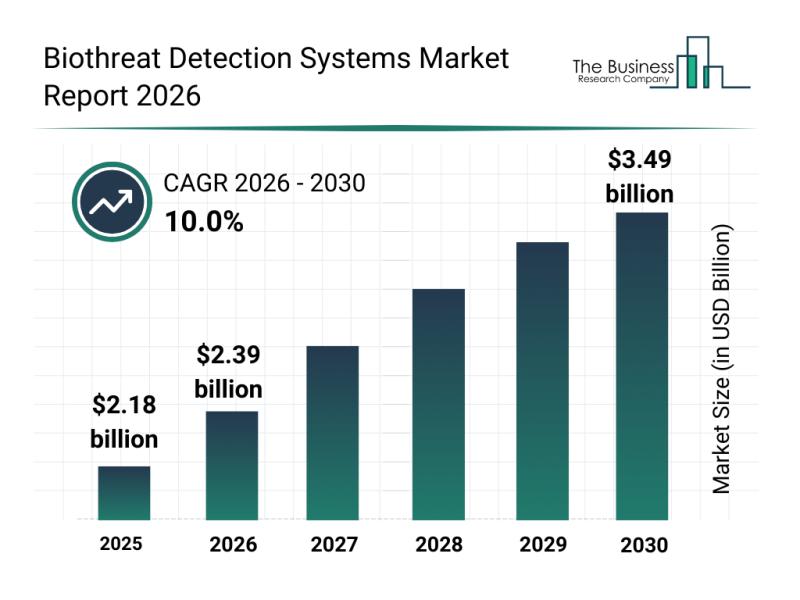
The biothreat detection systems market is poised for significant growth, driven by escalating global security concerns and advancements in technology. Analysts project that the market will reach a value of $3.49 billion by 2030, expanding at a compound annual growth rate (CAGR) of 10.0% during the forecast period. The increasing demand for early-warning systems, the integration of AI-powered analytics, and a greater focus on national biosecurity are key factors propelling this growth.
Market dynamics are shifting as the urgency for timely detection of biological threats accelerates. Governments and private sectors are increasingly adopting sophisticated surveillance technologies to prevent outbreaks and mitigate risks associated with biological attacks. The integration of artificial intelligence and machine learning is enhancing the speed and accuracy of detecting biological agents, thereby streamlining threat response efforts. This technological evolution is fostering innovation and broader adoption within the industry.
Leading companies in the biothreat detection systems sector include well-established firms such as Roche Diagnostics AG, Thermo Fisher Scientific Inc., and Abbott Laboratories, among others. Recent developments underscore the competitive landscape; for instance, in July 2026, Palo Alto Networks Inc. acquired Protect AI, a firm specializing in AI infrastructure security, to bolster its offerings for artificial intelligence lifecycle management.
Emerging trends indicate a growing emphasis on continuous biological surveillance, specifically through real-time aerosol-based pathogen monitoring systems. These technologies are designed to collect and analyze air samples continuously, allowing for the early detection of airborne biological threats in public spaces and crucial infrastructures. In August 2023, BioFlyte Inc. launched a pilot program at Pittsburgh International Airport, implementing autonomous air-sampling units that facilitate near real-time identification of airborne threats while integrating alert functions for rapid response by health and security teams.
The market segmentation reveals several focal points: by technology, including polymerase chain reaction (PCR) based detection and immunological detection; by detection type, such as biological, chemical, and radiological agents; and by application, spanning military and defense, public health, and environmental monitoring. Each technology category contains specific methodologies, with PCR methods encompassing real-time, digital, and multiplex PCR, while immunological detection involves various assays like enzyme-linked immunosorbent assay (ELISA).
Geographically, North America currently dominates the biothreat detection systems market, but regions such as Asia-Pacific are expected to experience the fastest growth due to increased investments in biosecurity infrastructure and environmental monitoring initiatives. This dynamic reflects a broader trend of adopting advanced detection technologies globally, underscoring the critical need for robust biothreat response systems.
The compelling growth trajectory of the biothreat detection systems market is indicative of the increasing prioritization of public health and safety. As technological advancements continue to reshape the landscape, the interplay of AI and innovative detection methodologies promises to enhance global biosecurity frameworks significantly. Stakeholders across various sectors must remain vigilant and proactive in their approach to foster resilience against potential biological threats.
See also AI-Driven Cyber Attacks Surge 89% in 2025, Reports CrowdStrike Global Threat Review
 CrowdStrike Reveals Cyberattack Breakout Time Dropped to Just 27 Seconds in 2026 Report
 Hospital Cyberattacks Surge as AI Lowers Barriers, Compromising Patient Data
 Safe Pro Group Unveils NODE AI Threat Detection with General Dynamics at Army TiC 2.0 Event
 IBM Reports 44% Surge in AI-Driven Cyberattacks Targeting Canadian Organizations















