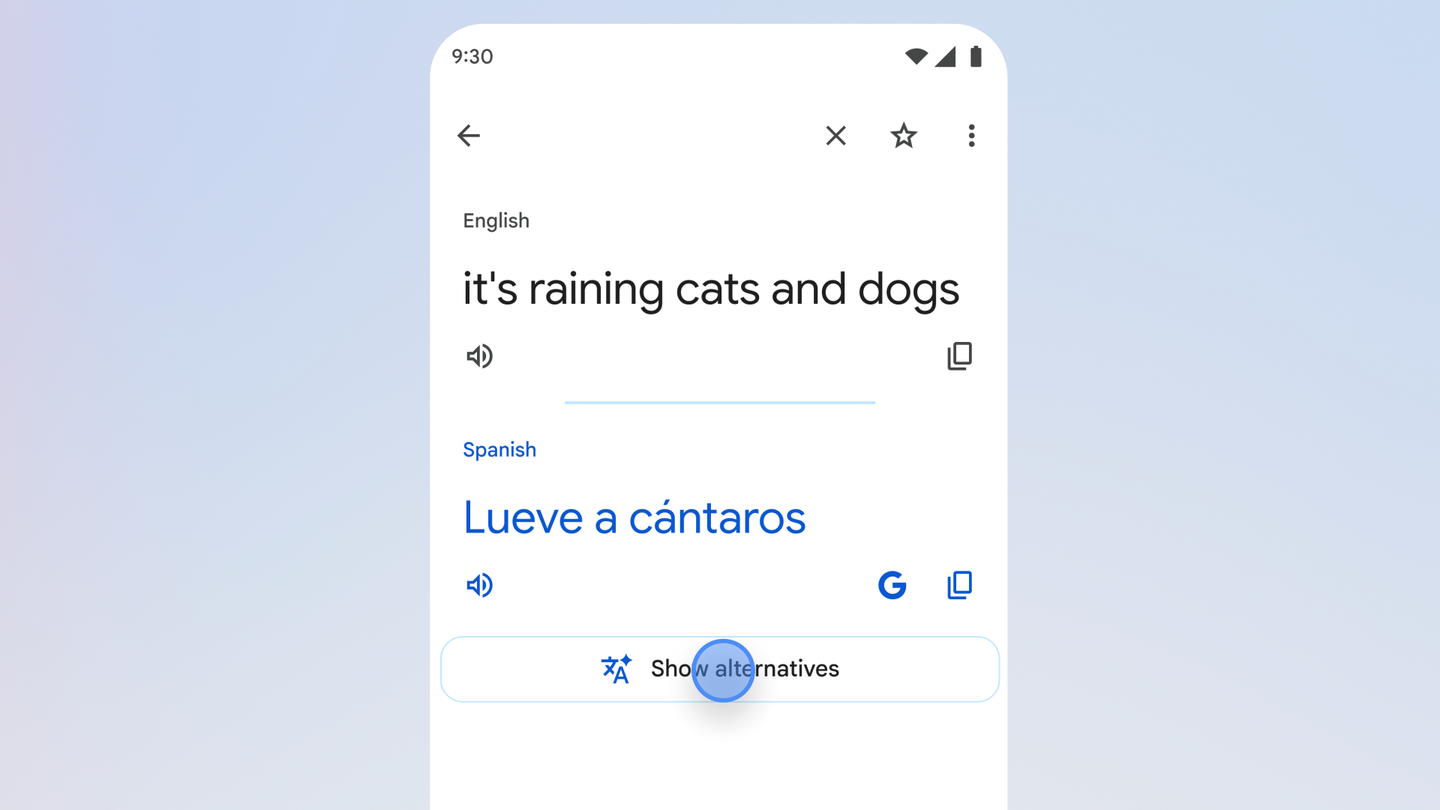
Google has unveiled new AI-driven features in Google Translate, aimed at enhancing communication clarity across various contexts, from casual conversations to professional meetings. The announcement was made today, with the upgraded features now available in the U.S. and India on both Android and iOS platforms, with web accessibility expected soon.
Utilizing the capabilities of Gemini, Google’s advanced AI model, the updated Translate function offers users a range of alternatives for translating phrases and idioms. This expansion is particularly beneficial when interpreting idiomatic expressions such as “It’s raining cats and dogs,” where the tool provides contextual guidance on selecting the most appropriate phrase based on situational nuances.
Users can tap the “understand” option to gain insights into the distinctions among various translations, while the “ask” feature allows for further inquiries regarding specific scenarios, such as dialectal variations or culturally relevant expressions. This interactivity ensures that users can select translations that are not only linguistically accurate but also culturally appropriate.
The introduction of these features underscores a broader trend in the tech industry, wherein AI-driven solutions are being increasingly integrated into everyday applications to enhance user experience and communication. As globalization continues to foster diverse interactions, tools like Google Translate become essential in bridging language gaps and facilitating more effective exchanges.
This enhancement is part of a growing portfolio of AI applications aimed at improving communication across languages. By focusing on context and tone, Google seeks to address common pitfalls in translation, where literal interpretations can often lead to misunderstandings. The updated Translate aims to mitigate these issues, making it a more reliable resource for users navigating multilingual environments.
As the landscape of artificial intelligence evolves, Google remains at the forefront, leveraging its extensive data sets and advanced machine learning models to refine its products continually. The real-time adaptability of the new features reflects a commitment to user-centric design, creating an intuitive interface that caters to individual communication needs.
Looking ahead, the rollout of these features may not only enhance personal interactions but also have implications for businesses operating in multiple markets. As companies expand their reach, tools that facilitate clear communication will be increasingly valuable. Google Translate’s updates signify a step towards more inclusive and effective communication, resonating with the demands of a globalized economy.
In conclusion, as Google Translate evolves with AI innovations, its ability to provide contextually rich and nuanced translations positions it as a pivotal tool in an interconnected world. Users in diverse settings can look forward to more thoughtful communication, paving the way for more meaningful exchanges across cultural and linguistic barriers.
See also AI Alert Apps Misinterpret Training Exercise, Sparking False Fire Reports in Colorado
 Lenovo Unveils AI-Driven Modular PCs and Rugged Devices at MWC 2026 to Enhance Business Workflows
 Autodesk Webinar Reveals AI Tools to Streamline CAD and Manufacturing Workflows
 AI Tools Transform Policing: New Systems Face Criticism and Bias Challenges
 IFS Acquires Softeon to Enhance AI-Driven Global Supply Chain Solutions