






















































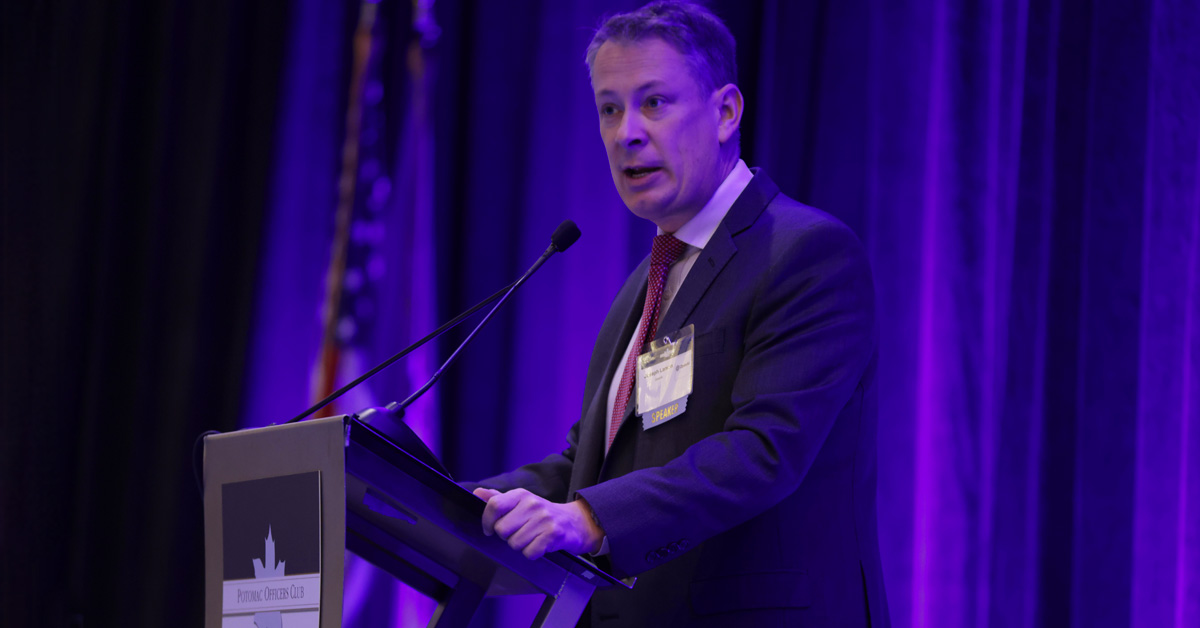
Public sector agencies must enhance their infrastructure to fully leverage the potential of artificial intelligence (AI) systems, according to a key executive from OpenAI. Joseph Larson, Vice President and Head of Government at OpenAI, emphasized this point during his keynote address at the Potomac Officers Club’s 2026 GovCon Executive Leadership Summit held on Thursday. Larson, a 2026 Wash100 Award winner, highlighted that while AI technology is advancing rapidly, the necessary infrastructure to support these capabilities often remains stagnant.
Larson remarked that many public sector professionals focus primarily on user experience when procuring technology, but the critical aspect is the underlying infrastructure that supports AI functionality. “This is a team sport and the infrastructure and data have to be there for AI to work,” he stated. “If we’re going to talk about AI doing more in advancing beyond its current applications, you need to get your infrastructure right first.”
He urged public sector professionals to manage their expectations regarding the performance of AI technologies. The unique nature of government work—impacting areas such as national security and consumer healthcare—requires a tailored approach to AI deployment. “AI access and availability is difficult when you talk about the public sector,” Larson said, stressing that agencies cannot simply apply commercial AI technologies to government missions and expect the same level of reliability, safety, and trust.
During the summit, Larson noted that although public sector professionals express excitement about AI, they often overlook the adequacy of their computing infrastructure. Many are unaware that their current capabilities may fall short of what is needed to fully realize their AI ambitions. Larson pointed out that some agencies do not possess the necessary computational power to execute their intended applications, emphasizing the need for a proactive approach in planning future infrastructure investments.
Larson also highlighted a growing disconnect between the capabilities of AI and how it is utilized within the public sector. He stated that many inquiries he receives focus on basic tasks such as drafting emails and summarizing reports, which, while useful, do not operationalize AI as a critical mission capability. “There’s a gap between what AI can do and how people use it,” he warned, observing that this gap is actually widening.
The evolving landscape of AI is also reshaping government technology procurement processes. Larson pointed out that current acquisition policies resemble those used to purchase military equipment prior to World War II. As AI technologies become more sophisticated, he urged for a systematic discipline that diverges from traditional methods of government procurement. “You can’t solve these reliability challenges in the abstract,” he remarked, adding that meaningful feedback from development teams is essential for the successful deployment of AI tools.
As the federal government seeks to integrate advanced AI technologies, Larson’s insights highlight the importance of a strategic approach to infrastructure development. He underscored that agencies that allocate substantial portions of their budgets to AI trust and safety will be better positioned to harness the full potential of these transformative technologies. “You can’t just slap these into sensitive public sector domains,” he cautioned, reiterating the need for careful consideration of AI safety issues that could lead to accidents, misuse, or other harmful outcomes.
For those interested in further exploring the potential of AI in the public sector, Larson encouraged attendance at the 2026 Artificial Intelligence Summit scheduled for March 18, where federal officials will discuss practical applications and strategies for maximizing AI’s impact.
Joseph Larson, who directs OpenAI’s interactions with various government levels, has a robust background in defense and technology, having previously served as the first deputy chief digital and AI officer for algorithmic warfare in the Office of the Secretary of War. He is also a colonel in the U.S. Marine Corps Reserve, serving as an intelligence officer, bringing an extensive perspective to the challenges and opportunities that AI presents for public sector agencies.
See also Trump and Hegseth Target Anthropic’s AI Guardrails, Advocating for Unrestricted Development
 Senate Passes AI Bill of Rights, Mandates Parental Consent for Minor Usage
 UK’s £27M AI Skills Program Falls Short; 56% of CEOs See No ROI Yet
 Israel’s Cyber Chief Yossi Karadi Reveals Key Strategies to Combat AI-Driven Cyber Threats
 Microsoft Supports Anthropic’s Claude Models Despite Pentagon Security Blacklist














