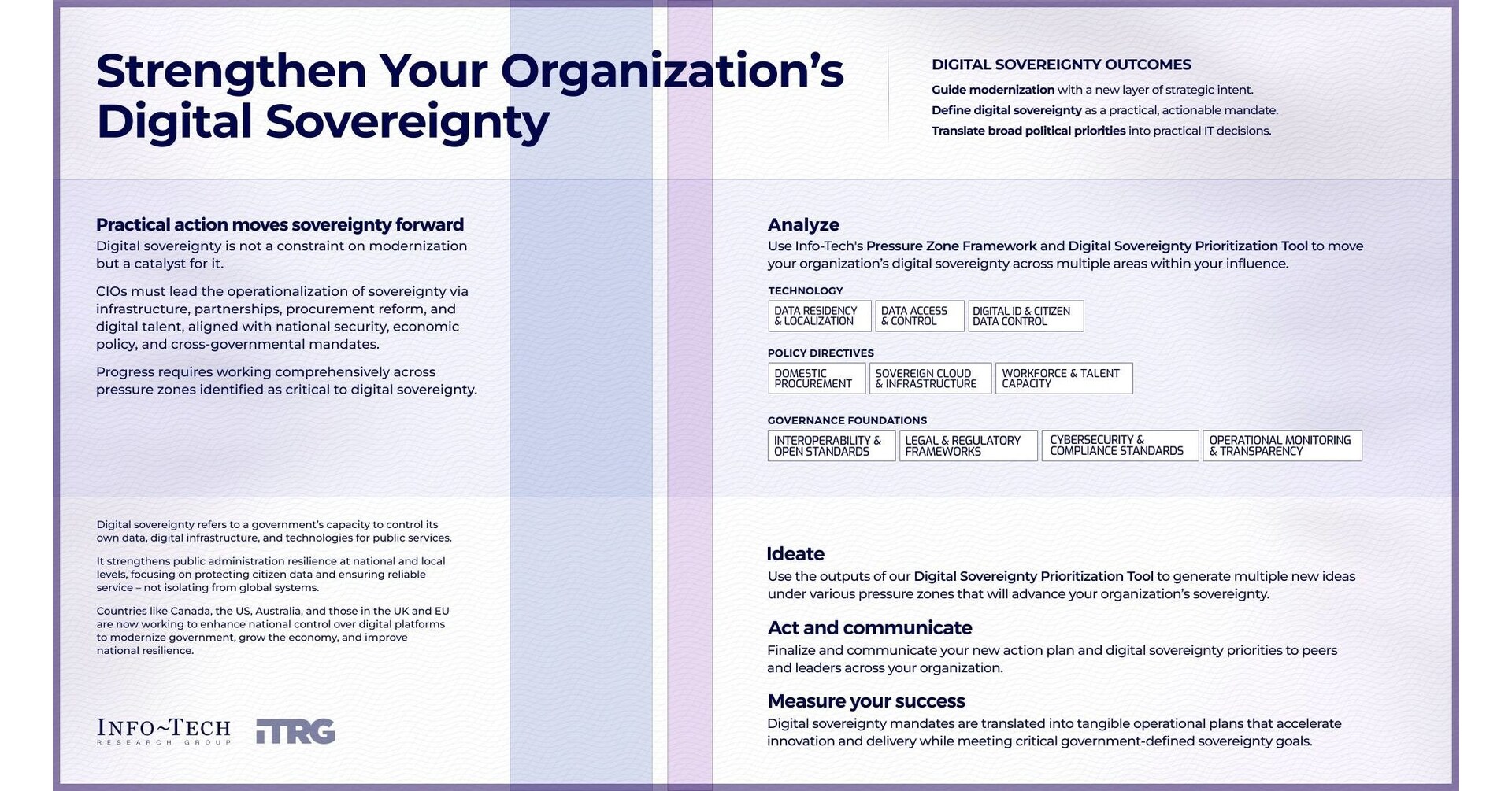
ARLINGTON, Va., March 4, 2026 /CNW/ – Governments worldwide are rapidly implementing digital sovereignty mandates, driven by geopolitical tensions, an increase in AI regulation, and heightened concerns regarding cross-border data security. However, many public sector organizations lack a robust operational framework to assess their control over cloud infrastructure, encryption keys, and AI systems. Insights from Info-Tech Research Group suggest that with structured prioritization of sovereignty pressures and governance alignment, these mandates can serve as catalysts for modernization and enhance the resilience of government institutions and services.
Digital sovereignty has transitioned from being a topic of policy discussion to an operational necessity for both national and subnational governments. Leaders are now under significant pressure to assert jurisdictional authority over data and technology while ensuring uninterrupted service delivery. According to Info-Tech Research Group, many public sector IT organizations lack comprehensive visibility into vendor control of encryption keys, cross-border data transfers, and legal exposure to extraterritorial claims. These deficiencies can jeopardize sovereignty objectives and give rise to operational and legal risks.
Info-Tech’s Strengthen Your Organization’s Digital Sovereignty blueprint emphasizes that achieving sovereignty does not necessitate isolation from global technology ecosystems. Instead, it advocates for the integration of domestic governance controls with certified sovereign cloud models, contractual safeguards, and structured oversight. Despite this guidance, many organizations continue to grapple with aligning procurement policies to their technical architecture, clarifying ownership between central agencies and departments, and mapping the processing and access points of sensitive data. Without this clarity, sovereignty initiatives risk remaining aspirational rather than operational.
“Digital sovereignty is ultimately about strengthening resilience and enforceable control,” says Andy Best, Research Director at Info-Tech Research Group. “Without clear jurisdictional boundaries and accountable ownership, governments risk discovering their exposure only when a disruption or legal challenge forces the issue. We’re seeing a clear shift where government leaders are no longer asking whether digital sovereignty matters; they’re asking for industry-leading frameworks to strengthen it through rapid operational action.”
To assist public sector organizations in converting policy intent into operational control, Info-Tech’s blueprint outlines a structured, four-phase approach tailored for CIOs and senior technology leaders working across IT, Legal, Procurement, and Policy functions. The first phase involves defining the scope of sovereignty and assessing current-state control, where CIOs establish a shared definition of digital sovereignty, clarify applicable mandates, and inventory existing controls over data residency, encryption keys, and AI systems to identify exposure points.
The second phase focuses on benchmarking against global sovereignty models. IT and policy leaders are urged to review international frameworks and leading jurisdictional approaches to understand how peer governments balance modernization with control, leveraging those insights to contextualize their own risk posture. The third phase prioritizes sovereignty pressure zones, utilizing the Digital Sovereignty Prioritization Tool to map vendor dependencies, cross-border data flows, and control gaps, resulting in a visual heat map that ranks high-impact risks.
The final phase entails developing a governed sovereignty roadmap. Executive sponsors are tasked with translating prioritized findings into sequential initiatives that include defined ownership, timelines, and oversight mechanisms. This ensures that sovereignty considerations are embedded within cloud strategy, AI governance, procurement reform, and modernization programs.
Treating digital sovereignty solely as a compliance issue could render it a liability. When integrated into modernization planning, it can bolster long-term control and operational continuity. Info-Tech’s framework aids governments in embedding sovereignty directly into their cloud, AI, and infrastructure decisions, ensuring that priorities endure through political and policy shifts.
For exclusive insights from Info-Tech’s experts, including Andy Best, along with full access to the Strengthen Your Organization’s Digital Sovereignty blueprint, interested parties are encouraged to contact [email protected].
About Info-Tech Research Group
Info-Tech Research Group is a leading and rapidly growing research and advisory firm, serving over 30,000 IT, HR, and marketing professionals globally. The organization provides unbiased research and industry-leading advisory support aimed at helping leaders make strategic, timely, and well-informed decisions. With nearly 30 years of experience, Info-Tech has closely partnered with teams to deliver actionable tools and expert guidance necessary for achieving measurable results.
For further information about Info-Tech Research Group or to access the latest research, visit infotech.com and connect via LinkedIn and X.
Media Contact: Sufyan Al-Hassan, PR Director, Info-Tech Research Group, [email protected], +1 (888) 670-8889 x2418
See also NVIDIA Powers Akamai’s $14.2B Cloud Expansion with Blackwell GPU Acquisition
 AI in K-12 Education Market Projected to Reach $9.18 Billion by 2034, Driven by Personalized Learning
 Chinese Tech Firms Unveil AI Glasses, Robots at MWC 2026, Highlighting Hardware Shift
 LLNL Launches El Capitan, World’s Fastest Supercomputer, to Advance HPC Innovation
 Taiwan’s GDP Surges 23.6% Amid AI Chip Demand, Straining Global Supply Chains