AST SpaceMobile (NASDAQ:ASTS) shares surged 12% in midday trading today following a pivotal agreement with Canadian telecom giant Telus (NYSE:TU) to provide space-based cellular broadband service to some of Canada’s most remote regions. The deal will enable Telus customers to utilize their existing smartphones for texts, calls, and data in areas lacking traditional tower infrastructure, with a rollout expected by late 2026. As part of the agreement, Telus will invest in ground infrastructure and acquire an equity stake in ASTS, aligning the two companies’ long-term interests.
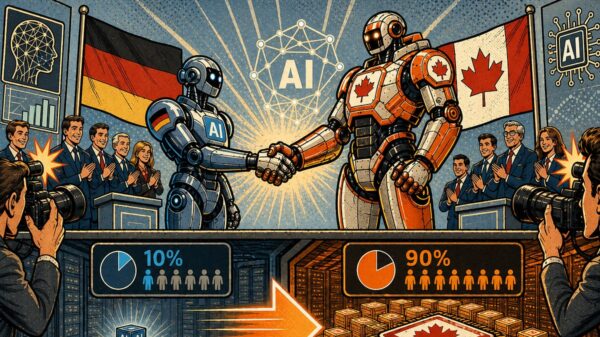
This transaction highlights a broader trend in corporate equity investments that gained momentum in 2024 and escalated dramatically through 2025. While major technology firms poured billions into artificial intelligence—AI accounted for nearly 50% of all global startup funding in 2025, up from 34% in 2024—the AST SpaceMobile-Telus partnership illustrates that this investment trend extends well beyond Silicon Valley’s AI race. Yet, as such deals proliferate, a critical question arises: is much of this corporate equity investment a form of circular financing that could ultimately lead to market instability?
At the core of this investment boom are billion-dollar “megarounds” aimed at foundation model laboratories. Companies like OpenAI, xAI, Scale AI, and Anthropic accounted for over 60% of total AI sector funding in 2025, according to industry analyses. These staggering investments have accelerated valuations and infrastructure developments at an unprecedented pace. Nvidia (NASDAQ:NVDA) emerged as a key player, investing around $1 billion across more than 50 startups in 2024. The trend accelerated in 2025, with a wave of mega-deals involving suppliers and ecosystem partners, momentum that has already spilled into 2026. Other tech giants like Microsoft (NASDAQ:MSFT), Amazon (NASDAQ:AMZN), and Alphabet (NASDAQ:GOOG)(NASDAQ:GOOGL) have followed suit, making significant investments to secure their strategic positions across various sectors, from cloud infrastructure to specialized AI applications.
The discussion surrounding circular financing was sparked by Nvidia’s aggressive investment strategy. The company has consistently rejected the “circular” label, arguing that its stakes represent strategic investments in long-term growth. However, skeptics highlight the interconnected relationships: Nvidia invests in AI startups and suppliers, which, in turn, purchase large quantities of its GPUs to power their models. This leads to capital flows that seem to generate demand for Nvidia’s own products.
The AST-Telus collaboration follows a similar pattern on a smaller scale. Telus’s equity investment in ASTS coincides with its commitment to purchasing satellite broadband services for customers in Canada. This investment aids in funding AST’s satellite constellation, which then produces recurring revenue for Telus, creating a self-reinforcing loop that enhances the viability of both companies on paper.
Critics caution that widespread circular financing inflates asset prices without authentic end-user demand, potentially setting the stage for a significant market correction. If AI adoption wanes or economic conditions tighten, the artificial demand cycle could collapse, leading to valuation resets across intertwined players. Though many such arrangements deliver real technological advancements and new revenue streams, the concentration of capital creates systemic risk. A limited number of Big Tech balance sheets and a narrow focus on AI now underpin trillions in market value, suggesting that any disruption could have far-reaching repercussions.
Each participant in this landscape will assert that their investments are prudent, long-term strategic bets on true innovation rather than circular schemes designed to inflate valuations. They cite tangible breakthroughs, expanding markets, and dedicated customers. Nevertheless, the emerging pattern in AI is hard to overlook: the same corporate giants investing hundreds of billions in infrastructure simultaneously generate and capture most of the demand for that same infrastructure. This closed loop does not merely reinforce itself; it distorts pricing, inflates input costs, and risks channeling trillions into a narrowly focused technological bet.
The bubble may not burst immediately. With 2026 already witnessing a rapid pace of corporate equity and infrastructure investment, it could funnel even more trillions into this singular megatrend. However, historical trends indicate that booms predicated on interdependent, circular capital flows often unravel when genuine external demand falls short. The true test will come when cash flows from paying end-customers outside this echo chamber grow quickly enough to justify the extensive buildout. Until broad, profitable traction materializes beyond the current closed ecosystem, today’s inflated valuations rest on precarious, self-reinforcing foundations that could falter under even slight setbacks. Real-world adoption must catch up to demonstrate resilience.
See also Motiv8AI Reveals Human-Centered AI Approach to Elevate Banking Experience
 Oracle Plans Major Job Cuts Amid AI Expansion, Reviewing Cloud Division Roles
 ServiceNow Surpasses $3.57B in Q4 2025 Amid SaaS Market Doubts, AI Integration Thrives
 Naver Expands Medical AI Team, Targets $183.85B Healthcare Market by 2032
 MeltPlan, Gushwork AI, and Elly Secure $68M in 2026 Funding for Innovative Solutions