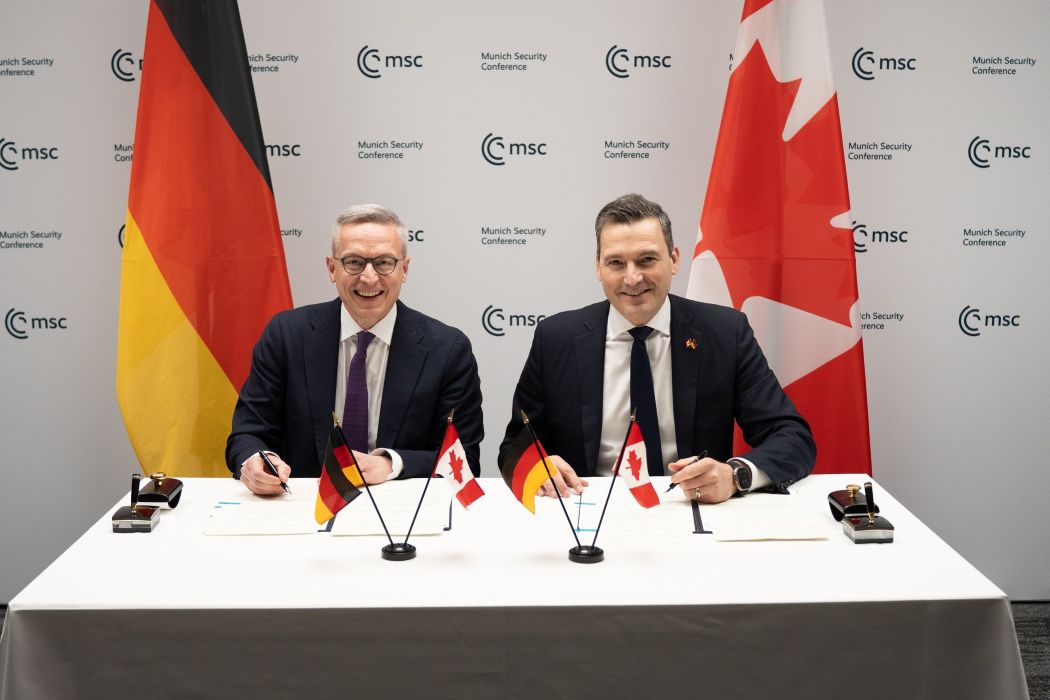
Canada’s artificial intelligence sector is buzzing with news of potential international collaboration. Cohere, a prominent AI firm, is reportedly in talks to merge with Aleph Alpha, a smaller German counterpart, according to reports from Handelsblatt and The Globe and Mail. The German government is poised to become a significant customer of the merged entity, indicating a strategic partnership that could enhance both nations’ AI capabilities.
Cohere declined to comment on the rumors but noted its ongoing discussions within the framework of Canada’s tech alliance with Germany. AI Minister Evan Solomon’s office echoed this sentiment, stating that the two countries have been collaborating closely on trusted AI initiatives.
The implications of this potential merger raise important questions about Canada’s investments in its sovereign AI landscape. With hundreds of millions of dollars already allocated to develop a national AI champion, stakeholders are concerned about the future control and governance of data. Where would the data centers be located? Would Cohere be subject to the European Union’s AI Act and General Data Protection Regulation (GDPR)? These issues could fundamentally alter the dynamics of Canada’s AI ecosystem.
The prospect of a partnership with Aleph Alpha could offer Canadian firms enhanced access to governmental expertise in integrating AI across public systems. As Canadians increasingly express openness to joining the European Union, a merger might position the new company as a formidable contender against U.S. tech giants.
In another significant development, Hypertec has been designated as Nvidia’s first original equipment manufacturer partner in Canada. This partnership allows Hypertec’s Ciara division to leverage Nvidia’s advanced AI chip technology, akin to a trusted team building a high-performance sports car. This collaboration will likely enhance Hypertec’s capabilities in building comprehensive solutions utilizing Nvidia’s cutting-edge technology.
Meanwhile, Neo Financial has joined the Interac payment system, marking its entry as the second FinTech to connect with Canada’s e-transfer network. This integration provides Neo with greater control over payment options, potentially streamlining services for its customers.
In the realm of life sciences, BDC Capital has announced a new $150-million fund aimed at seed and Series A-stage companies focused on therapeutic products and medical technologies. Parimal Nathwani, previously with Toronto Innovation Acceleration Partners, has been appointed as managing partner of this fund, signaling BDC’s commitment to fostering innovation in the life sciences sector.
Concerns for Canada’s innovation landscape were highlighted in an op-ed by Kurtis Broda, co-founder of Wyvern, following the cancellation of the $43-million Canadian Lunar Rover project. He argued that the Canadian Space Agency needs to establish itself as a reliable anchor customer for domestic innovation, rather than an intermittent source of funding.
In a separate interview, Clearpath Robotics co-founder Ryan Gariepy discussed the intersection of robotics and Canadian defense strategy. He addressed the potential of robotics in enhancing national security while questioning whether the country is adequately seizing these new opportunities.
Furthermore, the New York Times has suggested that Adam Back, co-founder and CEO of Canadian company Blockstream, is the true identity behind the pseudonymous Bitcoin creator Satoshi Nakamoto. This revelation adds another layer to the ongoing mystery surrounding the origins of cryptocurrency.
Toronto has also welcomed a new hub for accessibility innovation. The ATS Innovation Hub, opened by Access to Success, aims to support startups developing solutions for various accessibility challenges, fostering growth in this important sector.
In a notable shift, Jesse Wiebe, the community development lead at Startup TNT, announced his departure to pursue larger goals. His exit marked an emotional end to their spring agriculture investment summit, highlighting the dynamic nature of Canada’s startup ecosystem.
As Canada’s technology and innovation landscape continues to evolve, the challenges and opportunities presented by international collaborations, funding initiatives, and the integration of advanced technologies will play a crucial role in shaping the nation’s future. With ongoing discussions and new partnerships, stakeholders will be watching closely to gauge the trajectory of Canada’s sovereignty in the tech arena.
See also Meta Unveils AI-Driven Management System Aiming to Transform Leadership Roles
 Perplexity AI Declares Traditional Search ‘Primitive,’ Promises Revolution in Information Retrieval
 Big Tech’s AI Arms Race: $650B in Hardware Risks Rapid Obsolescence, Warns Expert
 Google Chrome and Microsoft Edge Introduce Local AI APIs for Enhanced Model Management
 Perplexity AI’s Jesse Dwyer Declares Web Search ‘Primitive’ After 24 Years of Stagnation