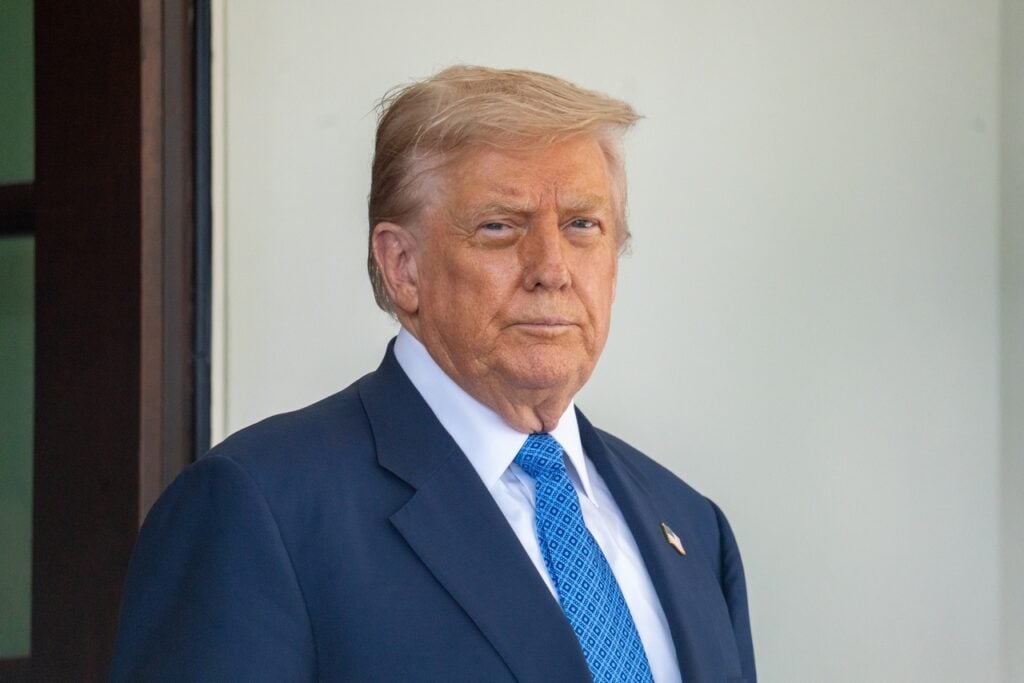
The Donald Trump administration is reportedly considering a new regulatory framework for exporting advanced artificial intelligence chips, potentially requiring foreign governments to invest in U.S. data centers. According to a report from Reuters published on Thursday, U.S. officials are deliberating on how to govern the export of advanced AI chips manufactured by companies such as Nvidia Corp and Advanced Micro Devices, Inc.
This proposed framework could mandate that countries seeking to import large quantities of chips—specifically those requesting shipments of 200,000 units or more—commit to investing in U.S.-based AI infrastructure or provide security guarantees at the government level. The discussions are ongoing, and the framework may evolve before any final decisions are made.
In a shift from the approach taken during the administration of Joe Biden, which largely exempted close U.S. allies from stringent export limits, the new rules could impose broader regulations. The draft indicates that even smaller installations involving fewer than 1,000 chips could require licenses. Exporters might also be tasked with monitoring chip utilization, while recipients may need to install software to prevent the chips from being integrated into larger computing “clusters.”
For foreign companies requesting up to 100,000 chips, there may be requirements for government-to-government assurances, while installations nearing 200,000 chips could be subject to inspections by U.S. export control officials. Saif Khan, a former national security official, noted that these rules could help the U.S. government prevent AI chips from being diverted to China, thereby facilitating a more secure development of powerful AI supercomputers. Despite this, he raised concerns that the proposed licensing requirements might be excessively broad.
The U.S. Commerce Department has acknowledged that discussions are taking place but aims to finalize rules that avoid the “burdensome” framework previously suggested. In a statement on X, the department emphasized its commitment to promoting secure exports of the American technology stack and referenced its successful export advances through historical agreements in the Middle East.
This potential regulatory shift comes amid growing concerns over national security and the implications of AI technology on a global scale. As companies like Nvidia and AMD lead the development of advanced AI chips, the stakes are high for both the U.S. and foreign nations seeking access to these crucial technologies. The evolving landscape of AI chip exports reflects the significant intersection of technology and international relations in the contemporary geopolitical environment.
As discussions continue, the implications of these proposed regulations could resonate beyond the tech industry, impacting international trade relations and the pace of AI development across the globe. The finalization of this framework will likely be closely monitored by industry stakeholders and foreign governments alike, as it has the potential to reshape the dynamics of AI technology deployment and investment.
See also Intel Expands AI-Native 6G Alliances, Enhancing Confidential Computing Strategy
 Synthetic Diamond Market Surges as AI Computing Drives $90 Billion Heat Dissipation Opportunity
 Legal AI Systems Risk Cross-Border Errors Due to Misleading Outputs, Warns TransLegal CEO
 AI-Powered Productivity Tools Launch to Automatically Manage Digital Distractions
 Credentials Boost Earnings by $79K for AI Professionals Amid Rapid Technological Change