






















































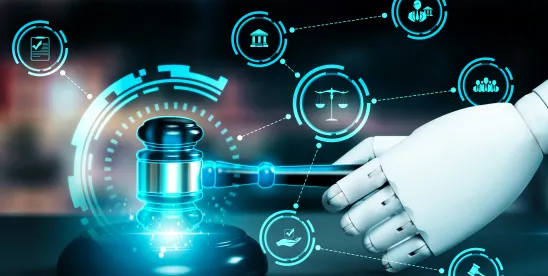
Generative AI tools, such as OpenAI’s ChatGPT, have rapidly transitioned from experimental novelty to essential components within various industries. As these systems become increasingly integrated into workflows, concerns surrounding their legal implications, particularly regarding copyright infringement, are growing. A pressing question emerges: if AI generates content that infringes on a third party’s exclusive rights, can the user who prompted the AI be held liable for copyright infringement?
As generative AI technology is still relatively new, the legal framework governing this issue is informed by traditional U.S. copyright law principles. While courts have not yet addressed this specific question, existing laws provide a foundation for assessing potential user liability. Under U.S. copyright law, the author of an original work retains exclusive rights, including reproduction, distribution, publication, and the creation of derivative works. Generative AI systems are typically trained on vast datasets, which often include copyrighted materials. If the use of such training data results in infringement of these exclusive rights—a topic currently under debate—users might indeed face liability due to their role in prompting the generation of infringing content.
Historically, direct copyright infringement cases involving automated systems have emphasized whether there is “some element of volition or causation.” In the case of Religious Technology Center v. Netcom On-Line Communication Services, the court concluded that an internet service provider, which automatically stored infringing material posted by users, did not violate copyright because its automated processes lacked the requisite volitional conduct. This principle was further reinforced by the Second Circuit in Cartoon Network LP v. CSC Holdings, which asserted that the individual who “presses the button” is responsible for volition, not the entity that owns or maintains the machine. Recent rulings across various circuits have echoed this sentiment.
While earlier cases concentrated on the volition within automated systems, the perspective can be shifted to assess the risks for end users. Unlike the simple act of pressing a “copy” button on a photocopier, the generative AI process yields novel outputs that may have unpredictable ties to the training data. The U.S. Copyright Office has likened an end user who prompts AI to an individual commissioning an artist rather than someone operating a mechanical reproduction device. This raises the question of whether users exert sufficient control over the AI-generated content to be liable for direct copyright infringement. However, if a user intentionally designs inputs to elicit content based on copyrighted material, copyright holders may argue that this user did supply the necessary volitional conduct.
The determination of whether adequate volition exists for direct infringement will be a significant consideration in copyright liability claims against users. Additionally, users might also encounter secondary copyright liability, either through contributory or vicarious infringement. However, several obstacles present challenges for these claims: First, establishing that the AI provider is a direct infringer is uncertain. Second, contributory infringement necessitates proof that the user knowingly induced or materially contributed to the infringing action, which is complicated by the user’s role as a recipient of outputs rather than a facilitator of the infringing conduct. Lastly, vicarious liability requires supervisory control and a direct financial interest in the infringement, which is difficult for users to demonstrate in relation to AI.
Beyond these issues, other copyright doctrines may preemptively dismiss claims before reaching questions of liability. Although copyright infringement is a strict liability tort, a plaintiff must still prove actual copying of the original work. Users might argue ignorance of the copyrighted training data, suggesting they could not have copied it. However, a user may still be liable if the AI’s outputs effectively derive from copyrighted materials. Additionally, the idea-expression distinction, which delineates between the underlying ideas and their expressive forms, complicates matters further—particularly in determining when AI output may infringe upon the expression of a copyrighted work.
Even if a user satisfies all elements of infringement, the potential for a fair use defense looms large. This doctrine allows for certain uses of copyrighted material that may otherwise infringe, depending on factors such as the purpose of the use and its effect on the market for the original work. The applicability of fair use to AI’s use of copyrighted training data is actively litigated, and whether users’ prompting and utilization of outputs could independently qualify for such a defense remains an open question.
Legal advisors for businesses leveraging generative AI should approach AI-generated outputs with the same scrutiny applied to any uncertain work product. This includes implementing review processes to evaluate outputs for potential similarities to existing copyrighted works prior to publication or commercial deployment, maintaining records of prompts and contextual information surrounding output generation, avoiding prompts that specifically reference known copyrighted works, and remaining vigilant about the terms of service from AI platforms, which often stipulate that users assume liability for copyright issues. As generative AI continues to evolve, the landscape of copyright litigation surrounding this technology is still in its infancy, suggesting that significant shifts could occur in the coming years. For now, caution remains prudent—users should avoid engaging with AI-generated outputs that may resemble copyrighted material without proper authorization.
See also Suno and Udio Settle $500M Lawsuits with Major Labels as AI Music Industry Evolves
 Stanford’s Iro Armeni Reveals Innovative Techniques in 3D Vision Models and Generative AI
 OpenAI Launches GPT-5.4 Mini and Nano for Free Users with 2x Speed Boost
 OpenAI Unveils GPT-5.4 Mini and Nano for Faster, Cost-Effective AI Workflows
 OpenAI Launches GPT-5.4 Mini and Nano Models for High-Volume AI Tasks at Lower Costs














