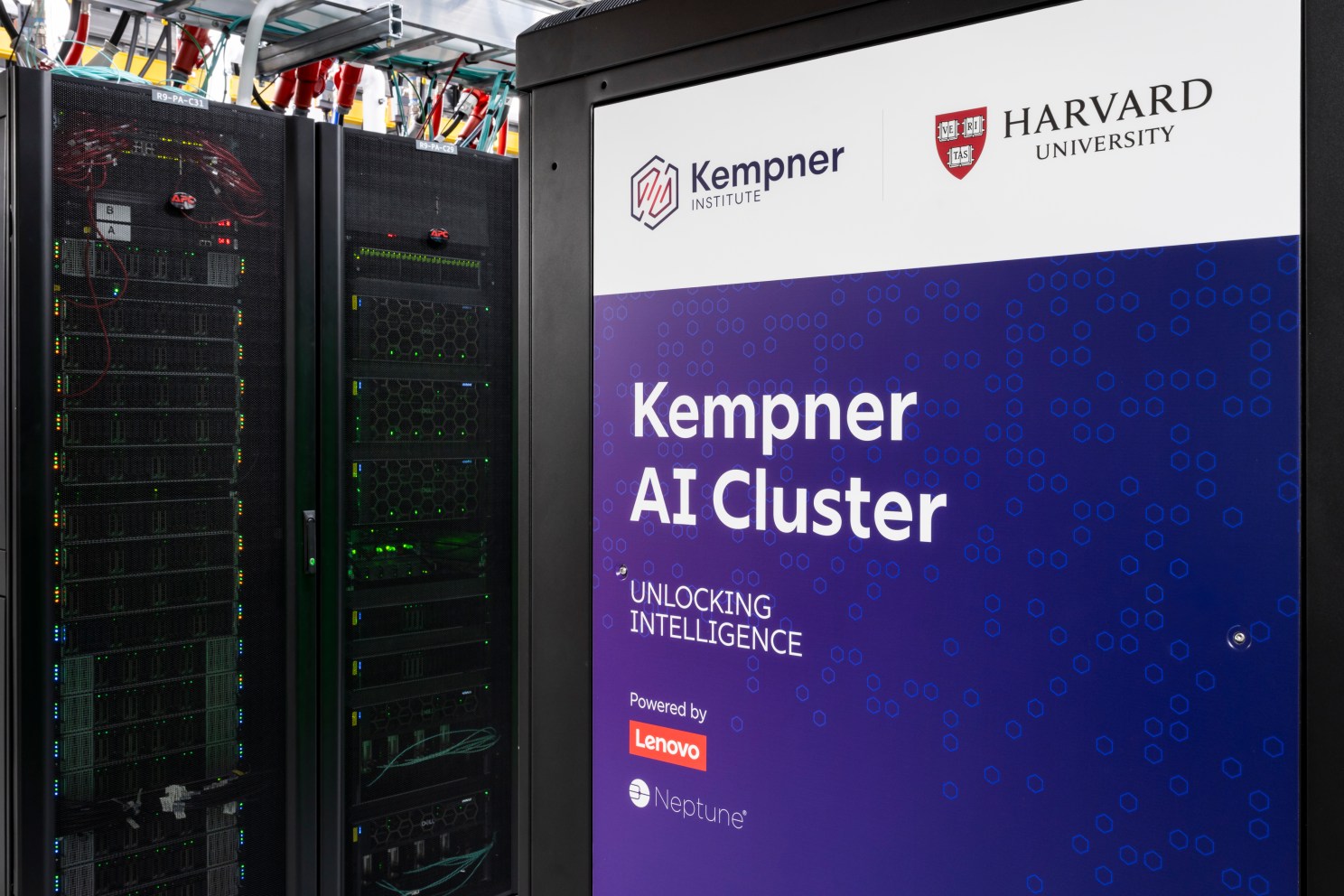
The Kempner Institute at Harvard University is set to significantly enhance its AI cluster, positioning it among the world’s fastest supercomputers. This expansion, which involves adding over 500 NVIDIA graphics processing units (GPUs), aims to bolster research capabilities in artificial intelligence and related fields.
Following the completion of the upgrade this spring, the renewed Kempner AI Cluster is anticipated to achieve performance metrics measured in exaFLOPS. This potent measure represents a quintillion mathematical operations per second, enabling the supercomputer to execute complex tasks in mere minutes—work that could take a standard personal computer several years to complete.
“There are very few academic institutions on the planet that offer this scale of compute to a research community of our size,” remarked Elise Porter, Executive Director of the Kempner Institute. “This expansion will allow for research in AI and natural intelligence at Harvard that would not otherwise be possible.”
The new configuration will feature 424 of NVIDIA’s H200 GPUs and 192 RTX PRO 6000 Blackwell GPUs, joining the existing 144 A100 and 384 H100 units. This brings the total number of GPUs in the cluster to 1,144, all interconnected in a specialized system designed to facilitate the training, testing, and refinement of large-scale AI models. Such advancements are expected to benefit a myriad of disciplines, including machine learning, neuroscience, robotics, and biomedical research.
This expansion underscores a growing trend in academia toward harnessing powerful computing resources to push the boundaries of research. As AI technologies continue to evolve, institutions like the Kempner Institute are increasingly investing in infrastructure that allows for more sophisticated experimentation and innovation. The ability to conduct high-volume calculations efficiently will likely yield significant insights across various fields, reinforcing Harvard’s status as a leader in AI research.
The investment in the Kempner AI Cluster reflects not only the demand for more computational power in research but also an acknowledgment of the critical role that AI will play in future scientific advancements. As researchers endeavor to tackle increasingly complex questions, resources like the enhanced AI cluster will be essential in developing solutions that could transform industries and improve lives.
See also Qualtrics Launches Synthetic Panels to Cut Research Time by 98% and Costs by 50%
 Study Reveals AI Validation Risks Undermining Financial Advisor Trust and Engagement
 Nvidia Reveals DLSS 5: A Game-Changer in AI Graphics with Enhanced Visual Fidelity
 New arXiv Paper Unveils God of Prompt, Boosting AI Accuracy by 25% for Businesses
 Virginia Tech’s Shehryar Khan Uses Machine Learning to Revolutionize Patent Novelty Evaluation