






















































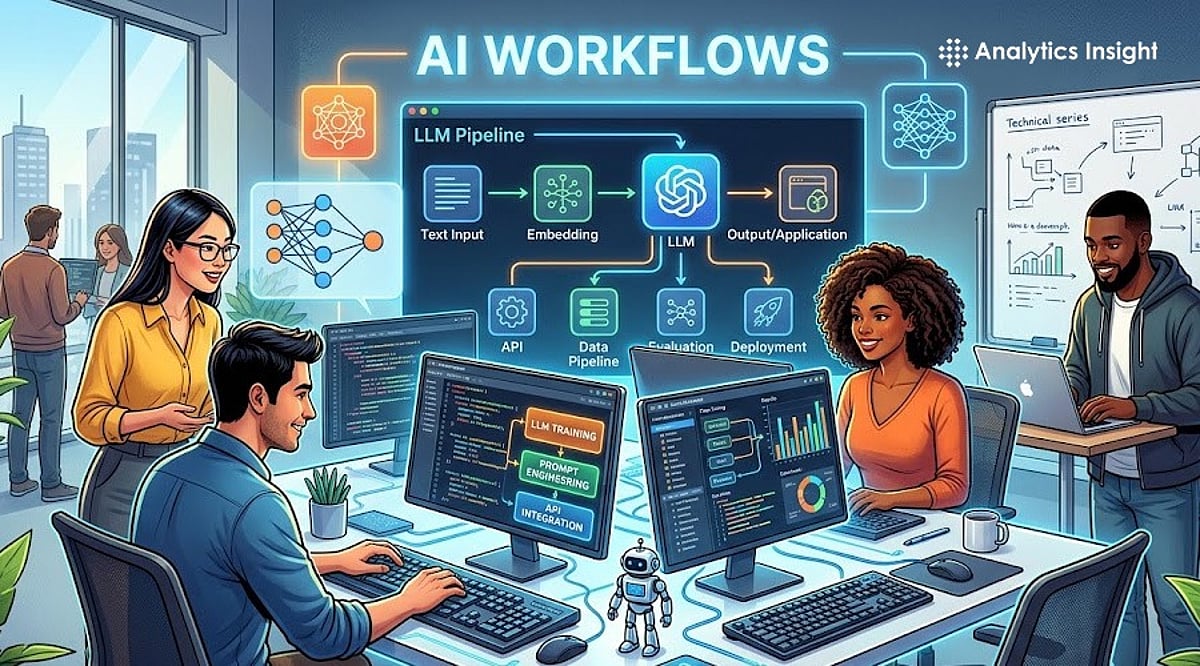
As companies increasingly adopt artificial intelligence (AI) technologies, the importance of large language model (LLM) workflows is becoming clear. These workflows encompass the practical application of these models in real-world scenarios, covering aspects such as prompt design, model chaining, API integration, and the development of complete AI applications. This shift from theoretical to practical use is particularly significant for the job market, with growing demand for professionals skilled in deploying LLMs effectively.
With an eye towards 2026, businesses are emphasizing the need for employees who can not only understand AI theory but also implement it seamlessly. Organizations are seeking professionals who can build, automate, and deploy AI solutions tailored to specific tasks. This reflects a broader trend in the tech industry as it moves toward more substantial applications of AI technologies, rather than solely relying on academic research.
To thrive in this evolving landscape, certain skills are becoming essential for those looking to master LLM workflows. Key competencies include prompt engineering, foundational knowledge of Python, and familiarity with API integration. Additionally, understanding tools like LangChain and vector databases is increasingly important. A grasp of how AI models behave is also crucial, providing context for their application in various tasks.
While a programming background can be advantageous, it is not a strict prerequisite to learn LLM workflows. Many accessible courses now offer insights into LLM concepts without requiring extensive coding expertise. However, possessing a basic understanding of Python can enhance one’s employability, offering a competitive edge in the job market where technical skills are highly sought after.
Numerous platforms are available for individuals eager to acquire knowledge in AI and its associated workflows. Learning can be pursued through popular platforms such as Coursera, Udemy, and edX, as well as specialized AI learning environments that focus on hands-on projects and practical use cases. These resources are becoming increasingly valuable as interest in AI continues to surge, prompting both new learners and seasoned professionals to seek skill development.
The evolution of LLM workflows is not merely a trend; it marks a significant shift in how organizations leverage technology to enhance productivity and innovation. As companies recognize the potential of AI to transform various sectors, the emphasis on practical applications of LLMs will likely intensify. This indicates a future where understanding and implementing AI solutions will be integral to a wide range of job roles across industries.
In summary, as the demand for AI capabilities grows, so too does the significance of mastering LLM workflows. Professionals equipped with the right skills to build and deploy AI applications will be crucial for companies looking to remain competitive in an increasingly AI-driven world. The continuing maturation of this technology suggests that the next few years will be pivotal for both the job market and the broader landscape of AI.
See also ByteDance Launches Seedance 2.0: A New AI Tool for Rapid Short-Form Video Creation
 Adobe Launches Firefly Custom Models for Personalized AI Image Generation
 Only 28% of Companies Implement AI Governance, Risking Compliance and Trust in CX
 AI Firms Drive Manhattan Office Leasing to 42.9 Million Square Feet, Highest in 10 Years















