
BIRMINGHAM – The integration of artificial intelligence (AI) agents into marketing is transforming how businesses structure their marketing departments, execute campaigns, and align strategies with lead generation. Over the past two years, AI has emerged as a focal point in business discussions, particularly following the mainstream adoption of generative AI tools like ChatGPT, Claude, Gemini, and Copilot.
While many organizations have begun using these AI tools, the most significant transformation lies not in the tools themselves, but in the restructuring of marketing operations within firms. The evolution is fundamentally structural.
AI is redefining the operations of marketing departments, altering how campaigns are created and how work flows across an organization. The marketing teams established five or even ten years ago were designed for a slower digital landscape, where campaign execution stretched over weeks, teams operated in silos, and performance reporting occurred post-launch. This model is rapidly becoming obsolete.
The emergence of AI agents in marketing compels companies to rethink their marketing function and to implement digital workflows that replace outdated, manual processes. Traditional marketing departments, organized around specific channels such as search engine optimization, social media, and content marketing, often worked in isolation, with tasks handed off in a linear manner. This workflow—comprising idea development, content creation, SEO optimization, publishing, and reporting—made sense in a slower-paced environment but has failed to keep pace with today’s fast-evolving digital expectations.
As consumers become more agile and competitors react more swiftly, the need for AI-driven systems to condense lengthy campaign cycles into more adaptive workflows is crucial. This evolution is why AI agents in marketing carry such significance; they do more than expedite tasks—they enable a broader shift from channel-based teams to workflow-based systems that enhance efficiency.
Currently, most businesses find themselves in the intermediate stage of AI adoption. They have started utilizing AI tools, with teams leveraging ChatGPT for writing assistance or employing automation platforms to streamline communication. While these steps are beneficial, they do not equate to a genuine metamorphosis of the marketing function.
Many organizations adopt AI tools without fundamentally redesigning their workflows, leading to quicker task completion but not necessarily improving the overall effectiveness of their marketing operations. Thus, the distinction between merely using tools and enacting organizational change becomes critical. Employees may generate ideas or draft content more rapidly, yet the department may still be mired in antiquated practices characterized by slow handoffs and disjointed systems.
Understanding the difference between AI tools and AI agents is essential for this transformation. AI tools perform specific tasks—such as writing, summarizing, or analyzing—generally operating on a one-prompt basis. In contrast, AI agents facilitate workflows, performing specialized roles within a broader digital process and seamlessly passing outputs to the next stage. Practical applications of AI agents in marketing range from market research to content generation, SEO optimization, visitor behavior analysis, and performance monitoring, each contributing to a cohesive process in a way that standalone tools cannot.
As companies adopt AI agents in marketing, the focus shifts from siloed teams to coordinated digital workflows. For instance, an AI agent could track industry trends, while another generates relevant content, a third optimizes that content for search engines, and a fourth monitors visitor interactions on a website. A final agent then aggregates performance metrics for quick analysis. This continuity promotes efficient information flow and allows for quicker adjustments to campaigns, freeing human marketers to concentrate on higher-value tasks such as positioning, storytelling, and strategic alignment.
One notable example from the manufacturing sector illustrates this shift. Consider a manufacturing firm aiming to attract customers interested in robotic palletizing systems. An initial AI agent could identify rising interest in this area, followed by another that drafts a blog post explaining its benefits. Subsequent agents might develop marketing materials and optimize the content for visibility. Once potential buyers engage, another agent analyzes their behavior to personalize calls to action. This cohesive, interconnected process, supported by AI agents in marketing, dramatically reduces turnaround times that previously spanned weeks.
The most significant error companies make is assuming that merely utilizing AI tools equates to modernizing their marketing efforts. Many organizations engage with AI superficially, using tools like ChatGPT for expedited research or writing while still relying on outdated workflows that hinder effective decision-making. Without structural changes, the benefits of AI often remain limited to individual productivity rather than enhancing overall departmental effectiveness.
Business leaders need not undertake a complete overhaul immediately but should take actionable steps. First, they should audit their existing marketing workflows to pinpoint slow or disjointed processes. Next, connecting marketing systems more effectively is paramount, as many firms struggle with fragmented tools and dashboards. Lastly, training marketing teams to utilize digital workflows will empower them to prioritize strategy and creativity while AI manages repetitive tasks.
Those organizations that proactively adapt to these changes will be better positioned as AI technology continues to advance. The future of marketing is not solely defined by access to innovative tools; it will be shaped by insights into constructing improved digital workflows. The integration of AI agents in marketing signifies a critical evolution, moving businesses away from sluggish, manual operations toward agile, cohesive systems capable of thriving in an increasingly competitive landscape.
See also Google’s AI Update Transforms SEO: Key Strategies for Professionals to Adapt Now
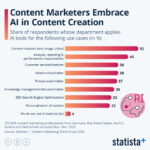 AI Tools Now Used by 52% of B2B Marketers for Content Creation and Analytics, Says Statista Study
 HelloFresh Launches AI-Driven Kochbox with 100% Recyclable Packaging and 12% Emission Reduction