Nvidia’s latest AI feature, DLSS 5, has sparked significant controversy among gamers, who largely regard it as a misstep in enhancing video game graphics. Announced on Monday, the new version employs generative AI to supposedly enrich visuals, but early reactions indicate that it may be falling short of expectations.
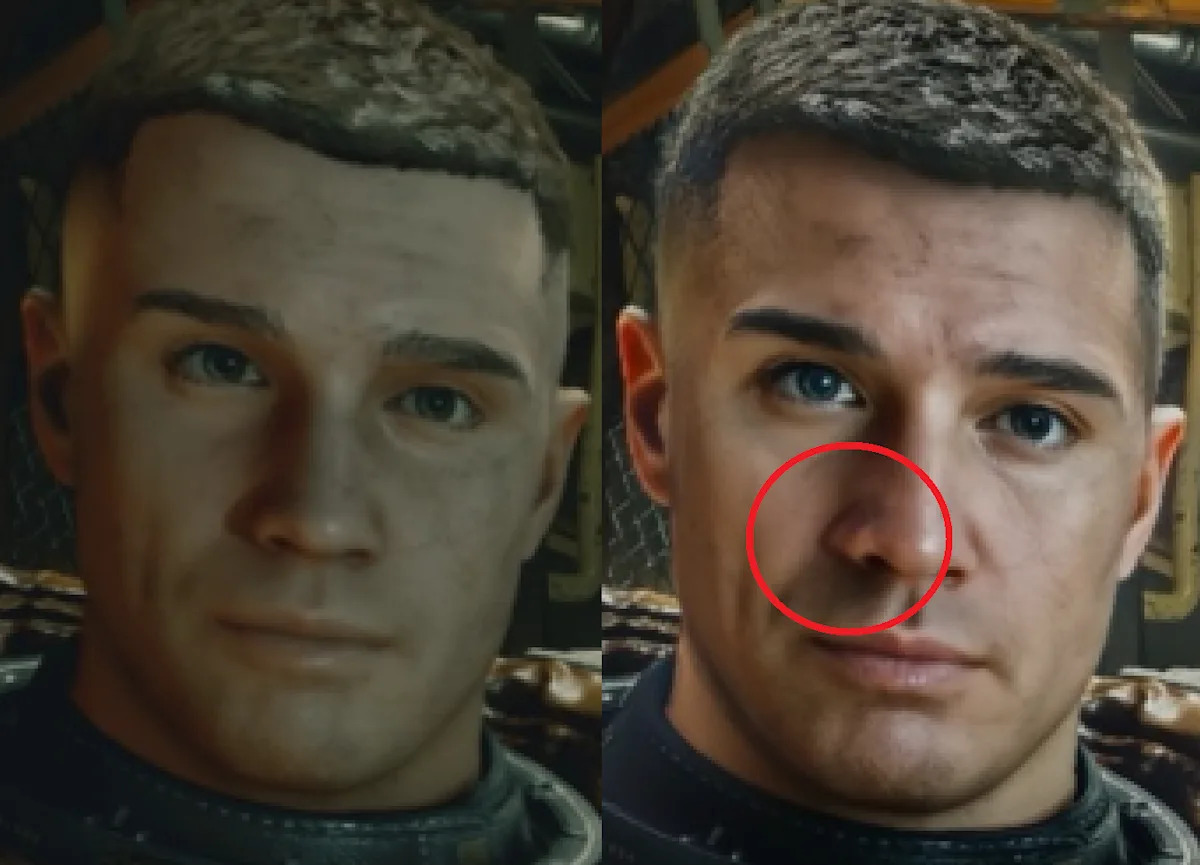
Critics have pointed to a particularly egregious visual error showcased in Nvidia’s promotional material. A screenshot from the game “Starfield” exhibited a character with an exaggerated facial feature—a “giga-nostril”—that many have found comically unappealing. The image, which has been shared widely on social media platforms, raises questions about the effectiveness of DLSS 5, especially since Nvidia itself chose to highlight it during the announcement.
Responses from the gaming community have been sharp. One user quipped, “That’s a nostril big enough to inhale the required amount of copium to believe that DLSS 5 will be useful,” while another joked about the AI’s failure to accurately represent the character’s features. Observers noted additional discrepancies, including mismatched eye colors, further fueling the skepticism.
The criticism stems not only from specific visual blunders but also from broader concerns about the implications of using AI in graphic enhancement. Previous iterations of DLSS technology focused on upscaling lower-resolution graphics to improve frame rates while maintaining image quality. In contrast, DLSS 5 applies a generative AI model, which many argue detracts from the original artistic vision of the games.
Nvidia’s CEO, Jensen Huang, defended the technology, asserting that the criticism misrepresents the capabilities of DLSS 5. He emphasized that developers retain “direct control” over graphical elements, and the new technology is not merely a filter but a more sophisticated process. Huang described DLSS 5 as a fusion of controllability in geometry and textures with generative AI, arguing that it operates at a deeper level than past technologies.
However, an email exchange revealed by YouTuber Daniel Owen complicates Nvidia’s claims. According to Jacob Freeman, an Nvidia representative, DLSS 5 essentially functions as a filter that takes 2D frames plus motion vectors as input. This admission suggests that the technology may not fully engage with the 3D complexities of a game’s environment, instead working with two-dimensional screenshots in real-time.
The backlash reflects a deeper unease within the gaming community about the role of AI in creative processes. Many gamers are concerned that applying generative AI could dilute the unique artistic styles that developers aim to achieve. Nvidia’s marketing focuses on the promise of enhanced realism, citing improved lighting and material details, but critics argue that the trade-off is a loss of artistic integrity.
As the debate continues, it’s evident that the gaming industry stands at a crossroads, balancing innovation with the preservation of creative expression. The future of AI-enhanced graphics will likely depend on how developers and companies like Nvidia navigate the fine line between technological advancement and the authentic experiences that gamers seek.
See also Mistral CEO Proposes 1-1.5% AI Levy to Fund European Cultural Industries
 Perplexity AI CEO Aravind Srinivas: Google Search Outperforms Competitors, Including Comet
 Jury Finds Elon Musk Liable in Twitter Fraud Case; Damages Could Reach $2.6 Billion
 Mistral Proposes Revenue-Based Levy for AI Training Copyright in Europe
 Google DeepMind Appoints Jasjeet Sekhon as Chief Strategy Officer Amid AI Competition