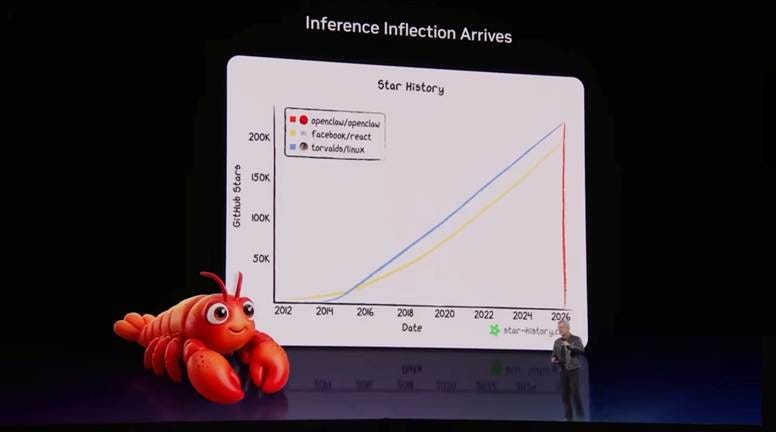
Nvidia made significant waves in the AI sector during its GTC 2026 conference, where CEO Jensen Huang emphasized the groundbreaking potential of its new product, OpenClaw, dubbed “the next ChatGPT.” This initiative aims to revolutionize agentic AI, enabling more autonomous and scalable AI systems. Complementing OpenClaw, Nvidia introduced NemoClaw, designed to facilitate seamless deployment with built-in privacy and security features, ensuring that these AI agents are both trustworthy and efficient.
Among the highlights of the conference was the unveiling of the Vera Rubin platform, now in full production for large AI factories. This platform integrates new GPU, CPU, networking, and storage components, significantly boosting performance for high-demand AI workloads. Notably, Nvidia’s Vera CPU promises twice the efficiency and 50% faster performance than traditional rack-scale CPUs, enhancing the infrastructure to support the needs of agentic AI.
Another major announcement was the launch of Dynamo 1.0, an open-source inference operating system designed for AI factories. It supports multiple frameworks, including LangChain and vLLM, reportedly increasing Blackwell inference performance by up to seven times and achieving compatibility with major cloud service providers.
Nvidia also expanded its Nemotron model lineup, introducing models tailored for agentic, physical, and healthcare AI applications. The new Nemotron 3 Ultra, Omni, and VoiceChat models are specifically developed to facilitate natural conversations, complex reasoning, and visual understanding, further positioning Nvidia at the forefront of specialized AI agents.
In the realm of competitive innovation, MiniMax unveiled its proprietary AI model, M2.7, optimized for agentic tasks and AI code. With exceptional scores in various benchmarks, M2.7 showcases the capability to autonomously handle up to 50% of its development, utilizing a feature termed “Self-Evolution.” This model represents a leap forward, effectively managing complex tasks through advanced reinforcement learning techniques.
In parallel, OpenAI introduced smaller variants of its GPT-5.4 model—mini and nano versions—optimized for speed and cost-efficiency in agentic workflows. Maintaining impressive performance metrics, such as a SWE-bench Pro score of 54.4%, these models are designed to manage high-token tasks in autonomous environments, thus making them economically viable for widespread use.
Mistral AI also made strides with the launch of Mistral Small 4, an open-weights model that integrates reasoning and multi-modal capabilities, positioning itself alongside top-tier models like OpenAI’s GPT-OSS-120B. This model emphasizes efficiency and versatility in coding and reasoning tasks, reflecting the ongoing arms race in AI model capabilities.
Google’s Stitch product underwent significant enhancements, incorporating “vibe design” features that allow for an AI-native software design canvas. This update includes a new infinite canvas for high-fidelity UI work and a design agent capable of reasoning across project history. Integrated with Google AI Studio, these advancements aim to streamline the transition from design prototypes to fully functional applications.
Midjourney launched its V8 model, which delivers high-definition image generation at rapid speeds. Although initial reviews highlight issues with anatomical coherence, the model’s ability to process complex prompts positions it as a notable player in the image generation market.
In a noteworthy development, Amazon CEO Andy Jassy projected that AI could double AWS’s annual revenue to $600 billion within the next decade, marking a new growth phase for hyperscale cloud computing. This perspective aligns with broader trends in the industry, as companies increasingly invest in AI infrastructure.
Meanwhile, the Trump White House released a National AI Legislative Framework, advocating for a unified federal standard to avoid a patchwork of state-level regulations. This framework aims to address various ethical and operational challenges posed by AI and has received mixed reactions, particularly from states concerned about federal overreach.
As Nvidia continues to redefine the AI landscape under Huang’s leadership, the company’s forward-looking statements predict $1 trillion in GPU sales by 2027, driven by an increasing demand for AI infrastructure. Huang’s vision suggests that the future will see every software company become agentic, emphasizing the need for a robust strategy centered around OpenClaw. His assertions underscore a pivotal transition towards a new platform shift within the industry.
See also Perplexity AI Launches Health Feature, Analyzing Personal Medical Data for Custom Advice
 Stability AI Launches Stable Virtual Camera to Transform 32 2D Images into 3D Videos
 Mark Zuckerberg Develops AI Agent to Enhance Meta’s Efficiency Amid Layoff Speculations
 NVIDIA CEO Reveals $1T Demand for Agentic AI, Introduces OpenClaw Strategy Through 2027