






















































Researchers at the Japan Advanced Institute of Science and Technology (JAIST) and Waseda University have unveiled a groundbreaking framework called the Memory-aware Multi-Conditional generation Network (MMCN), designed to forecast future urban layouts. This novel generative AI model aims to address the complexities inherent in urban planning, integrating factors like building density, height, transportation networks, and historical development patterns. The study detailing this framework was published online on March 2, 2026, and is set to appear in the forthcoming volume of the journal Sustainable Cities and Society on May 1, 2026.
Urbanization presents pressing challenges, particularly regarding environmental sustainability, as cities grow at unprecedented rates. The intricacies of urban design require careful consideration of infrastructure, building development, and land use—elements that shape a city’s future. Traditional urban planning methodologies often struggle to capture these interconnected dynamics, leading to fragmented and inaccurate predictions of urban development.
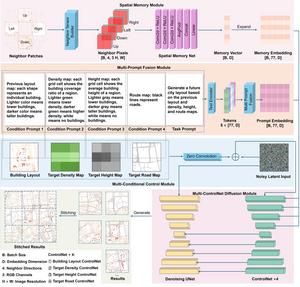
In response, the MMCN framework leverages a generative architecture-enhanced diffusion model, which employs multi-conditional control, semantic prompt fusion, and spatial memory embedding. This integration allows the model to produce coherent urban layouts while maintaining continuity across adjacent areas. The research team, led by Associate Professor Haoran Xie, includes doctoral student Xusheng Du from JAIST and Professor Zhen Xu from Tianjin University, China.
Dr. Xie stated, “We aimed to bridge the gap between current AI capabilities and the practical needs of urban planners by developing a predictive model capable of forecasting future urban layouts.” The MMCN model is trained on multi-temporal spatial data, standardizing building layouts, density, height, and transportation networks into 512 × 512-pixel patches. The team selected urban layout data from Shenzhen, one of the fastest-growing cities in China, to train the model effectively.
The MMCN architecture combines a diffusion model with a multi-conditional control mechanism, guiding the generation process with diverse urban factors. A semantic prompt fusion module encodes various input types, while a spatial memory embedding component preserves contextual information from neighboring regions. This structure enables the model to generate realistic urban layouts that remain consistent with historical patterns. The training process employs denoising and edge-stitching loss functions to enhance both reconstruction accuracy and the smoothness of transitions across patch boundaries.
Experimental results validate the framework’s efficacy, with the MMCN model outperforming baseline methods such as Pix2Pix and CycleGAN. It achieved a Structural Similarity Index (SSIM) of 0.885 and a Boundary Intersection over Union (IoU) of 0.642, indicating strong structural fidelity and spatial continuity in the generated layouts. Qualitative assessments revealed that MMCN produces coherent urban designs with continuous road networks and organized building clusters, contrasting with the fragmented outputs typical of other models.
Beyond technical performance, the MMCN framework offers practical tools for urban planners. By simulating potential growth scenarios, it aids in assessing the long-term implications of various development strategies, supporting sustainable decision-making aligned with the Sustainable Development Goals focused on resilient, inclusive city planning.
Looking ahead, the researchers plan to enhance the MMCN framework by integrating climate models to evaluate environmental impacts and incorporating socio-economic data for more comprehensive forecasts. Dr. Xie noted, “Interactive planning tools built on MMCN could facilitate community and stakeholder engagement in urban design.” Expanding the dataset to include diverse cities would also improve the model’s applicability across different urban contexts.
In conclusion, the Memory-aware Multi-Conditional generation Network represents a significant advancement in AI-assisted urban design. By integrating multiple spatial factors and historical patterns, it provides a robust tool for forecasting urban development, guiding cities toward more resilient and sustainable futures in an increasingly urbanized world.
Authors of the study include Xusheng Du, Chengyuan Li, Qingpeng Li, Yuxin Lu, Yimeng Xu, Ye Zhang, Zhen Xu, and Haoran Xie. The work received support from various grants, highlighting a collaborative effort between Japanese and Chinese institutions to advance urban planning through AI.
See also Luma AI Launches Uni-1, a Strong Contender to Google’s Nano Banana Image Model
 IIT Mandi Hosts HIVE 3.0 Conclave on Multimodal AI with 500+ Global Participants
 Idomoo Launches Strata: First AI Model for Editable Layered Video Production
 Tonic Textual Reveals LLM-Based Annotation Workflow Achieving 0.70 F1 with Minimal Human Input
 AI Companies Face $1.5B Settlement as Copyright Laws Evolve Globally by 2026






