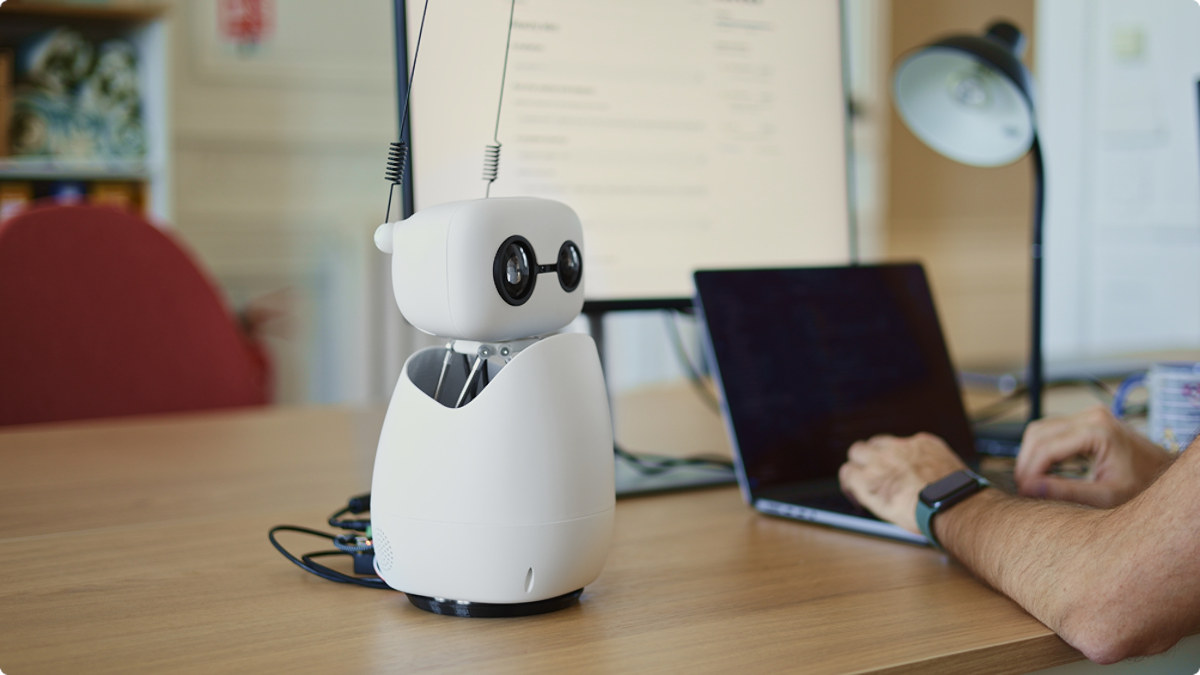
Hugging Face, a company renowned for its advancements in artificial intelligence software, has introduced the Reachy Mini, an open-source desktop robot. Unveiled last year, this innovative device aims to facilitate AI applications that interact with the physical world.
The Reachy Mini is equipped with a camera, four microphones, and a speaker, providing it with the capability to engage in voice interactions and perform tasks with its 6 Degrees of Freedom (DoF) head. It can rotate its body and even wave its antennas, all thanks to the integration of nine servo motors. Two distinct models are available: the Reachy Mini Lite, which is compatible with computers running Mac, Linux, and Windows, and the Reachy Mini Wireless, an autonomous version powered by a Raspberry Pi CM4, offering enhanced connectivity features such as WiFi and Bluetooth, alongside an accelerometer and battery support.
Beneath the surface, both models share a robust set of specifications. The Reachy Mini Lite is designed to operate without an internal computer, while the Wireless version incorporates a Raspberry Pi CM4. The Lite model is limited in connectivity, lacking WiFi, and runs solely on a wired power supply. In contrast, the Wireless version not only supports wired power but also battery operation, making it more versatile for mobile applications. Both versions include four microphones, a speaker, and a wide-angle camera, enabling them to serve as effective communication and vision tools. However, only the Wireless model features an accelerometer, enhancing its ability to detect movement and orientation. Both models stand at 28 x 16 cm in dimensions and weigh approximately 1.5 kg, with the Wireless version being slightly heavier due to additional components.
The Reachy Mini’s software development kit (SDK) is accessible via GitHub, primarily based on Python while also supporting JavaScript and web applications. This flexibility allows developers to easily integrate the robot with large language models (LLMs), facilitating the creation of various applications. Among these are a Conversation App designed for natural dialogue with the robot, a Radio App, and a Hand Tracker App that follows hand movements in real-time. For those without the hardware, a simulator using the MuJoCo engine is available, ensuring that interested developers can experiment with the robot’s capabilities virtually. Comprehensive documentation for the Reachy Mini can be found on the Hugging Face website.
Despite its capabilities, the Reachy Mini lacks legs or wheels, remaining stationary on a desktop surface. Its design focuses on the movement of its body, head, and antennas. The robot’s camera enables it to perform computer vision tasks, while its audio components allow for voice interactions—integrally powered by LLMs that facilitate text-to-speech and voice recognition functionalities.
Originally available for pre-order at $299 for the Reachy Mini Lite and $449 for the Reachy Mini Wireless, these models are still offered at these prices on the official website. They have also made their way onto AliExpress, where the Lite version is available for $388.84, while the Wireless model with the Raspberry Pi 4 retails for $699.
As the market for AI-integrated robotics continues to evolve, the Reachy Mini represents a significant step forward in desktop robotics, enabling developers and enthusiasts alike to explore the practical applications of AI in real-world scenarios. With its combination of hardware versatility and software accessibility, the Reachy Mini could catalyze further innovations in the field.
See also Mistral CEO Proposes AI Cultural Levy to Fund European Creative Sectors
 Microsoft’s $13B Stake in OpenAI Now Poses Significant Risk Amid IPO Talks
 Wedbush Predicts 2026 as AI’s Inflection Year; CrowdStrike Emerges as Key Investment
 Midjourney 8 Launches with 5x Speed Boost but Faces Artistic Flexibility Critiques
 Anthropic Seeks Court Order to Halt Pentagon’s Supply Chain Risk Designation