






















































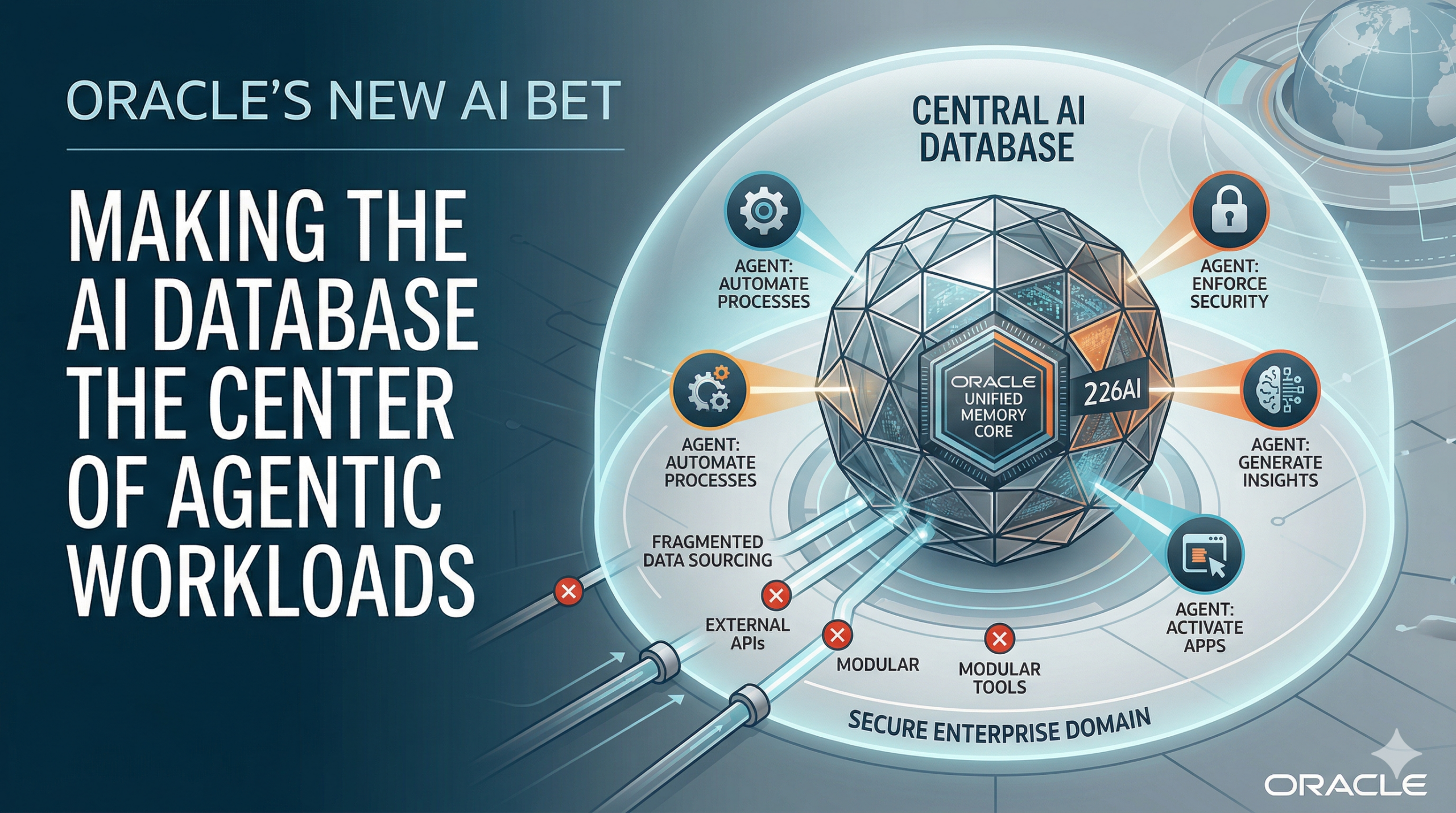
Oracle Corp. is redefining its strategy in the enterprise artificial intelligence space, positioning its database as a crucial element in the development of agentic AI systems. During the Oracle AI World Tour in London, the company showcased a shift away from traditional AI model competition, asserting that the future of AI hinges on the way AI agents interact with data, rather than solely on the capabilities of the agents themselves.
Historically, Oracle has thrived by controlling the system of record, and the company is now evolving the database from a mere back-end infrastructure to a foundational element for enterprise intelligence. Oracle argues that the key bottleneck in enterprise AI is not the sophistication of models, but rather the integration and management of data. While many organizations are experimenting with large language models, they are encountering significant challenges in scaling their AI initiatives, primarily due to difficulties in grounding AI outputs in real-time, governed enterprise data.
The fragmented nature of corporate data environments complicates matters further, with information often scattered across various systems, data lakes, and analytics platforms. This fragmentation can escalate operational liabilities when AI agents, designed to act autonomously, are layered on top of these disparate systems. Oracle’s solution aims to eliminate these complications by embedding agentic AI capabilities directly into its database architecture, which seeks to streamline the increasingly complex technology stack.
By proposing a converged data engine, Oracle plans to unify different types of data—transactional, embeddings, graph relationships, and more—into a single architecture that operates in real-time. Central to this vision is a unified memory layer that would allow AI agents to work directly with live enterprise data, thereby reducing latency and minimizing inconsistencies that arise from maintaining multiple copies of the same information.
Additionally, Oracle is introducing an internalized model for agent development, which is intended to bring the creation and execution of AI agents within the enterprise’s controlled environment. This approach contrasts with much of the current innovation in AI, which is happening in external ecosystems where flexibility often compromises security and control. As enterprises look for reliability rather than experimental solutions, Oracle’s focus on governance positions its offerings as more suitable for production-scale applications.
Oracle is extending its reputation for security into this new paradigm. Traditionally, access controls in corporate systems are enforced at the application level. Now, Oracle is shifting these controls down into the database, applying policy measures at the row, column, and cell levels, which are linked to user and agent identities. This change could provide a significant advantage for organizations that require rigorous security measures as they scale their AI workloads.
The overarching strategy of reducing AI data fragmentation highlights a notable trend within the industry. While the current AI landscape is characterized by specialization—with numerous vendors providing solutions for each layer of the stack—this has led to increased operational complexity. As businesses advance beyond pilot programs, the challenge becomes integrating these specialized systems without incurring additional latency and cost. Oracle posits that simplicity will be more advantageous than modularity for large enterprises seeking effective agentic AI solutions.
However, Oracle’s tightly integrated model must contend with a fast-evolving landscape dominated by specialized tools. Developers, who have driven much of the momentum in AI, may resist adopting more opinionated platforms. Furthermore, many enterprises are already deeply entrenched with major cloud providers, raising questions about how Oracle’s approach aligns with their existing investments. Oracle counters this by ensuring that its agentic AI capabilities can operate across major cloud environments, including Amazon Web Services, Microsoft Azure, and Google Cloud. This flexibility allows enterprises to deploy AI where their data resides, minimizing disruption and optimizing existing data frameworks.
The industry appears to be diverging into two philosophical camps: one favoring composability with loosely coupled systems, and the other, represented by Oracle, advocating for convergence through tightly integrated platforms. Each approach has its merits, and the ultimate success may hinge more on practical execution rather than ideology. As businesses shift from prototype to production, the focus is less on generating content and more on managing data effectively to ensure accuracy, consistency, and security at scale. In this context, the infrastructure layer is regaining its importance.
Oracle’s strategy places the database at the forefront of agentic AI, suggesting that the systems underpinning these technologies will influence their effectiveness in driving business processes. As AI agents become integral to core operations, the way organizations manage their data and govern agent actions will become increasingly crucial to their success.
See also AI Reduces Healthcare Burnout by 23.5% with Ambient Documentation Tools
 AI Concierge Systems Transform Investment Research Amid Growing Market Complexity
 Everpure Launches Evergreen//One and Data Stream Beta Amid 19.82% Share Drop
 Google Partners with Kroger to Enhance Retail Media Targeting on YouTubeVanguard’s Anant Somvanshi Advances Trusted AI Governance Framework for Financial Institutions















