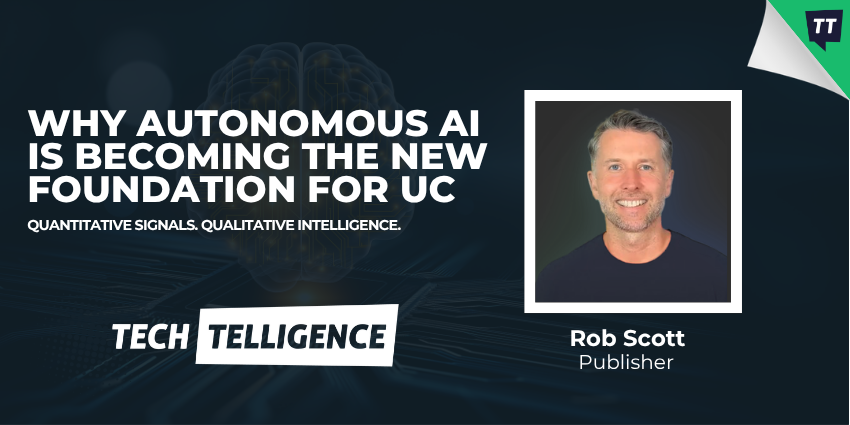
The landscape of artificial intelligence in unified communications (UC) is evolving rapidly, moving beyond traditional assistant roles toward more advanced architectures. Recent tracking by Techtelligence indicates a marked shift in enterprise interest toward UC Multi-Agent Systems, Autonomous AI, and agentic architectures capable of executing tasks with minimal user prompts. This transformation is underscored by a significant surge in research activity, with interest in agentic AI reportedly tripling over the past 90 days. As a result, the combined buyer intent in these areas has now surpassed that of other enterprise technology themes.
This shift in focus is critical as it informs vendor strategies and market positioning. When buyers hone in on a select group of emerging architectures, those vendors who manage to establish visibility during this phase often secure early mindshare. Rob Scott, Publisher of Techtelligence, emphasizes the market implications of this trend: “When a research signal grows this quickly, it becomes a market filter. Buyers start forming preferences early, and visibility during that phase has real commercial consequences.”
In this evolving context, the function of AI in UC is undergoing a notable transformation. While traditional copilots have been praised for their ability to summarize meetings and streamline communications, the new emphasis is on what happens after those initial insights are generated. Businesses are now looking for systems that can carry operations forward seamlessly across various systems and teams. This shift suggests a movement from merely enhancing productivity to facilitating operational execution.
Scott articulates this transition, noting, “Copilots improved work inside the moment. The new demand is for systems that can carry work forward responsibly, especially when coordination spans multiple tools.” This evolution implies that discussions around AI in UC are no longer limited to features, but are expanding into considerations about architecture, including how systems initiate actions, maintain context across different channels, and ensure accountability in automated processes.
Multi-Agent Systems as a Priority
The introduction of multi-agent systems represents a significant change in design philosophy. Rather than relying on a single AI to handle tasks, enterprises are beginning to adopt architectures composed of multiple specialized agents that collaborate to execute workflows efficiently. This approach not only enhances scalability but also necessitates new requirements for UC platforms themselves. As multiple agents work in concert, the platforms must effectively manage decision-making processes and actions, while also providing transparency for post-action evaluations.
Scott notes, “Multi-agent systems force discipline. They bring governance questions to the front because you have more coordination, more action, and more responsibility.” Within enterprise environments, this translates to clearer operational boundaries, stronger permissions, and audit-ready records of system behavior. The implications of adopting these systems are substantial, as they require a rethinking of governance structures and accountability in automated actions.
As organizations explore the potential of agentic AI, they face the challenge of distinguishing meaningful capabilities from market hype. Evaluating agentic systems solely on their performance as copilots can lead to misleading conclusions. The reality of production environments demands reliability and predictability, prompting buyers to focus on governance readiness. This includes the ability to oversee agent actions, monitor behaviors over time, audit actions, and intervene quickly in response to changing contexts.
Scott summarizes this pivotal moment in the industry: “A useful test is whether governance is explained clearly. If oversight and auditability are vague, the risk only becomes clear once deployment starts.” As research interest in agentic AI continues to accelerate, the competitive landscape for vendors becomes increasingly defined by their ability to establish thought leadership. Those who can provide early guidance and credible information are likely to shape buyers’ frameworks in their favor.
Techtelligence’s findings indicate that the market is poised for a significant transformation, with a decisive shift from copilots to more complex systems designed for enhanced coordination and action. As buyer intent converges on agentic, autonomous, and multi-agent themes, unified communications platforms that can deliver robust control mechanisms, human oversight, and clear audit trails will likely gain a competitive edge. This evolution reinforces the importance of discerning durable signals from transient trends, guiding enterprises toward making informed investments in their technological futures.
See also Nvidia, Digital Realty, Credo Technology Set to Benefit from $700 Billion AI Capex Surge
 OpenAI Secures $122 Billion Funding, Achieves $852 Billion Valuation Amid AI Costs Surge
 Meta Unveils KernelEvolve, Boosting AI Model Throughput by 60% with Automated Optimization
 Google Reveals TurboQuant Memory-Compression Breakthrough for AI Inference Performance
 Brands Risk Reputation with Common AI Training Pitfalls, Warns Harvard Study