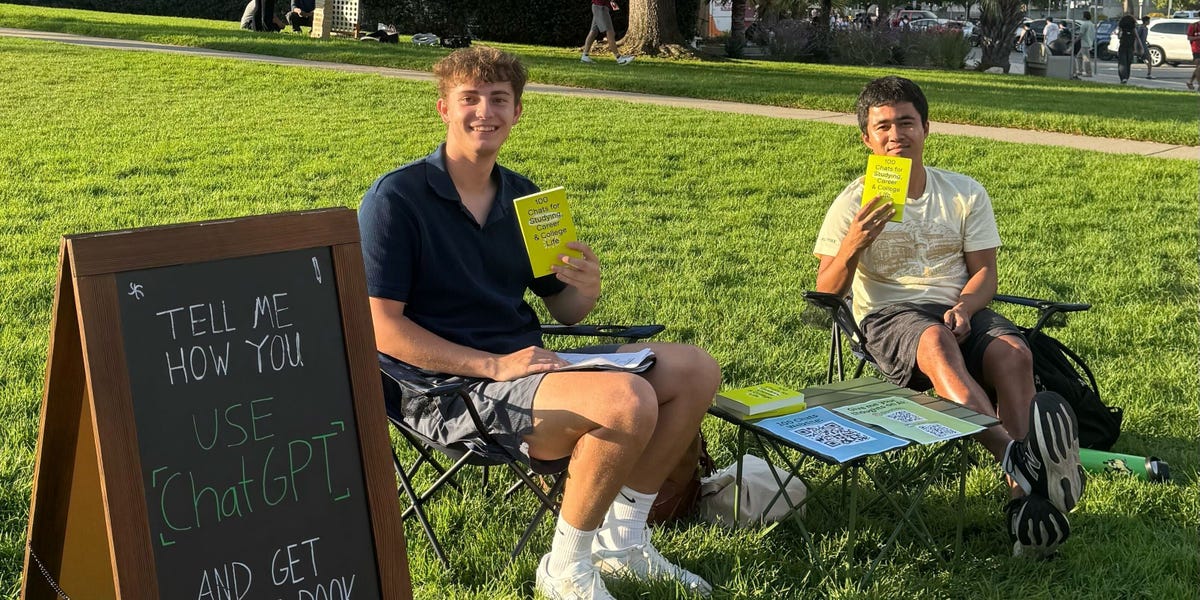
Parker Jones, a software engineering student at Cal Poly, has unintentionally positioned himself as a challenger to traditional educational norms. After conducting interviews with over 50 peers, he discovered that students are adapting to AI tools like ChatGPT more rapidly than faculty can keep pace with educational developments.
Jones’s findings contrast sharply with prevalent narratives surrounding AI in academia, which often focus on cheating and misuse. He found that most students utilize AI to enhance their learning experience—serving as a “24/7 office hours” assistant. They rely on these tools to clarify confusing concepts, organize assignments, and refine their thought processes. This usage leans towards enhancing learning rather than circumventing it, a conclusion he shared in a recent post on OpenAI’s ChatGPT for Education blog.
Despite the widespread adoption of these tools, many professors remain hesitant or skeptical, Jones notes. “The most common thing is not addressing it,” he stated in a recent interview. When AI does come up in discussions, it is often framed in a negative light, fostering a disconnect between students and faculty. Consequently, students find themselves relying heavily on tools they feel uncomfortable discussing with their instructors.
Jones argues that institutional inertia, rather than AI misuse, is the primary problem. He expressed disappointment that computer science educators, who he expected to embrace these technologies, appear to be lagging behind. Many professors seem to be waiting for clearer guidelines or more comprehensive research before integrating AI into their curricula. “There’s a sort of tendency in the academia space to wait and get things right,” he said. “I think it’s also causing us to miss the moment.”
Cal Poly’s Institutional Response
In response to evolving educational needs, Cal Poly has introduced an AI and machine learning concentration within its computer science and software engineering major, as noted by spokesperson Matt Lazier. The university is bolstering these initiatives with the development of an Nvidia-powered Advanced AI Factory and a new data science bachelor’s program set to launch in Fall 2027. Events like PolyPrompt are also designed to enhance hands-on learning experiences with AI.
Cal Poly’s approach aims to provide students with comprehensive exposure to AI technologies, ethics, and practical applications across various disciplines, according to Lazier.
However, Jones’s concerns resonate beyond Cal Poly. Kiran Maya Sheikh, who graduated from UC Irvine with a degree in computer science in June 2025, echoed similar sentiments. She noted that while her curriculum covered programming languages and software development, it lacked formal instruction on AI tools. “With AI in particular, I felt like I graduated a bit too early,” Sheikh remarked, highlighting a common frustration among recent graduates facing a rapidly evolving tech landscape.
Many students, devoid of robust official curriculum support, have taken it upon themselves to learn and share knowledge of AI tools. Jones illustrated this trend by describing how he introduced AI coding tools, including OpenAI’s Codex, to his classmates during a senior project, which significantly improved their output. This bottom-up approach is emerging across campuses, primarily without formal guidance.
Importantly, Jones is not advocating for a wholesale abandonment of foundational knowledge or an uncritical embrace of AI. Many students he spoke with are cautious about overreliance on these tools. Instead, he believes that universities should adapt to meet students where they are—already employing these technologies, experimenting, and innovating.
His message to faculty is straightforward: engage with students and the technologies shaping their education. As students navigate one of the most significant technological shifts in education largely on their own, the need for a collaborative dialogue between students and professors has never been more urgent.
See also WMF AI Global Summit Returns to Address $500B Market Shift from Hype to Execution
 Microsoft Achieves $5.4B in Annual Revenue as ‘Agentic’ AI Transforms Enterprise Software
 Boston University Launches Online Master’s in AI for Business Leaders Focused on Execution
 OpenAI Reveals 25 AI-Powered Healthcare Use Cases Transforming Patient Outcomes
 Nvidia Launches Agent Toolkit to Streamline Deployment of Autonomous AI Agents