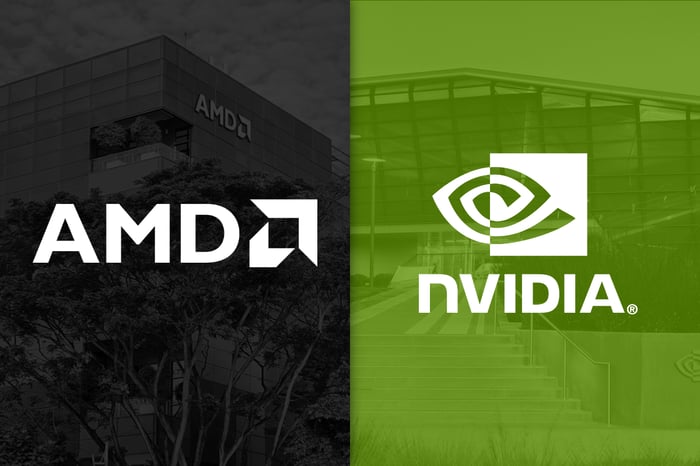
Nvidia and Advanced Micro Devices (AMD) are on the forefront of the artificial intelligence (AI) revolution, each capturing significant market attention amidst a surge in demand for their chips. However, as the AI boom continues to evolve, analysts are weighing their positions in the market, with AMD emerging as a compelling investment choice.
Nvidia (NASDAQ: NVDA), often regarded as the king of AI infrastructure, has already solidified its place in the industry. The company has experienced remarkable growth, with revenue projections soaring from less than $17 billion in fiscal 2021 to an anticipated $216 billion by fiscal 2026. This growth trajectory has propelled Nvidia to a staggering market capitalization exceeding $4 trillion, making it the largest company in the world at present.
Nvidia’s dominance is largely attributed to its graphics processing units (GPUs), which are essential for training large language models (LLMs) that underpin various AI applications. The company’s CUDA software platform has become the foundation where most AI code is developed, granting Nvidia a commanding 90% market share in the GPU domain. As the company looks to maintain its leadership, it is diversifying its offerings, recently licensing technology from Groq and hiring its employees to integrate language processing units (LPUs) designed for inference into its ecosystem.
In contrast, AMD (NASDAQ: AMD) is strategically positioned at the intersection of two significant AI trends: inference and agentic AI. While Nvidia has built a substantial lead in LLM training, it has not established as deep a foothold in the inference market, which is expected to outpace training in growth potential. AMD has recently secured substantial GPU deals with industry giants OpenAI and Meta Platforms, which will compel both companies to integrate AMD’s ROCm software into their infrastructure. These agreements are projected to generate hundreds of millions in new revenue for AMD and enhance its standing in the AI sector.
A noteworthy aspect of AMD’s strategy lies in its leadership in data center central processing units (CPUs). With the growing demand for AI agents, CPUs are becoming increasingly vital as they manage the logical processes that direct GPUs. The anticipated boom in CPU demand positions AMD favorably to capitalize on this emerging trend, allowing it to play a crucial role in the future of AI infrastructure.
Both Nvidia and AMD are poised to benefit from what is being termed as the AI supercycle, which is expected to drive substantial long-term returns as the demand for AI infrastructure escalates. However, from an investment perspective, AMD appears to hold a slight edge at this juncture.
While Nvidia’s preeminence in the AI landscape is well established, its valuation may limit potential upside for investors. As the largest company globally, Nvidia’s stock might be nearing its peak, leaving less room for growth compared to AMD, which is smaller and has ample opportunities ahead, particularly in the burgeoning data center CPU market. The partnerships with OpenAI and Meta also position AMD well to enhance its GPU sales and market presence.
Investors considering Nvidia should exercise caution, especially given the recent recommendations from analysts. The Motley Fool Stock Advisor team has highlighted ten alternative stocks that they believe present better investment opportunities than Nvidia at this time. Historical performance indicates that strategic investments made during pivotal moments can yield extraordinary returns; Nvidia itself was once among the top recommendations, generating significant wealth for early investors.
As the AI landscape continues to develop, the differing trajectories of Nvidia and AMD will likely evolve further. AMD’s focus on both GPUs and CPUs positions it uniquely to harness the next wave of AI advancements, while Nvidia seeks to maintain its leadership amidst increasing competition. The ongoing evolution of AI infrastructure will be critical for both companies, but for those looking to invest in the sector, AMD may currently represent the more promising opportunity.
See also AI Transformation Stalls as 95% of Initiatives Fail to Scale, Capgemini Reports
 Hailo Technologies Plans SPAC Merger, Valuation Drops from $1.2B to Under $500M
 d-Matrix Acquires GigaIO’s Data Centre Business to Enhance AI Infrastructure Capabilities
 Meta Assembles New AI Hardware Team Led by Rui Xu to Drive Innovation in AI Devices
 AI Retail Expert Scott Steinberg Reveals Five Key Trends Transforming eCommerce Success