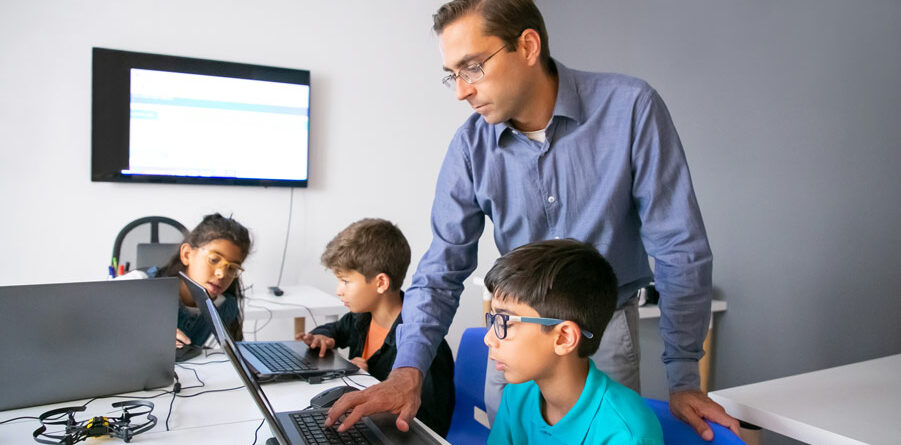
K-12 teachers and students in the United States are increasingly integrating artificial intelligence (AI) into their educational practices, with 85% of public school teachers reportedly utilizing AI during the 2024-2025 school year. This usage is primarily focused on curriculum and content development, while students are employing AI tools like ChatGPT for homework and research.
According to recent data, 13% of teenagers used ChatGPT for academic purposes in 2023, a figure that notably rose to 26% by 2025. Concurrently, 86% of K-12 students indicated in 2025 that they had engaged with AI in some capacity, with half of them using it specifically for educational tasks, such as tutoring or seeking college advice.
Despite its growing prevalence, there is a notable lag in policies and training surrounding AI usage in educational settings. Only 35% of school district leaders reported providing students with AI training in 2025, while 45% of principals stated there were existing policies or guidance regarding AI in schools, according to the RAND Corporation.
Concerns have also arisen regarding the potential misuse of AI among students. Recent incidents have highlighted the risks associated with using AI for mental health support, with troubling reports of students who have self-harmed or taken their own lives after engaging with AI chatbots. A 2025 study revealed that AI chatbots sometimes offered harmful suggestions in response to mental health queries.
The critical questions surrounding the safety and efficacy of AI in education remain unanswered. It is unclear how AI influences learning outcomes for students compared to traditional methods, and whether it effectively alleviates the burdens faced by teachers.
Some educators, including Tal Slemrod, an associate professor of special education, are investigating these questions. Research conducted at institutions like the University of Kansas focuses on using AI to support students with learning disabilities. In 2025, 57% of special education teachers reported they used AI to aid in developing individualized education plans for students, suggesting that AI can play a significant role in reducing barriers for these learners.
While AI appears to offer certain advantages, such as adapting assignments to meet individual learning needs and reducing teachers’ grading workloads, concerns about student privacy and potential biases in AI systems persist. Special education teachers are actively exploring the benefits of generative AI despite these concerns.
However, the available research on AI’s effectiveness in K-12 education is mixed. Studies conducted between 2019 and 2022 suggest that AI can enhance student motivation and provide a personalized learning experience. Yet, findings by Guilherme Lichand from the Stanford Accelerator for Learning indicate that students who rely on AI may struggle academically once they can no longer access these tools.
A report from the Brookings Institution in 2026 cautioned that the risks associated with generative AI in classrooms may outweigh the benefits. Concerns include the erosion of crucial relationships between students and teachers and potential threats to student safety. Furthermore, a 2025 study by the Center for Democracy and Technology revealed that 71% of teachers found it challenging to ascertain whether student work was genuinely their own when AI was employed.
Parental apprehensions are also evident, with nearly two-thirds of parents expressing concerns in 2025 that AI usage is undermining essential academic skills in their children, such as writing and critical thinking.
The rapid incorporation of AI into K-12 education echoes past trends in educational technology, notably during the COVID-19 pandemic when schools hastily adopted online learning platforms. This rush posed challenges for educators striving to provide adequate support to each student, particularly those with disabilities.
Historically, the excitement surrounding emerging technologies like social media and smartphones often overshadowed the potential risks they posed to children. A reflective approach, rather than outright rejection of AI, is necessary to address the potential risks to students’ academic skills, behaviors, and emotional well-being.
As studies continue to emerge, the dialogue surrounding AI in education underscores the importance of a measured approach. While AI has the potential to transform learning experiences, it is crucial to ensure that its integration into classrooms is done thoughtfully and responsibly, keeping the best interests of students at the forefront.
See also AI Transforms India’s Education: ₹1.39 Lakh Crore Union Budget Fuels Skill Development
 EduSync Secures Seed Funding to Launch AI Teaching Assistant and Expand Edtech Platform
 AI in Education Market Expected to Surge from $5.21B to $61.34B by 2034