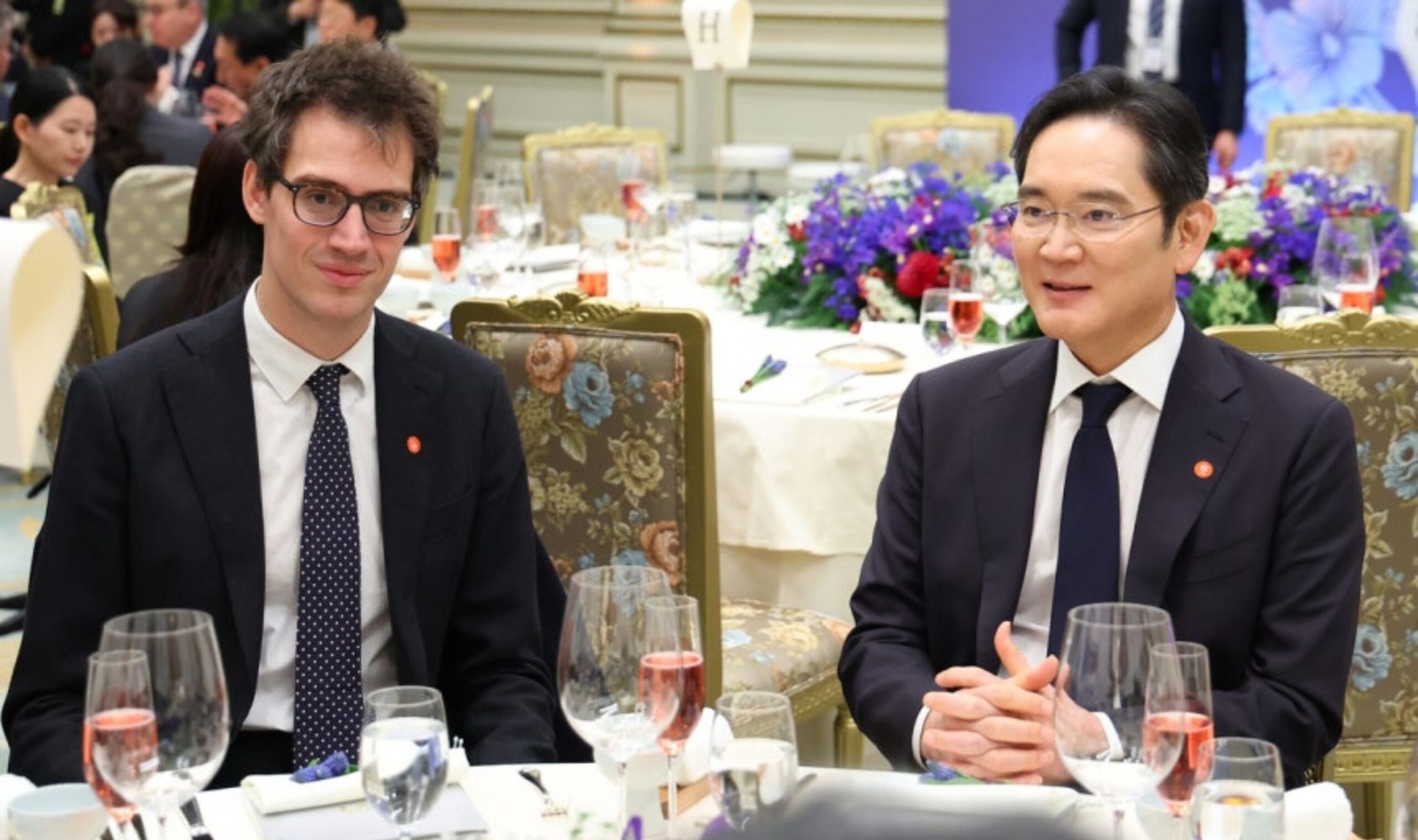
Arthur Mensch, co-founder and CEO of Mistral AI, met with Jeon Young-hyun, head of Samsung’s device solutions division, at the company’s Hwaseong campus last week. The discussions focused on potential cooperation in AI memory and semiconductor supply chains, according to sources familiar with the matter. As Europe’s alternative to OpenAI, Mistral AI requires a stable supply of advanced memory chips to support its large language model, Mistral Large, and its expansion plans.
Mistral’s direct outreach to Samsung reflects growing pressure on AI companies to secure their own chip supplies rather than relying on traditional distribution channels. This meeting coincided with French President Emmanuel Macron’s visit to Seoul for talks with South Korean President Lee Jae Myung, underscoring the strategic importance both nations place on semiconductor cooperation.
South Korean officials utilized this opportunity to present Seoul’s ambition to rank among the world’s top three AI powerhouses. They discussed potential synergies between Korean companies like Samsung and international partners, including AMD, within the fast-evolving AI sector. These discussions illustrate a broader trend in which countries and companies are pivoting towards collaborative frameworks to enhance their positions in the AI landscape.
Mistral’s approach follows recent talks between Samsung executives and Lisa Su, CEO of Advanced Micro Devices, regarding possible AI partnerships. The French startup appears to be pursuing similar discussions, specifically with Samsung, to ensure a reliable chip supply amid tight market conditions for memory. The global demand for high-bandwidth memory, essential for AI servers and data centers, has created what Barclays analysts describe as a “powerful upswing in AI-driven memory demand.” Both Samsung and SK Hynix stand as key beneficiaries of this structural shift away from cyclical memory markets.
However, Barclays cautions that merely benefiting from cyclical pricing strength will not suffice for long-term success. Both Korean chipmakers must pivot towards a more AI-centric product mix, emphasizing specialized memory solutions tailored for AI workloads. Execution in scaling advanced memory production while maintaining yield improvements will ultimately determine which companies can capture the largest share of this burgeoning market segment.
The direct partnerships being explored between chipmakers like Samsung and end-users such as Mistral could significantly reshape traditional semiconductor supply relationships. In this rapidly evolving landscape, companies that successfully align their production capabilities with the specific needs of AI applications are likely to gain a competitive edge.
As the AI industry continues to grow, the implications of these partnerships extend beyond immediate supply chain concerns. The collaboration between semiconductor firms and AI developers might lead to innovative product offerings that could redefine computing capabilities. This shift not only reflects the urgency for businesses to adapt to changing market dynamics but also highlights the strategic importance of securing technological resources in a hyper-competitive environment.
This realignment in semiconductor supply strategies is likely to influence the broader AI ecosystem, prompting other companies to reevaluate their own supply chains and partnerships. As the world increasingly relies on AI technologies, the ability to access and utilize advanced memory solutions will be paramount for sustained innovation and growth.
Featured image source: Yonhap
See also Amazon’s Strong Balance Sheet and AWS Growth Support Buy Thesis Amid Market Caution
 Anthropic Reveals Claude AI’s 171 Emotion Concepts, Impacting Decision-Making
 Anthropic Cuts Off OpenClaw from Claude Plans, Users Now Face Extra Charges
 Meta Cuts 200 Jobs Amid $10B Investment in AI Data Center to Boost Efficiency
 Perplexity AI Appeals Amazon’s Injunction, Challenging CFAA Misinterpretation in AI Browser Case