






















































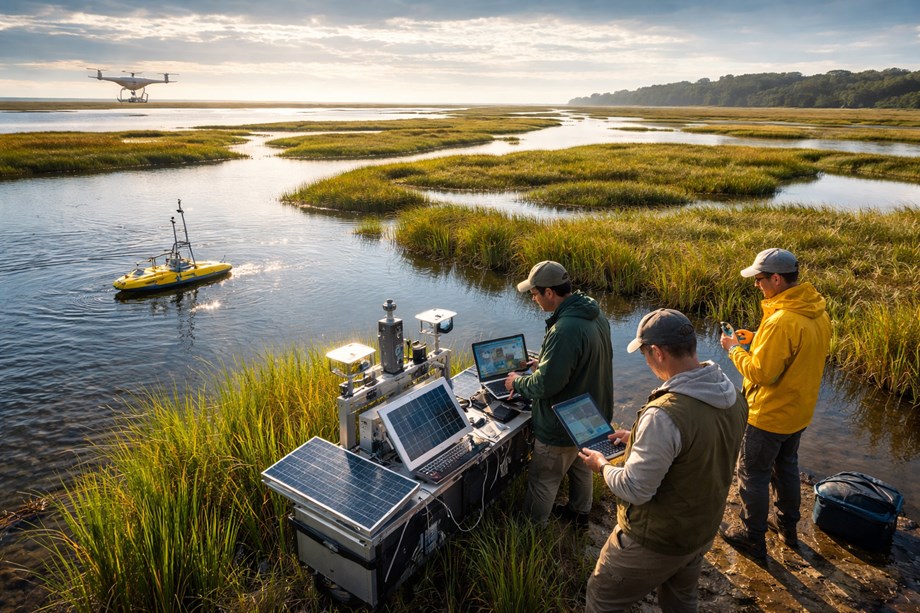
Artificial intelligence (AI) is increasingly being leveraged to enhance the monitoring of fragile ecosystems, particularly transitional water environments like estuaries, lagoons, and coastal wetlands. A new systematic review published in the journal Environments highlights how machine learning tools are becoming essential for understanding and managing these complex ecosystems. The review synthesizes findings from nearly a decade of research, evaluating 96 peer-reviewed studies to map the current landscape of AI applications in ecological analysis and to identify gaps in methodology and application.
This extensive review reveals that AI’s strengths lie in its ability to navigate the nonlinear and variable nature of transitional water ecosystems. Traditional ecological models often rely on oversimplified assumptions, but AI can process large volumes of diverse data and uncover patterns that are challenging to detect otherwise. Dominant machine learning techniques in this field include Random Forest and Support Vector Machines, which are adept at managing nonlinear relationships and noisy datasets. These methods have been successfully applied to tasks such as predicting water quality and identifying pollution sources.
Regression-based approaches constitute a significant portion of the reviewed studies, making up over 44 percent of applications. These models are commonly utilized to estimate crucial environmental variables, including nutrient concentrations and chlorophyll content. Classification methods account for more than a third of the studies and are employed to categorize ecological conditions or detect anomalies, while clustering techniques are used to identify patterns in complex datasets without predefined labels.
Water quality monitoring emerges as the most prominent application of AI, enabling timely detection of pollution events and more effective management responses. This is particularly vital in transitional waters where conditions can shift rapidly. Beyond water quality, AI applications extend to biodiversity assessment, habitat mapping, and ecosystem forecasting, often integrating multiple data sources such as remote sensing imagery and in situ sensor data. By synthesizing these inputs, AI systems provide a more comprehensive understanding of ecosystem dynamics.
The recent rise of deep learning technologies marks a transformative phase in this field. Since 2020, neural networks, particularly those designed for image and time-series analysis, have gained traction in processing high-dimensional data such as satellite imagery and sensor streams. These advanced models have demonstrated strong capabilities in tasks like detecting algal blooms and mapping vegetation, critical for assessing ecosystem health.
The complexity of transitional water ecosystems is a primary factor driving the adoption of AI methods. These environments exhibit considerable spatio-temporal variability, complicating traditional modeling approaches that often struggle to capture such dynamics. AI models can adapt to irregular or sparse datasets, learning directly from the data to provide actionable insights. They are particularly well-suited to predicting abrupt regime shifts, where minor environmental changes can lead to significant ecological transformations, a challenge various conventional models face.
Moreover, the increasing availability of environmental data due to advances in remote sensing technologies and sensor networks has opened the door for AI applications. However, the review also identifies challenges in data quality and representativeness, noting that many datasets are incomplete or biased. Proper data preprocessing and validation across multiple sources are essential for improving model performance.
The integration of different data types is crucial for effective transitional water research. Combining satellite imagery with ground-based measurements helps link broad environmental patterns with localized ecological conditions. This multimodal approach enhances the accuracy of AI models, but it also adds complexity in data alignment and processing.
Methodological Gaps and Challenges Ahead
Despite the promising applications of AI, the study identifies significant gaps that could hinder broader adoption. One pressing issue is the lack of standardized validation practices; many studies employ varying evaluation metrics, complicating comparisons and assessments of model reliability. While some AI models exhibit high predictive accuracy, this does not guarantee meaningful ecological insights. Without proper validation, models may capture misleading correlations or fail to generalize to new environments, particularly in transitional waters where conditions can vary greatly.
Another major challenge is the interpretability of AI models. Many advanced systems operate as “black boxes,” making it difficult for researchers and policymakers to decipher how predictions are made. This lack of transparency can erode trust and limit the practical application of AI in environmental decision-making. The authors of the review advocate for more explainable AI approaches that can elucidate the underlying drivers of ecological change.
Looking ahead, the study calls for a holistic approach to AI-driven ecological research. This includes developing standardized frameworks for model evaluation, enhancing collaboration between data scientists and ecologists, and improving data quality and integration. The potential for emerging technologies, such as hybrid models that combine machine learning with mechanistic approaches, could also help overcome current limitations. While AI has already contributed significantly to the understanding of transitional water ecosystems, its full potential remains to be realized, requiring ongoing innovation in methods, data integration, and validation for effective environmental management.
See also Salesforce Enhances Slackbot with 30+ Features, Boosting Productivity by 90 Minutes Daily
 AI Transforms Truck Maintenance: 400 Data Points Drive Proactive Diagnostics
 AI Programming Surge Creates 1M Lines of Code to Review, Heightening Security Risks
 Top AI Sales Tools of 2026: 8 Platforms Transforming Revenue Generation
 Adobe Summit 2026 Launches New AI Tools, Unveils Key Customer Experience Strategies















