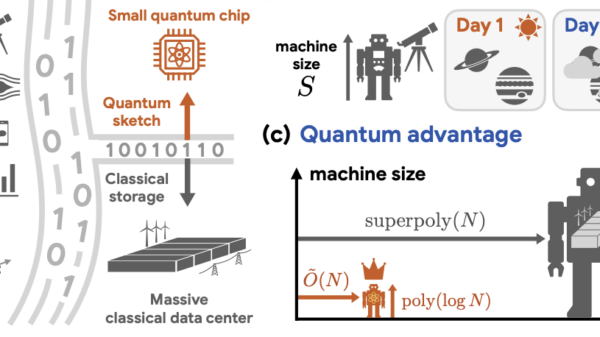
BTQ Technologies Corp., a quantum technology company, has released a significant research paper titled “Kardashev Scale Quantum Computing for Bitcoin Mining,” authored by Pierre-Luc Dallaire-Demers. The paper, available on arXiv, offers a detailed analysis of the potential for quantum computers to mine Bitcoin, revealing that while theoretical shortcuts exist through Grover’s algorithm, practical applications remain unfeasible due to astronomical requirements for hardware and energy.
Published on April 6, 2026, the paper finds that under the most favorable conditions, quantum Bitcoin mining would necessitate approximately 10^8 physical qubits and 10^4 megawatts of power, a demand comparable to that of a large national electricity grid. As Bitcoin’s mining difficulty escalates—projected to reach significant levels by January 2025—requirements could skyrocket to 10^23 qubits and 10^25 watts, approaching the energy output of a star. This stark reality challenges the notion that quantum mining poses a near-term threat to Bitcoin’s proof-of-work consensus.
The research emphasizes that the more pressing quantum risk lies not in mining but in the vulnerability of Bitcoin’s digital signatures, which can be exploited through quantum algorithms like Shor’s. Dallaire-Demers stressed the urgency of addressing the authentication layer, stating, “The real cryptographic crisis is the signature vulnerability, and that clock is already ticking.” This assertion aligns with BTQ’s mission to enhance Bitcoin’s security framework through the development of a quantum-safe architecture that incorporates post-quantum cryptography.
BTQ’s efforts extend to initiatives like Bitcoin Quantum, a project designed to transition Bitcoin-like systems towards post-quantum standards. This includes the implementation of NIST-standardized ML-DSA signatures and the introduction of innovative transaction designs, such as BIP 360 (Pay-to-Merkle-Root). The company believes that its findings reinforce the need for immediate action in securing digital asset infrastructures against quantum threats, particularly focusing on signatures and wallet security.
Beyond the immediate implications for mining and signatures, the research also supports BTQ’s long-term vision for Quantum Proof of Work (QPoW). This initiative proposes a consensus model specifically designed for quantum systems, diverging from traditional approaches that attempt to retrofit quantum technology onto existing frameworks. QPoW is characterized by computational tasks tailored to harness the unique capabilities of quantum hardware efficiently. The paper suggests that rather than forcing quantum hardware into classical systems, the industry should explore consensus architectures that inherently utilize quantum strengths.
In comparative analyses, BTQ’s model indicates that QPoW could offer substantial energy savings, consuming only 0.25 kWh over a ten-minute block interval compared to approximately 390 kWh required for classical mining setups. This suggests that QPoW might provide a more viable energy-efficient alternative for future digital consensus mechanisms.
The publication concludes with a clear message for the cryptocurrency and blockchain communities: while quantum mining may not represent an immediate threat, the vulnerability of Bitcoin’s signature system requires urgent attention. BTQ’s research underscores the necessity of preparing for a future where quantum capabilities could reshape digital finance. “What matters now is securing authentication and preparing Bitcoin-like systems for the post-quantum era,” stated Christopher Tam, President and Head of Innovation at BTQ Technologies.
In summary, BTQ Technologies’ recent findings serve as a clarion call for the digital asset space to prioritize post-quantum security and rethink consensus models in anticipation of the quantum computing era. As the field evolves, the focus must shift to enhancing authentication infrastructures before quantum threats become mainstream.
See also Tech Firms Cut Over 165,000 Jobs Amid AI Push; Future Workforce Uncertain
 Edge AI Hardware Market to Reach $29.75 Billion by 2033, Driven by 13.7% CAGR Growth
 AI in Engineering: ATU Hosts Global Experts to Explore AI as a Partner, Not a Competitor
 AI-Optimized Renewable Systems Market to Reach $5.5B by 2035 with 29.1% CAGR
 IBASE Launches MBB1002 AI-Ready eATX Motherboard for Advanced AI Workloads