






















































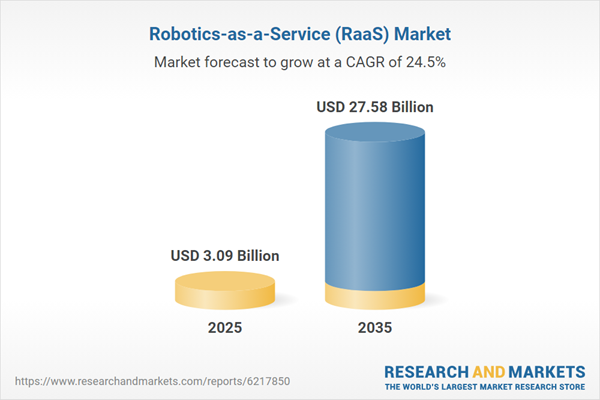
The global Robotics-as-a-Service (RaaS) market is poised for significant expansion, projected to grow from USD 3.09 billion in 2025 to USD 27.58 billion by 2035, at a compound annual growth rate (CAGR) of 24.45%. This surge is driven by advancements in artificial intelligence (AI), cloud technology, and collaborative robotics, which are enhancing scalability and flexibility across various sectors, particularly logistics and manufacturing. The increasing urgency for cost-effective automation solutions, exacerbated by ongoing labor shortages, is propelling organizations to adopt RaaS solutions more widely.
A report titled “Robotics-as-a-Service (RaaS) Market – A Global and Regional Analysis: Focus on Application, End User, Product, and Country Analysis, 2025-2035,” published by ResearchAndMarkets.com, highlights these trends. It indicates that the RaaS market has become integral to modern automation strategies, enabling companies to deploy robotic solutions without hefty upfront investments.
As complexities in business operations increase, RaaS platforms—ranging from autonomous mobile robots to collaborative manufacturing systems—are delivering essential productivity gains. The report emphasizes the role of RaaS in diverse sectors, including logistics, manufacturing, healthcare, and retail, where operational efficiency is paramount.
Enhanced autonomy and precision through AI integration and cloud-based platforms are fostering a demand for subscription-based models, which offer performance guarantees and managed services. This trend is particularly crucial as organizations grapple with rising labor costs and increased competitive pressures. The RaaS market’s flexibility supports diverse applications, including warehouse automation and customer service robotics, positioning it as a vital component for future service-driven automation.
Within the RaaS market, the handling segment is anticipated to lead by application, projected to expand from USD 849.8 million in 2025 to USD 7.85 billion by 2035, reflecting a CAGR of 24.91%. This growth is fueled by the increasing demand for automated material handling solutions, advanced picking systems, and collaborative robots, all designed to optimize real-time operational efficiency across sectors. As industries focus on modernizing warehouse management and supply chain processes, investments in sophisticated handling robotics are anticipated to rise.
The assembling and dispensing applications within the RaaS framework are expected to be the fastest-growing, expanding at a CAGR of 25.41%. This growth reflects the rising need for precision in assembly operations, crucial as manufacturing increasingly moves toward automated production line environments. Similarly, the welding and soldering segment is forecasted to achieve a CAGR of 24.41%, attributed to advancements in collaborative robotics that enhance manufacturing consistency and improve safety measures.
Logistics is projected to remain the dominant end-user segment in the RaaS market, with its value expected to rise from USD 924.4 million in 2025 to USD 8.93 billion by 2035, marking a CAGR of 25.46%. This growth corresponds with a surge in demand for warehouse automation and advanced material handling systems, particularly in e-commerce and distribution networks. Automotive and healthcare sectors are also anticipated to witness significant growth, with projected CAGRs of 24.96% and 24.46%, respectively.
Challenges that lie ahead include the complexities associated with subscription models, pricing sustainability, and fleet scalability, which could hinder broader market adoption. The competitive landscape features both established players and innovative startups, each vying for market share in an evolving digital transformation landscape.
As organizations increasingly prioritize operational flexibility alongside cost-efficiency, the RaaS market is expected to play a pivotal role in shaping the future of automation. The emphasis on subscription-driven solutions is not only making robotics more accessible but also fostering collaborations among robotics manufacturers, software developers, and service providers, thereby reinforcing RaaS as a cornerstone of 21st-century operational efficiency.
See also JMIR’s Dr. Chew Calls for Science Publishing Overhaul to Tackle AI Reproducibility Crisis
 Illinois State University Signs AI Partnership with South Korea’s Chungnam University
 UNU and Tsinghua University Launch Hub to Drive Ethical AI Governance in China
 Hong Kong Researchers Launch AI Framework for Real-Time Wildfire Forecasting with 85% Accuracy















