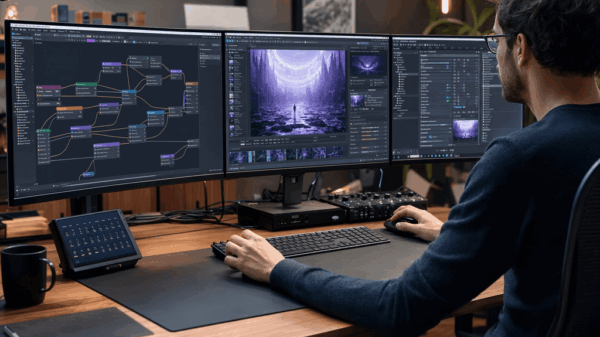
A growing number of freelancers, educators, and startup founders are turning to free AI image generators for quick, cost-effective visual content. As these tools gain traction, understanding their capabilities and limitations is increasingly vital, especially as the technology continues to evolve rapidly.
The AI image generation market has transformed significantly since the initial releases of platforms like DALL-E and Midjourney. By 2024, most services had adopted a trial-and-pay model, offering a limited number of free image generations before requiring payment. However, by 2026, the competitive landscape encouraged many of these platforms to introduce permanent free tiers with generous daily allowances for image generation.
This shift is largely driven by a decrease in training costs for diffusion models, which have dropped by approximately 60% since 2023, according to research from Epoch AI. The emergence of open-source models such as Stable Diffusion and FLUX has further democratized access to the underlying technology, prompting platforms to differentiate themselves through user experience and model diversity rather than just generation capability.
Currently, many free tiers offer between five to twenty image generations per day, though quality and resolution can vary greatly. Some platforms limit free users to older models that yield subpar results, while others like CreateVision AI provide access to production-grade models even on free plans, allowing users to allocate daily credits across various model tiers.
Not all free AI image generators are equally beneficial. The distinction between a useful tool and a mere marketing gimmick hinges on three main factors: model quality, prompt intelligence, and output usability. Some platforms restrict access to their best models for paid users, leaving free users with outdated technologies that often produce distorted images or blurred text. In contrast, platforms that prioritize prompt intelligence can significantly enhance the quality of generated images by refining vague user inputs into more effective prompts.
When assessing the utility of free AI image generators, it’s essential to consider output usability. Images with resolution limits, visible watermarks, or restrictive licensing often prove inadequate for practical applications. The most effective free tools typically deliver images at standard web resolutions, without watermarks, and under licenses that permit commercial use.
Despite the appeal of “free,” the operational costs for AI image generation remain substantial. Generating a single image can cost platforms between $0.01 and $0.08, depending on the model and resolution. For platforms providing 80 free generations daily to thousands of users, these costs can accumulate rapidly. Consequently, many free AI image generators employ one of three business models: credit-based freemium systems, ad-supported generation, or conversion funnels to incentivize users to upgrade to paid plans.
Among these, the credit-based model appears most sustainable, aligning user expectations with platform costs while still offering a genuinely useful free experience. This model allows users to choose how to spend their credits based on their specific needs, such as generating quick social media graphics or high-resolution product images.
Free AI image generators excel in various contexts, particularly for social media content, prototyping, educational materials, and personal creative projects. However, they fall short in professional production settings. For instance, generating multiple consistent images for a product catalog can quickly deplete daily allowances, while maintaining brand consistency is challenging without fine-tuning capabilities.
Notably, the rise of multi-model platforms in 2026 marks a significant development in the industry. These services allow users to access various generation architectures through a single interface, providing flexibility that single-model tools lack. Users can select the most suitable model for different tasks, enhancing the overall user experience and allowing for integration of new architectures as they emerge.
When evaluating free AI image generators, users should consider factors such as daily allowances, model access, output resolution, prompt assistance, commercial licensing, and the presence of watermarks. As the gap between paid and free offerings narrows, a well-chosen free AI image generator can deliver substantial value, fulfilling up to 80% of the needs met by a paid subscription.
Looking ahead, the trajectory of free AI image generation appears promising. As compute costs decline and competition increases, platforms that prioritize their free tiers as genuine products are likely to thrive. For users, the best strategy is to choose tools that offer transparency in credit systems, access to current models, and quality outputs suitable for professional use. The era of “free but useless” AI image generation is fading, reshaping the landscape for content creators and professionals alike.
See also Teams Combat Visual Drift in AI Workflows with New Generative Style Bible Framework
 ASU’s Yang Reveals Digital Fingerprints to Identify AI-Generated Media with Precision
 Nano Banana 2 Launches as Advanced AI Image Editor with 2K Output and Multilingual Support
 UVA Scientists Launch AI Tools to Revolutionize Drug Development and Improve Efficacy
 Generative AI Advances: New Techniques Enhance Image, Text, and Audio Creation