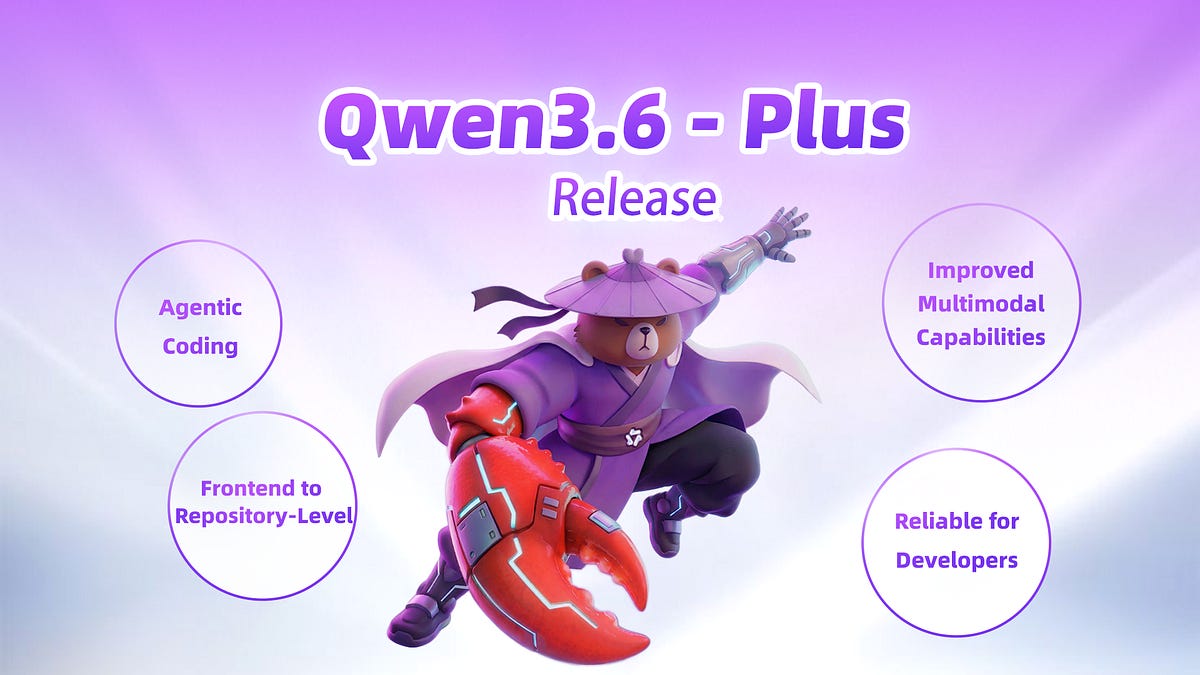
Two of China’s prominent AI laboratories have recently announced a shift towards closed frontier models as they attempt to capitalize on a lucrative market. Alibaba’s Qwen team introduced the Qwen3.6-Plus and Qwen3.5-Omni as hosted offerings on Alibaba Cloud, while Z.ai unveiled its GLM-5-Turbo as a closed-source model. This pivot reflects a broader trend among Chinese AI teams, who are increasingly motivated by the need to generate revenue amidst a competitive landscape dominated by proprietary offerings from companies like ByteDance’s Seedance 2.0 and Kuaishou’s Kling 3.0.
The Chinese AI ecosystem initially gained traction in the wake of ChatGPT’s success, with model makers striving to compete through open-source offerings, albeit with varying degrees of performance. This moment of opportunity saw the emergence of idealists within the sector, leading to significant attention on open models as a means to capture global market share. However, despite rhetoric from the Chinese government advocating for open-source development, financial support for such initiatives has been lacking. The high costs associated with model training and user service cannot be sustained by goodwill alone.
In stark contrast to the United States, where funding for AI development is extensive, China’s financial landscape for AI is markedly smaller. While Masayoshi Son’s $20 million investment helped Alibaba take off, he has since directed nearly $100 billion into OpenAI, leaving the Chinese ecosystem underfunded. Western venture capitalists have largely focused their investments on American labs, with Gulf investors contributing approximately $100 million to Chinese companies like Minimax and Zhipu, compared to around $15 billion into firms like Anthropic and OpenAI. This disparity highlights the challenges China faces, as the state has only recently begun to consider financial support for its AI laboratories, resulting in underwhelming valuations and a sense of urgency among Chinese firms as they navigate rushed initial public offerings.
China’s leading AI players are now under pressure to generate profit, which has accelerated the shift towards closed-source models. While smaller open models may facilitate market entry overseas and contribute to advancements in robotics, they do not cover the substantial costs associated with operating large-scale AI infrastructure. As a result, the initial allure of open-source models within China appears to have faded.
Interestingly, the concept of open source has begun to permeate broader political discourse in China. Zheng Yongnian, dean of the School of Public Policy at The Chinese University of Hong Kong, recently characterized “Chinese-style modernization” as a form of “open-source” modernization, emphasizing values of self-reliance and global benefit. This framing, found in a People’s Daily commentary, reflects an attempt to position China’s development model as both innovative and collaborative on the global stage.
The Fifteenth Five-Year Plan, approved earlier this year, includes a directive to “promote open-source system construction and improve open-source operating mechanisms,” although it does not explicitly link these goals to AI. This ambiguity suggests that policymakers are repurposing the “open source” concept to advocate for a geopolitical model emphasizing openness and cooperation, rather than focusing solely on technological development.
Looking ahead, the implications of the Chinese AI ecosystem’s pivot to closed models are significant. It seems unlikely that the government will invest the billions needed to sustain open-source development. Even a groundbreaking release like DeepSeek V4 would struggle to shift the prevailing business realities facing Chinese labs. The Chinese government’s ongoing focus on hardware rather than software suggests that substantial systemic changes may not be forthcoming.
Despite the tightening landscape, there may still be opportunities for innovation within the Chinese AI sector. Certain players may continue to seek prominence with models that can capture attention, particularly if they can navigate the regulatory environment while upholding the party’s open-source rhetoric. There remains a glimmer of hope that with clever data strategies, companies could produce viable models without the vast financial resources typically required, allowing them to generate interest and market buzz.
See also Grok Surpasses ChatGPT and Claude with Real-Time X Integration for Daily Insights
 H Company Launches Holo3 AI Agent with 35B Parameters for Multi-App Task Execution
 DeepMind CEO Demis Hassabis Highlights UK’s Talent Edge Over Silicon Valley in AI
 OpenAI, Google, Anthropic Unite to Combat AI Model Theft Amid Rising Distillation Attacks
 Florida AG Launches Investigation into OpenAI Over AI Misuse and Child Safety Risks