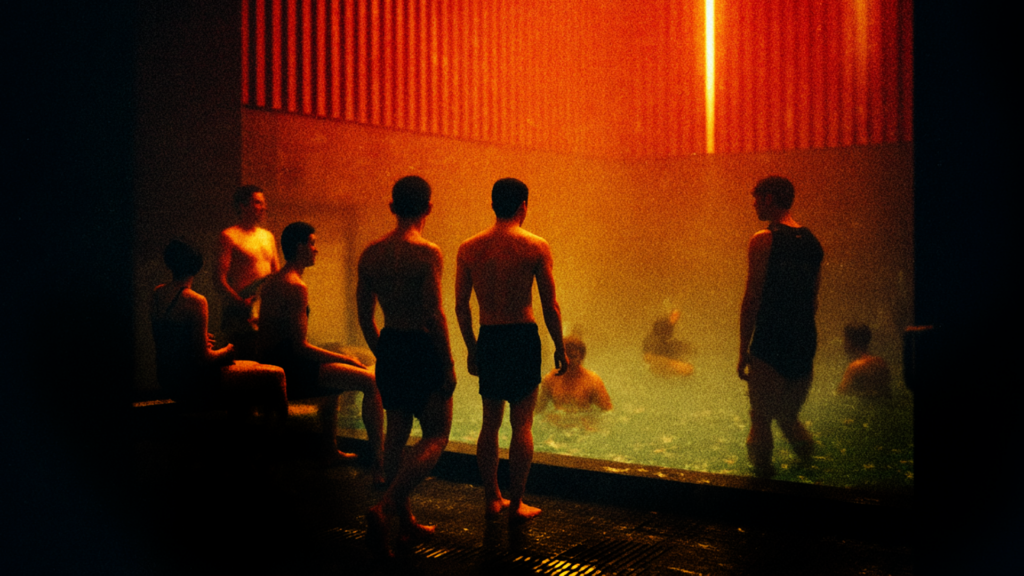
The Minneapolis City Council is deliberating a proposal to reinstate bathhouses where sexual activity among consenting adults would be permissible. The initiative is sparking broader discussions about stigma, criminalization, and community dynamics. Introduced on March 26, the proposal encompasses four interrelated measures aimed at amending regulations for venues that facilitate sexual activities and updating provisions concerning indecent conduct and disorderly houses, with exceptions for licensed establishments.
The council is scheduled to revisit the proposal during a meeting on Thursday, as reported by local ABC affiliate KSTP. Councilmember Elliott Payne, who co-authored the measures, emphasized that the policy has been informed by community input. “These venues are historically LGBTQ+ spaces, with advocacy organizations emphasizing their importance in the community,” he stated.
Historically, bathhouses have existed since ancient times in various cultures. In the United States, their prominence rose alongside urbanization in the late 19th and early 20th centuries, primarily as a public health initiative. Cities established free bathhouses to encourage “healthful living” and address unsanitary conditions in tenement housing, according to then-New York health commissioner Francis E. Fronczak in 1915.
Over the years, some bathhouses transitioned into venues where men could discreetly engage in sexual encounters. Allan Bérubé, in “The History of Gay Bathhouses,” noted that despite increased scrutiny during the 1950s, more bathhouses opened as explicitly gay institutions, providing a haven for individuals at a time when LGBTQ+ identities were largely unrecognized in political and social spheres.
Besides being spaces for sexual encounters, these establishments also served as centers for dining, entertainment, and community organizing. Notable figures, such as Bette Midler, began their careers performing at venues like the Continental Baths in New York City. However, the AIDS crisis led to stringent regulations that effectively closed many bathhouses, with the last one operating legally in Minneapolis shutting down in 1988.
Despite their apparent decline, bathhouses have experienced a resurgence in various cities such as San Francisco, which still legally permits them to function as sex clubs. Payne’s proposal aims to frame the legalization of bathhouse sex as a public health strategy, highlighting the need for venues that prioritize consent, health, and safety. “Parties and events that operate as adult sex venues already occur underground, and this policy will ensure that they center and prioritize consent, health, and safety,” he remarked.
Payne has expressed a desire to model Minneapolis bathhouses after those in cities like San Francisco and Chicago, which have recently played a role in public health interventions, such as providing free monkeypox vaccinations. He noted, “We cannot govern through stigma and should reflect advancements that are proven to be effective and supportive.” The proposal also indicates a shift in the narrative around LGBTQIA+ gathering spaces, historically targeted by criminalization and policing.
Jason Chavez, another Minneapolis City Council member and co-author of the ordinance, echoed this sentiment on social media, stating that the long-standing ban has pushed sex-related gatherings underground and removed them from a public health framework. “We can do better,” he asserted.
The potential reintroduction of explicitly sexual bathhouses in a Midwestern city like Minneapolis is significant. It stands in stark contrast to the ongoing digitalization of relationships and sexuality, portraying the bathhouse as a nostalgic, tangible space for human connection. As conservative opposition to LGBTQ+ content and communities resurges, the push for physical spaces that are overtly sexual may be viewed as both courageous and subversive.
Even if the proposal does not advance, it has the potential to spark essential conversations about the role of anti-LGBTQ sentiment in the historical closure of these venues. Questions arise regarding the public health implications of such bans and how to create safe spaces for diverse expressions of sexuality in society.
In a separate but equally pressing matter, Anthropic’s latest AI model—Claude Mythos—has been deemed too potent for public release. The company announced that access will be restricted to a select group of organizations through a program called Project Glasswing. Mythos’s advanced capabilities include identifying zero-day vulnerabilities—previously undetected security flaws—leading to concerns about its potential misuse. As such, the decision to limit its availability has drawn the attention of government officials and cybersecurity experts alike.
See also Demis Hassabis Critiques ChatGPT’s Impact, Warns AI Risks Are Evolving
 Mistral AI Secures €1.7B Funding to Lead Europe’s Generative AI Revolution
 Cohere and Aleph Alpha Advance Merger Talks, Eyeing Strategic AI Collaboration
 DeepSeek Secretly Trains AI Model on Nvidia’s Blackwell Chip Despite U.S. Ban
 Anthropic Surpasses $30B Revenue, Emerges as Top Choice Over OpenAI at HumanX Conference