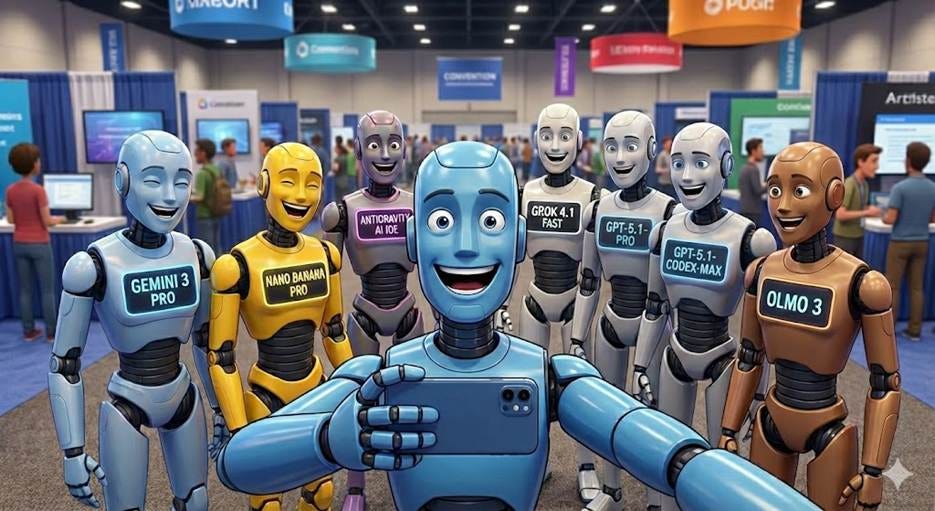
This week marked a significant shift in the AI landscape with the launch of several powerful models, notably Google’s Gemini 3 Pro, which sets a new benchmark for multimodal reasoning and overall AI performance. This release is seen as a transformative moment in the AI era, as it competes against other notable entries, including Nano Banana Pro, OpenAI’s GPT-5.1 Pro, and xAI’s Grok 4.1.
Google’s Gemini 3 Pro stands out as the most advanced multimodal AI reasoning model, demonstrating state-of-the-art performance across various tasks such as reasoning, mathematics, coding, and visual understanding. The model achieved an impressive score of 45% on the ARC-AGI-2 benchmark while operating in the “Deep Think” mode, more than doubling the score of any prior model. Its real-world applications are significant, particularly in areas like visual analysis and coding user interfaces.
Accompanying this release is Google’s Antigravity, an AI-first integrated development environment (IDE) designed to streamline coding tasks with multiple agentic AI capabilities. The IDE features tools for bug-fixing, documentation, and browser integration, highlighting its ability to manage complex workflows. Built to leverage the capabilities of Gemini 3 Pro, Antigravity can also interact with other AI models.
In addition to Gemini 3 Pro, Google introduced Nano Banana Pro, a potent image generation tool that leverages high-fidelity rendering techniques and advanced visual reasoning. This model is capable of producing images with a resolution of up to 4K and exhibits a dramatic reduction in error rates for text rendering, dropping from 56% to just 8%. It facilitates the creation of intricate designs such as infographics and educational materials, and is integrated into the Gemini app for paid users. Developers can access Nano Banana Pro via an API key in Google Studio, which supports collaborations with platforms like Adobe and Figma.
Meanwhile, OpenAI’s latest release, GPT-5.1-Codex-Max, is aimed at enhancing long-term software engineering tasks, capable of maintaining context over sessions as long as 24 hours. This model has demonstrated state-of-the-art results in benchmarks like SWE-Lancer IC SWE (79.9%) and TerminalBench (58.8%). OpenAI also upgraded ChatGPT to GPT-5.1 Pro, emphasizing its deep reasoning capabilities, and introduced group chat functionality for users on both web and mobile platforms.
xAI’s Grok 4.1 was also released this week, along with Grok 4.1 Fast, which features a 2 million-token context window and advanced tool-calling capabilities. This model achieved a score of 1483 on LMArena, making it one of the highest-rated models in emotional intelligence and creative writing. The Agent Tools API enables Grok to execute web searches, run codes, and retrieve documents, positioning it as a highly effective tool for deep research.
Additionally, the Allen Institute for Artificial Intelligence (AI2) unveiled its open-source model family, Olmo 3, which includes variants such as Olmo 3-Base and Olmo 3-Instruct. These models not only promise state-of-the-art capabilities but also provide transparency through full access to training data and model checkpoints.
In related developments, Meta introduced the Segment Anything Model 3 (SAM 3), enhancing visual segmentation tasks and enabling 3D object reconstruction from images. This technology has practical applications in Facebook Marketplace, assisting users in visualizing decor items in their spaces. SAM 3 is released under permissive open-source terms, allowing for commercial use and ownership of modifications.
On the regulatory front, the White House is reportedly preparing an executive order aimed at centralizing AI oversight at the federal level, curbing state-level laws and establishing uniform disclosure standards. In contrast, the European Commission has initiated a simplification package to reduce regulatory burdens for AI innovation, postponing obligations for high-risk models until December 2027.
As the AI sector continues to expand rapidly, Nvidia recently reported a record $57 billion in revenue, coupled with a substantial $500 billion order backlog for upcoming years. Despite this success, concerns linger regarding the potential for an “AI bubble,” particularly in light of aggressive competition from global rivals, particularly in China.
The week rounds out with a Deezer-Ipsos survey revealing that an astounding 97% of listeners are unable to differentiate between human-composed and AI-generated music, highlighting the rapid advancements in AI music production and raising questions about the future of creativity in the digital age.
See also NVIDIA Unveils Nemotron Elastic LLMs, Reducing Training Costs by 360x with Nested Models
 OpenAI Halts FoloToy Sales After Kumma Bear’s Inappropriate Conversations Raise Safety Concerns
 AI-Generated Images: Can You Identify the 5 AI Creations Among 10 Real-Life Photos?
 Five Generative Models: Key Strengths and Use Cases for AI Professionals
 OpenAI’s GPT-5 Launch Faces Backlash on Reddit, Sam Altman Responds to Criticism