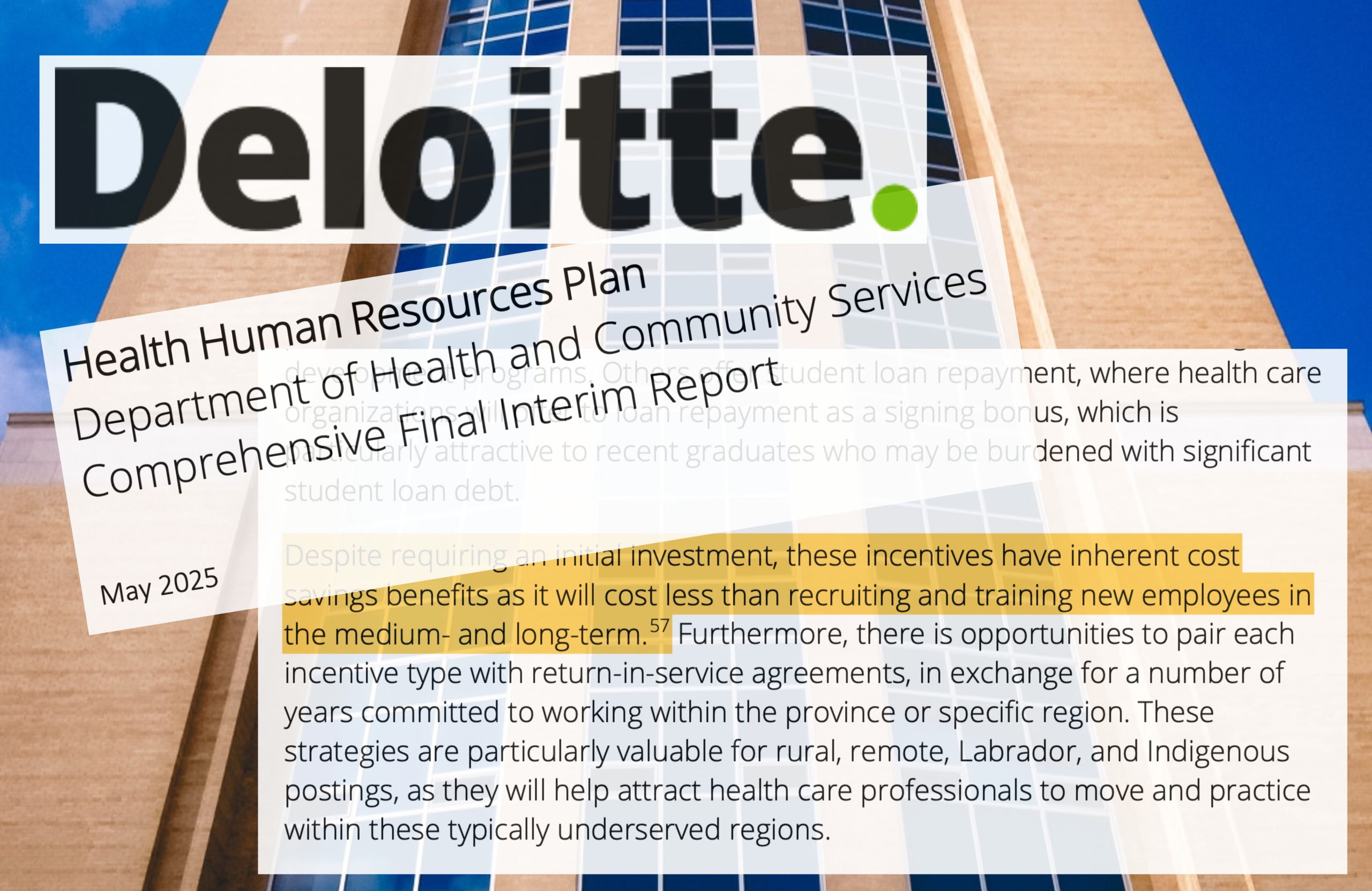
A recent investigation has exposed serious issues with the credibility of government-commissioned policy reports in Newfoundland and Labrador, particularly concerning the use of artificial intelligence in generating content. Following a scandal involving fabricated sources in the province’s Education Accord, The Independent has confirmed that Deloitte’s report, the Health Human Resources Plan, likewise contains multiple false citations.
Commissioned by the provincial government and released in May 2025, the report cost approximately $1.6 million. This document is part of ongoing efforts to address significant staffing shortages in healthcare, particularly among nurses and doctors, a pressing issue in the province’s healthcare system.
The Health Human Resources Plan cites research papers to substantiate claims around recruitment and retention strategies, the financial implications of hiring, and the impact of COVID-19 on healthcare professionals. However, at least four of these citations have been found to be either non-existent or likely generated by AI, raising serious questions about the integrity of the document.
Fabricated Citations and Expert Concerns
Among the false citations, one references a paper supposedly demonstrating that monetary recruitment incentives yield long-term cost savings. Martha MacLeod, co-author of an actual study on rural nursing, asserted that “the citation is false and potentially AI-generated,” explaining that they never conducted a cost-effectiveness analysis.
Additionally, another cited source claimed that “local recruitment is typically the most cost-effective strategy.” However, Gail Tomblin Murphy, an adjunct professor at Dalhousie University and co-author of a related study, clarified that the referenced paper does not exist. She suggested that the inaccuracies hint at a heavy reliance on AI in generating content for the report.
Another erroneous citation claims to document the increased workload and stress levels among respiratory therapists due to the pandemic, referencing an article that is not verifiable in any academic database.
Broader Implications for AI in Policy Making
This incident is not an isolated case for Deloitte. Recently, the consulting firm faced backlash after a report for the Australian government featured fabricated quotes and non-existent research papers, leading to a partial refund of $290,000. Despite the controversy surrounding AI’s role in these errors, Deloitte has not confirmed its involvement in the Newfoundland and Labrador report.
Deloitte has been actively promoting the use of AI technologies, emphasizing their potential in supporting decision-making in healthcare and data analysis. In their Health Human Resources Plan, the firm recommended leveraging generative AI to enhance clinical decision-making and personalize treatment plans. However, the credibility of such reports is now under scrutiny, especially given their significant financial cost and potential impact on public policy.
The Newfoundland and Labrador government, led by Premier Tony Wakeham, has yet to commit to a review of its AI policies in light of these findings. While the Premier expressed embarrassment over the errors in the Education Accord, his administration has not prioritized a similar investigation into Deloitte’s recent report.
Opposition leaders, including NDP Leader Jim Dinn, have voiced strong concerns regarding the implications of these errors, stating, “You’re playing with people’s lives.” He emphasized the importance of trust in the healthcare system and the need for accurate, evidence-based reports to inspire public confidence.
As the Newfoundland and Labrador government continues its engagement with Deloitte to assess nursing resources, the absence of transparency regarding AI’s role in the preparation of these reports raises critical questions. With the Health Human Resources Plan still available on the government’s website without any acknowledgment of AI involvement, there is a pressing need for greater oversight in the use of AI technologies in policy-making.
In summary, the revelations surrounding Deloitte’s reports serve as a cautionary tale about the reliance on generative AI in high-stakes environments. The challenge lies in ensuring that such innovations enhance rather than undermine the integrity and efficacy of critical public policy documents.
See also Government Launches YUVA AI Program: Free AI Training for 1 Crore Students and Citizens
 Governments Must Address Job Concerns Amid AI Investments, Says PM Wong at G20
 Researchers Unveil AI Adoption Framework for Higher Education and Government Sectors
 Governments Accelerate Ethical AI Adoption for Enhanced Security and Citizen Trust
 Amazon Invests $50B in Data Centers to Enhance AI Capabilities for US Government