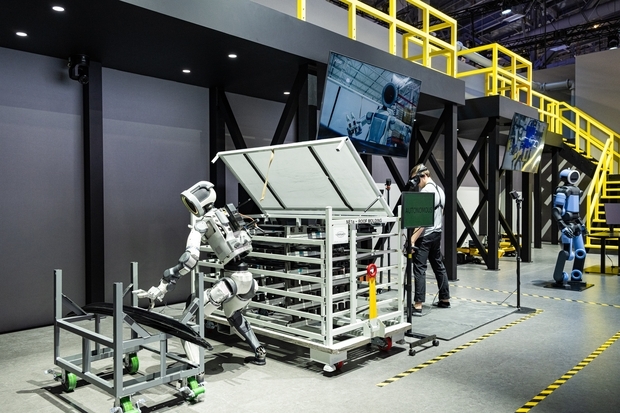
Concerns are mounting within Korea’s labor community regarding the government’s initiative to develop artificial intelligence (AI) that leverages “tacit knowledge.” This knowledge, encompassing the skills and experience of workers, is at risk of being transferred to AI systems without adequate compensation, raising fears of job displacement. The Federation of Korean Trade Unions (FKTU) issued a statement on Wednesday criticizing the Ministry of Trade, Industry and Energy’s (MOTIE) recent announcement about its “Manufacturing Tacit Knowledge-Based AI Model Development Project.”
While the FKTU acknowledges the project’s goal to enhance industrial competitiveness and address the manufacturing crisis, it argues that such a significant policy shift is being implemented without proper social dialogue. “Beyond simple technology development, this is a project that seeks to convert the experience, intuition and judgment of master manufacturers into data for AI to replace and reproduce,” the FKTU stated. The union emphasizes that this shift could fundamentally alter labor dynamics and workplace structures, raising essential questions about the rights to skills, potential employment shocks, and accountability for the resulting AI models.
The FKTU further warns that the transition from tacit knowledge to AI could lead to “monopolization of profits” and “destruction of jobs.” The crux of the issue lies in whether companies can utilize workers’ hard-earned skills as training resources for AI without offering fair compensation. “We question whether companies carrying out the project, which will accumulate vast amounts of data, will end up monopolizing the gains,” the union remarked. As companies benefit from increased productivity derived from decades of accumulated worker expertise, the lack of established standards for compensating those workers is a significant concern.
Concerns over job security are compounded by predictions that the adoption of tacit knowledge AI will accelerate job loss. As manufacturing knowledge is transferred to AI, companies may have less incentive to retain skilled, and often expensive, labor. The manufacturing sector has already seen a decline in workforce numbers, with more than 73,000 jobs lost last year, resulting in a total employment share of just 15.2%, the lowest since 2013. Oh Min-kyu, head of the research office at the Labor Issues Institute Haebang, warned that small and medium-sized manufacturing plants without unions stand to suffer the most, losing both jobs and data without any means of protection.
Furthermore, the fear of skill appropriation by AI may prompt workers to engage in “covert slowdowns,” thereby undermining productivity. The traditional method of passing down skills through apprenticeship could be at risk of collapse due to the increasing reliance on AI. This situation raises the likelihood of new forms of labor-management disputes, as workers may demand fair compensation for their skills that are being utilized in AI training.
In light of these developments, the Economic, Social and Labor Council (ESLC), a forum for dialogue among labor, management, and government, has made “Labor in the Age of AI” an official discussion topic. The FKTU insists that the implications of AI’s conversion of tacit knowledge must also be addressed within this framework. “If the government uses only the outcomes as resources for industrial policy while excluding workers, who are the very subjects accumulating the skills, society’s inequality structure will become entrenched,” the FKTU cautioned. It urges the government to heed labor community concerns and avoid pursuing this project unilaterally.
The implications of these ongoing debates extend beyond immediate employment concerns, highlighting the broader challenge of integrating AI into the workforce without exacerbating social inequalities. As countries around the globe grapple with similar issues, how Korea addresses the intersection of labor rights and AI development could serve as a bellwether for future industrial policies.
See also UK Departments Clash Over AI Datacentre Energy Use: DSIT Projects 6GW by 2030
 UAE Announces Plan for 50% Government Operations to Shift to AI by 2028
 Governments Adopt AI in Health Framework to Prioritize 6 Key Application Areas
 Korea Partners with Google DeepMind to Launch AI Campus, Boosting Global AI Ecosystem
 Andhra Pradesh Grants Environmental Clearance for 1 GW Google-Adani Data Center Amid Activist Backlash