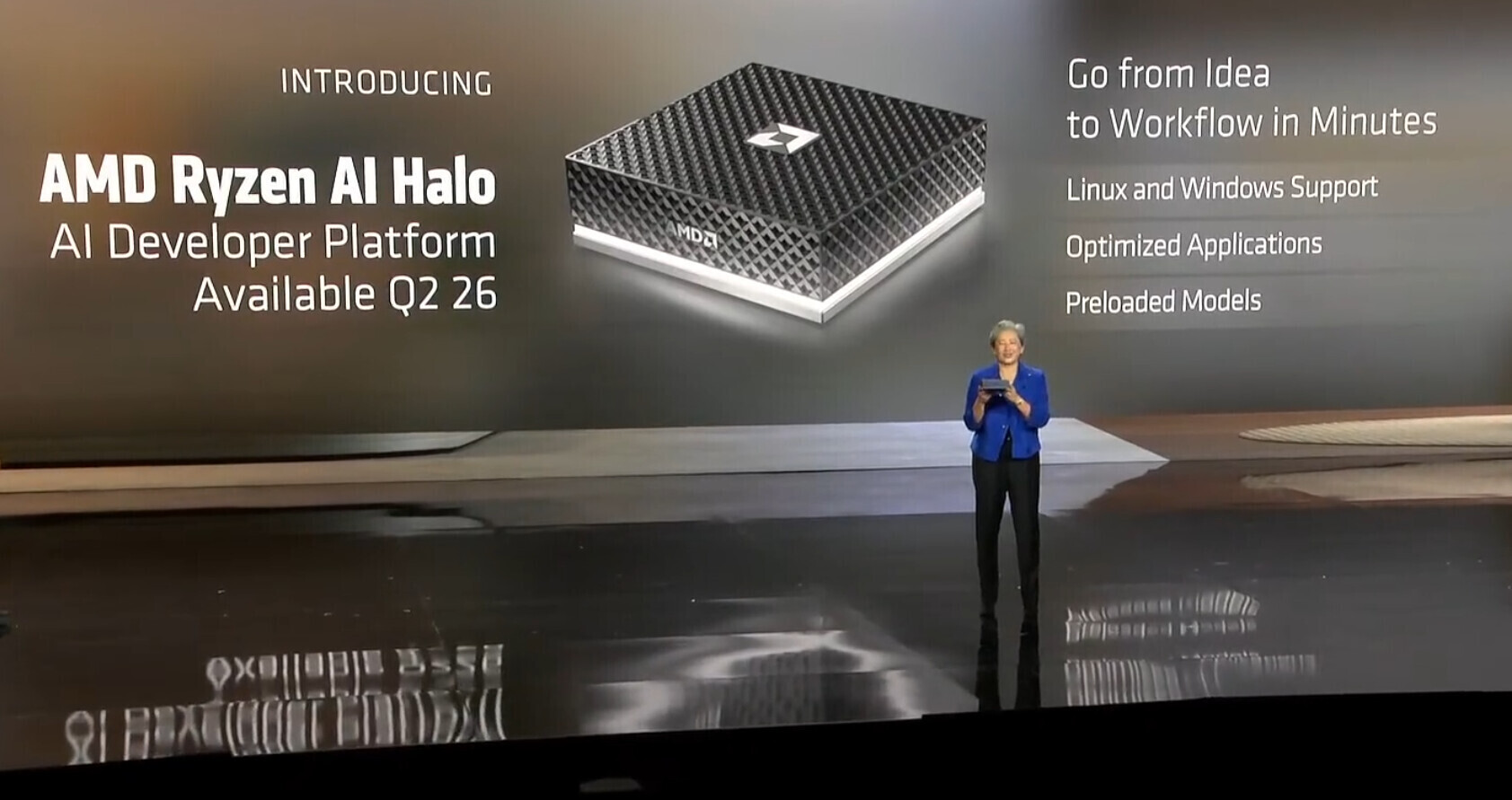
Advanced Micro Devices (AMD) is set to unveil the “Ryzen AI Halo,” a high-performance Mini-PC specifically designed for local artificial intelligence (AI) development. This device aims to position itself as a competitive alternative to Apple’s Mac Studio and Nvidia’s specialized hardware, offering a Windows-based solution for running large language models (LLMs).
The Ryzen AI Halo is built on the Strix Halo platform, focusing on the needs of AI developers. AMD seeks to establish a foothold within the burgeoning AI hardware market, which has been dominated by established players such as Nvidia and more integrated systems like the Mac Studio. With its unified memory architecture, the Mac is increasingly favored by traditional users for local AI tasks, creating a need for competitive alternatives.
From a hardware perspective, the Ryzen AI Halo resembles conventional computers but is tailored for augmented performance in AI applications. This approach allows AMD to leverage high-performance components typically reserved for laptops and Mini-PCs while pricing them competitively against dedicated AI hardware.
At the core of the Ryzen AI Halo is the AMD Ryzen AI Max+ 395 APU, featuring a 16-core Zen 5 CPU with 32 threads. This processor operates at a base frequency of 3.00 GHz and can boost up to 5.10 GHz, equipped with 16 MB of L2 cache and 64 MB of L3 cache. The device has a base thermal design power (TDP) of 55 W, with the option for a customizable cTDP ranging from 45 to 120 W. Manufactured by TSMC using a 4 nm process, it supports AVX-512, enhancing its capabilities for specific workloads.
A key advantage of the Ryzen AI Halo is its combination of CPU, integrated graphics processing unit (iGPU), and AMD’s XDNA2 neural processing unit (NPU). Collectively, these components can deliver up to 126 total trillion operations per second (TOPS). While this performance metric may not rival some dedicated AI solutions, it is enhanced by the system’s ability to leverage nearly all available RAM through the iGPU. Consequently, AMD claims that the Ryzen AI Halo can effectively run models with up to 200 billion parameters locally, with the Ryzen AI Max+ datasheet suggesting capabilities of processing up to 235 billion parameters under specific configurations.
However, the impressive specifications come with important caveats. The performance figures are contingent upon factors such as quantization, context, model format, and the desired performance level. Therefore, it does not guarantee that any model with 200 billion parameters will operate at speeds comparable to those found in data centers.
As AMD prepares to enter this competitive landscape, the success of the Ryzen AI Halo will likely depend on its ability to attract both developers and enterprises looking for powerful yet accessible AI solutions. With the increasing reliance on local AI processing, AMD’s strategic move to offer a robust alternative could reshape user preferences in a market where traditional giants like Apple and Nvidia have long held sway.
In conclusion, as local AI development becomes more prominent, the Ryzen AI Halo represents AMD’s ambition to carve out a significant niche in a rapidly evolving tech space. As the demand for capable computing solutions grows, the effectiveness and flexibility of the Ryzen AI Halo could play a pivotal role in determining its market success.
See also Growing Opposition to NextDC’s M3 Datacentre Expansion Amid Community Concerns in Melbourne
 Tesseract Launches Site Manager and PRISM Vision Badge for Job Site Clarity
 Affordable Android Smartwatches That Offer Great Value and Features
 Russia”s AIDOL Robot Stumbles During Debut in Moscow
 AI Technology Revolutionizes Meat Processing at Cargill Slaughterhouse