Rivian Accelerates AI and Autonomous Driving Strategy
Rivian is making strides in the autonomous driving and artificial intelligence sectors, as evidenced by its recent Autonomy & AI Day. At this inaugural event, held to showcase the company’s innovations, CEO RJ Scaringe emphasized Rivian’s vertically integrated strategy to leverage first-party data for enhancing its AI capabilities and driving performance.
Scaringe noted that by owning its entire AI stack—comprised of custom silicon and data ingestion platforms—Rivian is positioning itself to compete with industry giants such as Tesla and Waymo, a unit of Alphabet. “Directly controlling our network architecture and our software platforms in our vehicles has, of course, created an opportunity for us to deliver amazingly rich software,” Scaringe stated. He underscored that this infrastructure not only empowers the delivery of advanced software but also lays the groundwork for integrating AI throughout the company.
Several key announcements emerged from the investor meeting. Rivian introduced its Rivian Autonomy Processor (RAP1), a custom-designed 5nm processor that consolidates processing and memory within a single module. This processor employs RivLink, a low-latency interconnect technology that enables greater processing power by networking chips together. Rivian also outlined its new Autonomy Compute Module 3 (ACM3), capable of processing 5 billion pixels per second.
In terms of AI capabilities, Rivian has developed an in-house AI compiler and a comprehensive platform known as the Rivian Autonomy Platform. This platform features an end-to-end data loop and incorporates a Large Driving Model (LDM), designed to extract insights and strategies from Rivian’s dataset.
Looking ahead, Rivian plans to incorporate LiDAR technology into its upcoming R2 models expected by the end of 2026. This move aims to complement its multi-sensor approach to vehicle autonomy. Additionally, Rivian will introduce Universal Hands-Free driving features for its second-generation R1 vehicles, which will cover 3.5 million miles of roadways across the United States and Canada.
Rivian’s broader AI strategy also encompasses the development of Rivian Unified Intelligence, a multi-modal data platform intended to enhance service offerings, facilitate predictive maintenance, and improve customer interaction. A next-generation voice interface, set to launch in early 2026, will leverage edge models, third-party integrations, and advanced reasoning capabilities.
During the strategy meeting, Scaringe highlighted the accelerating pace of technological change, suggesting that companies should prepare for a much faster evolution in the next five years compared to the previous half-decade. “If we look forward 3 or 4 years into the future, the rate of change is an order of magnitude greater than what we’ve experienced in the last 3 or 4 years,” he remarked.
Another crucial takeaway was the importance of first-party data for developing autonomous systems. Scaringe explained, “Our approach to building self-driving is really designed around this data flywheel.” He emphasized that Rivian’s deployed fleet benefits from a well-structured data policy that enables the identification of crucial events for training large models offline, ensuring they are appropriately distilled back into vehicle systems.
Rivian is also focused on applying AI across its entire enterprise, affecting various processes from sales and service to supply chain management. Senior Vice President of Electrical Hardware, Vidya Rajagopalan, elaborated on why Rivian opted for in-house silicon development, stating, “The reason for doing it is velocity, performance, and cost.” Such customization facilitates rapid software development and optimizes future use cases, allowing for cost savings as well.
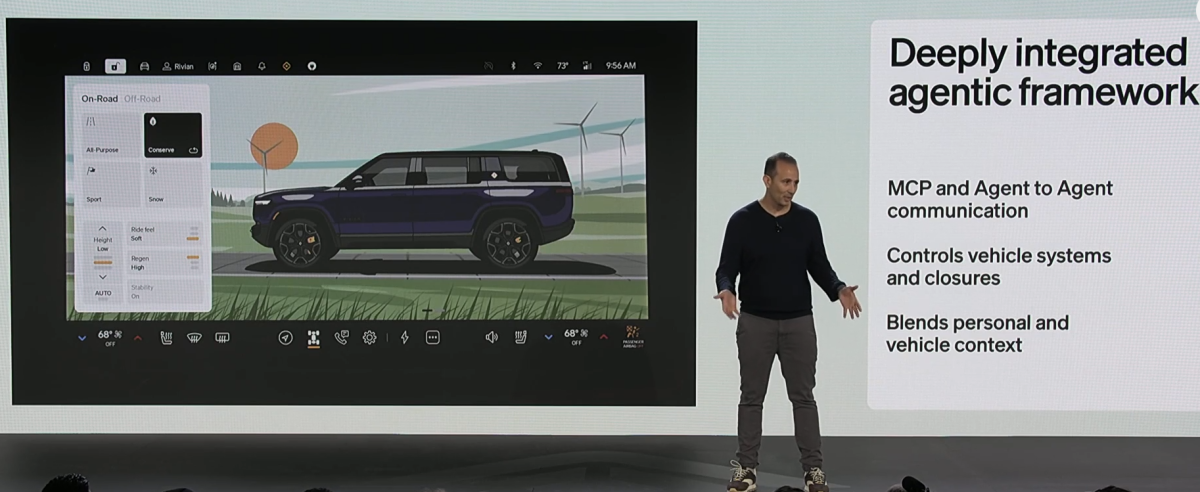
Highlighting the company’s innovative approach, Chief Software Officer Wassym Bensaid talked about the integration of multiple models to enhance driving capabilities. “Every Rivian system from manufacturing, diagnostics, EVR planning, navigation becomes an intelligent node through MCP,” he explained. This architecture is designed to facilitate the movement of workloads from the cloud to edge systems, forming the backbone of Rivian Unified Intelligence.
As Rivian continues to carve its niche in the competitive landscape of autonomous driving and AI, its commitment to leveraging proprietary technology and data could set a new standard for how automotive companies engage with these transformative technologies. The industry is likely watching closely as Rivian implements its ambitious plans in the coming years.
See also Elon Musk’s xAI Launches Grok Chatbot in 5,000 El Salvador Schools for 1M Students
 BCC Research Reveals $1.5T AI Market Surge Driven by Biotech, Food & Beverage Innovations
 GenAI’s Limits in Scientific Discovery: New Study Reveals Creative Shortcomings
 US Customs Proposes Mandatory 5-Year Social Media History for 42 Countries’ Tourists
 Trump’s Executive Order Blocks State AI Regulations, Favours Tech Giants Amid Innovation Race