
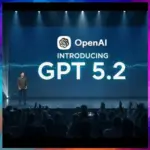
OpenAI has announced the rollout of GPT-5.2, its latest artificial intelligence model, which is optimized for professional knowledge work. The model achieved a score of 70.9% on knowledge work tasks using the GDPval benchmark, a significant improvement over its predecessor, GPT-5.1, which scored 38.8%. The new version is now available in ChatGPT, starting with paid plans, and can also be accessed via the OpenAI API.
The company claims that GPT-5.2 brings major advancements in areas such as general intelligence, long-context understanding, agentic tool-calling, and vision capabilities. “Overall, GPT-5.2 brings significant improvements… making it better at executing complex, real-world tasks end-to-end than any previous model,” the company stated.
In a related development, Google has launched its improved Gemini audio models, specifically Gemini 2.5 Flash Native Audio, which enhances the model’s ability to handle complex workflows and engage in natural conversations. The new capabilities are incorporated into Google’s user-facing products, including Gemini Live and Search Live, and are also available in the Google AI Studio and Vertex AI.
Moreover, Google introduced live speech translation in the Google Translate app, allowing users to translate spoken language in real-time while maintaining speaker intonation, pacing, and pitch. The feature supports over 70 languages and 2000 language pairs, facilitating real-time conversation between two speakers of different languages.
This week also saw the beta release of Google’s Interactions API, designed for developers to work with Google’s models and agents, such as Gemini Deep Research. The new API aims to enhance AI communication capabilities, allowing for the construction of custom agents and improved interactions among existing ones.
In another major announcement, Mistral unveiled Devstral 2, its latest open-source coding model, available in two sizes: Devstral 2 (123B) and Devstral Small 2 (24B). Mistral also introduced the Mistral Vibe CLI, an open-source command-line coding assistant that utilizes Devstral. This tool can interface with developers’ codebases using natural language, featuring capabilities like project-aware context, smart references, and multi-file orchestration.
The Linux Foundation has established the Agentic AI Foundation (AAIF) to foster the transparent evolution of agentic AI, integrating several key projects at its inception, including Anthropic’s Model Context Protocol (MCP), Block’s goose, and OpenAI’s AGENTS.md. Mike Krieger, chief product officer at Anthropic, emphasized that donating MCP to the Linux Foundation ensures its open and community-driven future, vital for advancing AI infrastructure.
In technology advancement aimed at developers, Progress Software announced updates to its Telerik and Kendo UI products, featuring an Agentic UI Generator. This tool enables the creation of multi-component, fully styled enterprise-grade page layouts with a focus on AI-based code generation. Loren Jarrett, EVP and GM of digital experience at Progress Software, stated, “With today’s release, AI-based code generation is now enterprise-ready, providing new horizons for UI development.”
Wherobots has launched RasterFlow, a satellite image preparation and inference solution aimed at facilitating insights from satellite data. According to Ben Pruden, head of go-to-market at Wherobots, RasterFlow will streamline data processing, allowing customers to apply AI models to physical world questions, such as predicting agricultural field boundaries.
Lastly, Augment Code announced a new Code Review Agent designed to alleviate the bottleneck of code review in software development teams. Co-founder Guy Gur-Ari highlighted that this agent operates at a higher semantic level, enabling developers to interact with it conceptually rather than through specific code references. This approach aims to improve workflow efficiency and enhance the development lifecycle.
These advancements reflect a broader trend in the tech industry towards integrating AI into various applications, enhancing productivity and effectiveness across multiple sectors. As companies continue to innovate, the implications for both developers and end-users will likely evolve significantly in the coming months.
See also CapCut Launches Advanced AI Image Generator for Instant Social Media Visuals
 Karen Hao: Generative AI Requires 100 Earths to Sustain, Echoing Colonial Exploitation
 OpenAI Launches GPT-5.2 Model, Boosting Performance in Reasoning and Coding
 Kent Kaufman Releases AI L4IR: A Practical Leadership Guide for the Fourth Industrial Revolution
 AI Expert Advocates for AI to Combat Misinformation and Deepfakes in Media